
Decasonic perspective
How New Technologies Reach Mainstream Adoption
Frontier adoption and mainstream adoption are different problems. At the frontier, success means proving real use cases, monetization, and identifiable customers - even when costs remain high. Moving into the mainstream requires something different: cost must fall, trust must be established, and distribution must fit into behaviors people already have. From AI to crypto and Web3 x AI, understanding where a technology sits on this path is critical to knowing what comes next.


in this piece
all perspectivesFrontier adoption and mainstream adoption are different problems, and each stage has its own requirements
At Decasonic, we invest at the frontier of Web3 and AI. Meeting countless founders and operators across our portfolio and pipeline has made one lesson clear: frontier adoption and mainstream adoption are different problems. Adoption happens in stages, and each stage has its own requirements.
We think about three stages: frontier adoption, adoption, and mainstream adoption.
Frontier Adoption Comes First, and It Has Its Own Signals
User counts say little about a technology at the frontier. The frontier trade is high outcome at high cost: bleeding edge users pay prices that look unreasonable to everyone else because the output is worth it to them. So the signals we look for at this stage are concrete: a working product, live use cases, real monetization, a business model aligned with how the technology creates value, and clearly identifiable customer profiles. If someone is paying at today's prices, frontier adoption is working as intended.
Cost behaves differently at this stage than most adoption frameworks assume. Frontier technology starts expensive and gets cheaper as volume grows, and costs typically keep falling the closer a technology gets to mainstream adoption. GPUs, humanoid robots, and early blockspace all began costly and rode volume down the cost curve. Disruptive technology is different: it can enter a market cheap from day one. Frontier technology almost never can. So price is the wrong test at the frontier. The right questions are whether the cost curve is falling and whether anyone is paying at today's prices.
Cost, Trust, and Distribution Carry a Technology From Adoption to Mainstream Adoption
Once a technology has real frontier adoption and moves into the adoption stage, three factors decide whether it crosses into everyday use.
The first is cost. The curve has to have fallen far enough that price stops being part of the decision, so trying the technology costs nothing and failing with it costs almost nothing.
The second is trust. Mainstream users and institutions do not evaluate new technology directly. They inherit trust from something they already believe in, a regulator, a brand, a human checking the output, or the system has to make trust verifiable on its own.
The third is distribution. Technologies reach the mainstream when they meet people inside behavior they already have. Adoption curves that require users to build a new habit first are slow. The fast ones remove the habit change entirely.
Below, we apply the stages to the sectors where we spend our time: AI, crypto, and Web3 x AI.
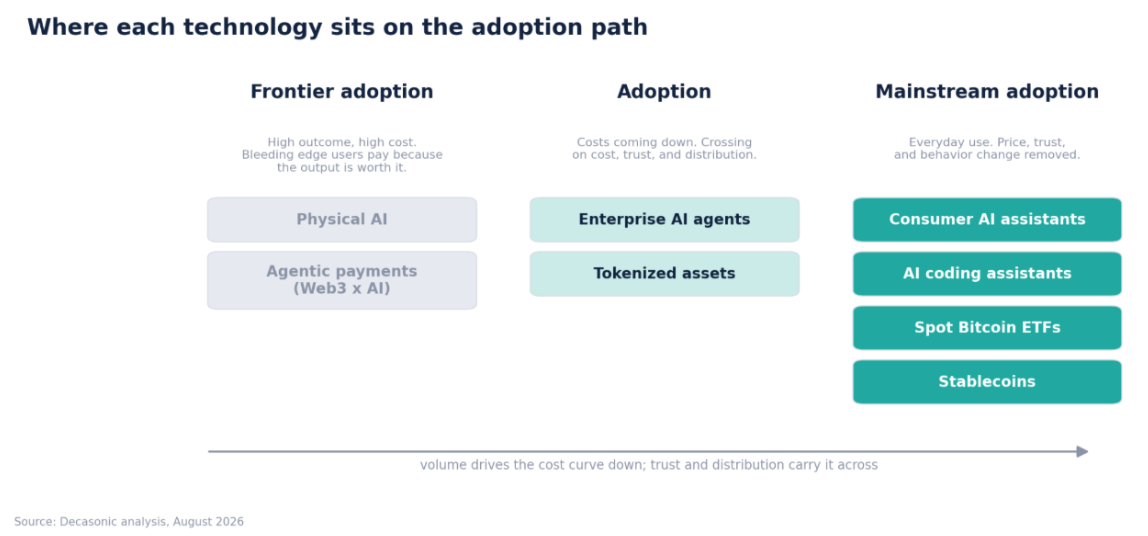
AI: Mainstream at the Front, Frontier at the Back
Consumer AI is the fastest mainstream crossing in the history of technology. ChatGPT grew from 400 million weekly active users in February 2025 to 900 million in February 2026, and became the fastest app ever to reach one billion monthly active users by mid 2026.
The three factors explain why, and so does the stage that preceded it. Years of expensive compute bought by researchers and early builders paid down the cost curve at the frontier. By the time the consumer product arrived it was free to try, so cost never entered the decision. It was a text box, an interface every internet user already understood, so distribution required no new behavior. And a human reviewed every output before acting on it, so the product never asked for trust it had not yet earned. AI coding assistants followed the same path inside the enterprise: adopted within the editor developers already worked in, with a human accepting or rejecting every suggestion.
Enterprise AI agents sit at the adoption stage, and the surveys this year all describe the same situation. 97% of executives say their company deployed AI agents in the past year, and 63% of businesses have operationalized AI somewhere in the organization, up from 45% a year ago. At the same time, 79% of organizations report serious challenges converting that deployment into value, a survey of 650 enterprise technology leaders found only 14% have scaled an agent to production, and RAND puts the AI project failure rate above 80%, roughly double conventional IT.
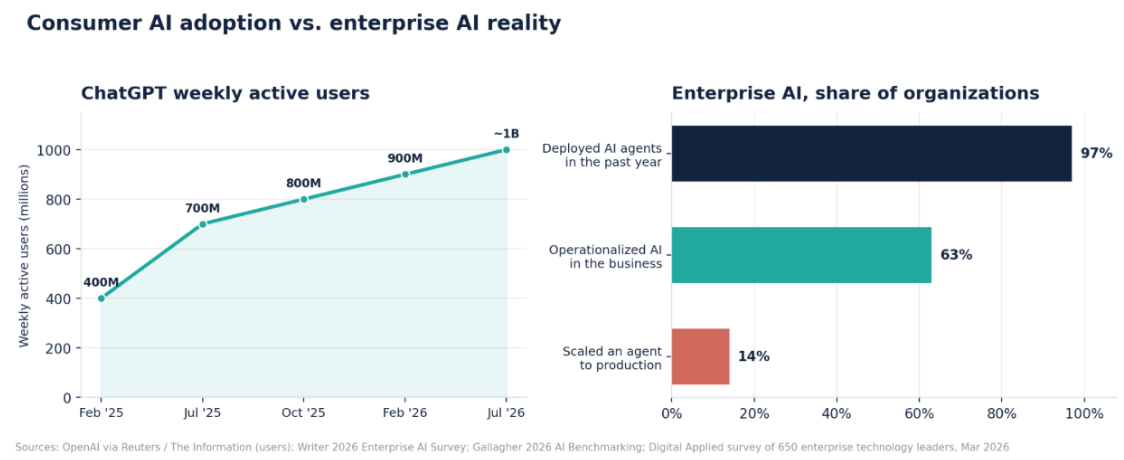
Our read is that enterprise adoption tracks how much trust each use case demands. Most of what has gone mainstream is human-delegated AI: a person provides the intent, reviews the output, and executes on it. The next stage, AI that delivers outcomes end to end without a human checking each step, is where enterprises are stuck, and the same surveys point at why: fewer than half of businesses deploying AI have any formal risk management framework. Deployment has moved faster than the trust layer underneath it.
For AI to cross from delegated outputs to autonomous outcomes, it needs a substitute for the human review loop it removes: verifiable identity for agents, bounded and revocable permissions, audit trails, and accountability when nobody is checking the work. We return to this in the third section, because building that layer is a large part of the Web3 x AI opportunity.
Physical AI is at the frontier adoption stage, and the frontier tests are the right ones to apply. The hardware started expensive and is riding volume down the cost curve, with roughly 50,000 humanoid units expected to ship this year. The signals to watch are live use cases, monetization, and identifiable customers, which is why teleoperation assisted deployments matter: paying customers in settings where errors are cheap, with every human intervention generating training data. We went deeper on this sector in The State of Physical AI.
Crypto: Mainstream as an Asset, Early Mainstream as a Market
Crypto has produced two of the most useful adoption case studies of this decade, and in both the underlying technology barely changed. The packaging and the channel did.
The first is the spot Bitcoin ETF. Bitcoin spent a decade without mainstream ownership on its own terms. In January 2024 it was repackaged into a vehicle investors already trusted and distributed through channels they already used, and the result was roughly $100 billion in AUM with $58.7 billion in cumulative net inflows in about two years. Distribution widened again this year when Bank of America began allowing its advisors to recommend Bitcoin ETFs and Morgan Stanley launched a proprietary product for its roughly 16,000 advisors. At no point was the end investor asked to change behavior. Buying an ETF was already a habit.
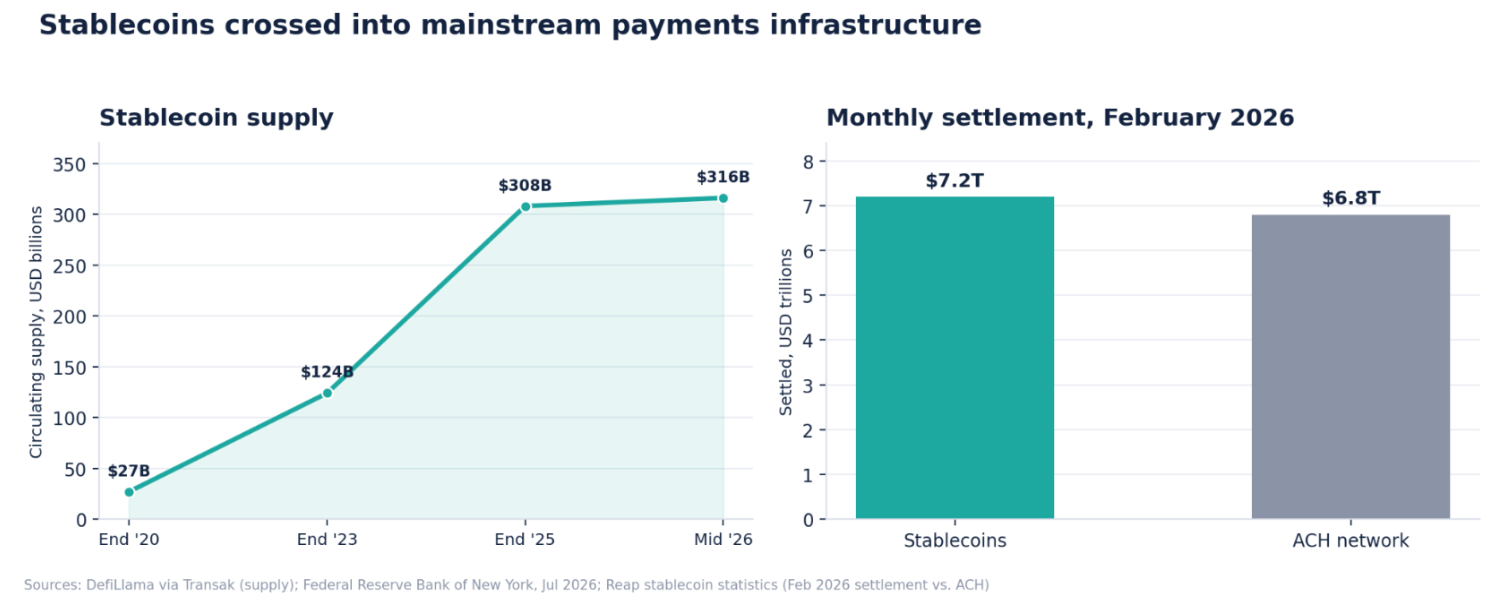
The second is stablecoins, which took the opposite route to the same outcome: they went mainstream by disappearing into existing rails. Supply sits around $308 billion, up 30% in just over a year, per the Federal Reserve Bank of New York, and in February, stablecoins settled $7.2 trillion in a single month, surpassing the ACH network for the first time. The trust factor was addressed by regulation, with the GENIUS Act establishing the first federal framework for dollar stablecoins. The distribution factor was addressed by incumbents: a user moving money through Stripe or a remittance app today often has no idea a blockchain was involved.
The market layer, tokenized assets and the always-on trading behavior forming around them, sits at the adoption stage. The frontier signals are already in place: working products, live use cases, and real monetization. What it is working through now are the three factors.
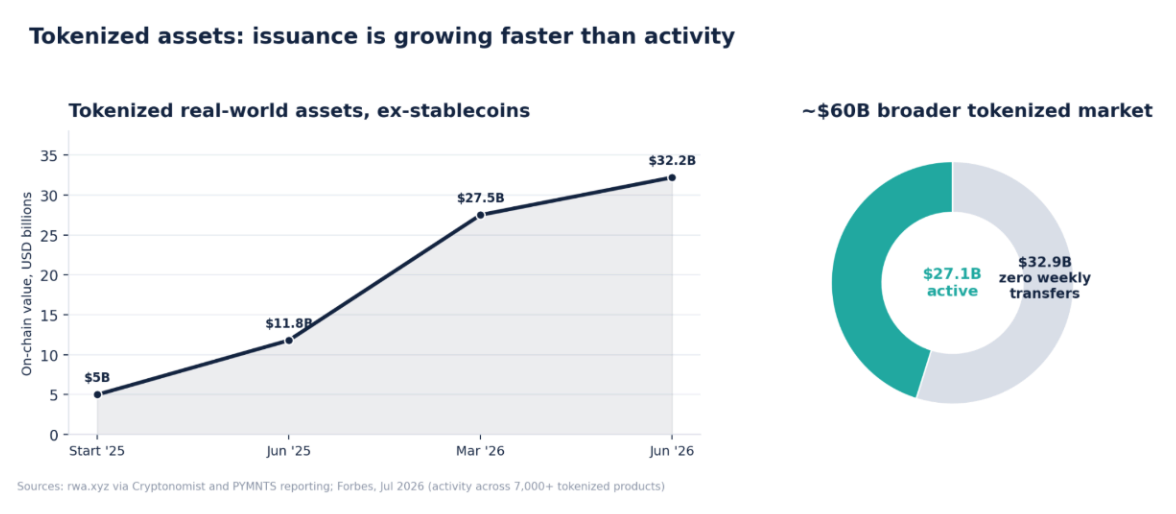
Issuance is accelerating across asset classes. Tokenized real-world assets reached roughly $32 billion on-chain by mid 2026, nearly triple a year earlier, with tokenized Treasuries the largest category at around $15 billion. Tokenized equities are moving even faster from a smaller base: monthly on-chain volume hit $9.22 billion in June, then $18.2 billion in July, a 4.4x jump in a single month, and this week Crypto.com launched tokenized exposure to 1,500 US stocks and funds with 24/7 access from one dollar.
The 24/7 behavior is showing up in the data, and it is one of the clearest demand signals in the sector. Kraken launched regulated perpetual futures on tokenized US stocks that trade around the clock, and when traditional markets were closed during geopolitical stress earlier this year, trading desks used on-chain markets to price risk, with weekend volumes on on-chain commodity perpetuals up ninefold since the start of 2026. Markets that never close, settle in seconds, and are reachable from any wallet globally are a genuinely new distribution surface for financial assets, and it is why we expect this category to compound.
The regulatory groundwork is being laid at the same time. The SEC staff issued a formal taxonomy for tokenized securities in January, and DTCC, which safeguards over $100 trillion in securities, received a no-action letter for a tokenization pilot rolling out in the second half of 2026.
The counterweight is real, and we think it makes the opportunity clearer rather than weaker. A Forbes analysis found $32.9 billion of tokenized assets across more than 900 products showing zero weekly transfer activity. Many assets got on-chain before secondary liquidity and distribution existed for them. What this category needs next is the same thing the Bitcoin ETF had: distribution through channels institutions already use, which is what the DTCC pilot represents, plus deep enough secondary markets that tokenized assets trade rather than sit. As a16z has argued, the next phase is origination rather than just tokenization: assets born on-chain instead of off-chain assets wrapped after the fact.
Web3 x AI: Frontier Adoption Underway
Judged by mainstream measures, nothing at the Web3 x AI intersection qualifies, and we will say that plainly. But mainstream measures are the wrong test for a sector at the frontier stage. The right tests are the frontier ones: working product, live use cases, monetization, and identifiable customers. On those, the sector is further along than the headline numbers suggest.
As AI systems move from producing outputs to acting as economic participants, they need three things: identity so they can be recognized, permissions so a human can bound what they do, and payment rails so they can transact. All three began arriving this year, and each has real usage at the bleeding edge.
The identity layer went live in January. ERC-8004, a standard giving AI agents verifiable on-chain identity and portable reputation, launched on Ethereum mainnet on January 29, authored by contributors from the Ethereum Foundation, MetaMask, Google, and Coinbase. Over 445,000 agents are registered across 24 chains as of August 12. Registration is cheap and counts identities rather than activity, but the curve shows the standard being adopted.
The control layer is arriving with it. MetaMask launched an agent wallet built on a delegation framework in June, where an agent can transact only within rules a human defined and cannot act outside its allowances regardless of what the model decides.
The payment layer has the most frontier adoption to show. Coinbase's x402 standard, the leading protocol for agent payments, has processed over 201 million transactions all time, moving roughly $53 million across about 853,000 buyer wallets and 267,000 sellers, per x402scan, the ecosystem's explorer. Those buyers and sellers are the bleeding edge users of this sector: agents and developers paying per call for data, compute, and services. The honest caveats stay attached. Much of the transaction count arrived in a late 2025 surge that Chainalysis attributes largely to memecoin farming activity, activity has cooled since, and the protocol's entire settled history amounts to roughly two minutes of Visa volume. In July, Visa, Mastercard, and Ripple joined the standard.
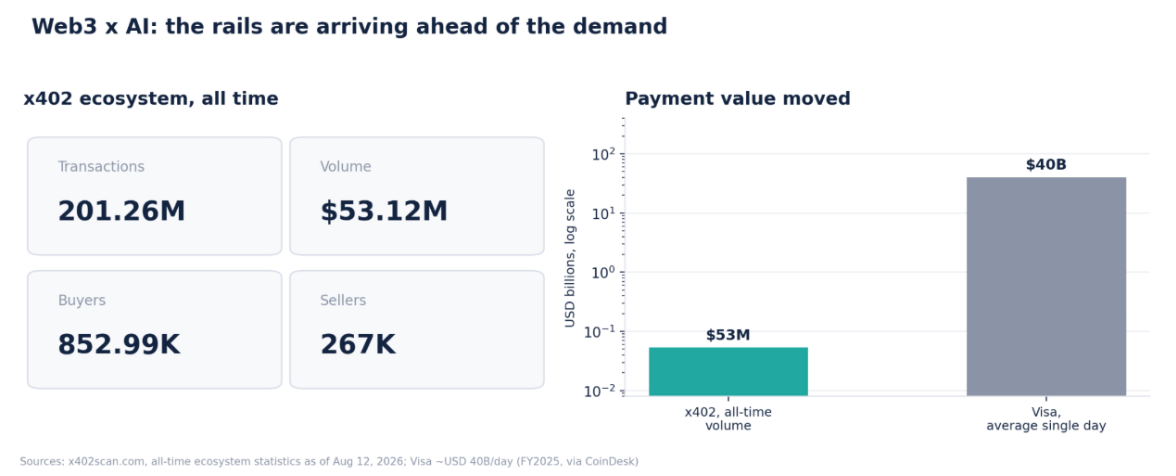
What moves this sector from frontier adoption to the adoption stage is the three factors, and its position on them is straightforward. Cost is already solved, since these transactions clear for fractions of a cent. Trust is what the sector is actively building, and it is the same trust layer enterprise AI is missing: verifiable agent identity, bounded and revocable spend authority, and on-chain records of what an agent did. Distribution will follow the stablecoin route, with agent payments shipping invisibly inside the payment infrastructure businesses already run, which is why the card networks joining these standards matters more than any crypto-native volume figure.
Our view is that Web3 x AI adoption is downstream of AI adoption. Demand for agent identity, agent wallets, and agent payments arrives at scale when enterprises trust agents to act without a human reviewing every output, and the infrastructure being built here is a large part of what earns that trust. The sector sits at the intersection of the exact problems holding the other two back, and that is why we are investing in it now. The specific use cases we are backing across this stack are outlined in our request for startups.
What This Means for Founders
Diagnose your stage before your strategy. At the frontier stage, the work is proving use cases, monetization, and identifiable customers, and pushing volume so the cost curve falls. Chasing mainstream distribution too early burns capital on users who are not ready. From the adoption stage on, the work flips to the three factors, and the discipline is finding which one actually binds your product, because it is rarely the one your team is best equipped to solve. Model quality does not fix a trust problem. A token does not fix a distribution problem.
Every mainstream crossing in this post, ChatGPT, coding assistants, the Bitcoin ETF, stablecoins, won by removing a decision from the user: the decision to pay, the decision to trust, or the decision to change behavior. The frontier stage is where a technology earns the right to attempt that crossing.
Partner with Decasonic
We are a team of investor-operators actively investing in early-stage AI, Web3, and intersection companies, and we form our views by building with these systems ourselves. Whether you are proving frontier adoption or crossing to the mainstream, reach out to the team. We are actively deploying capital.
The content of this material is strictly for informational and educational purposes only. It is not intended to constitute investment advice, nor should it be considered a recommendation or a solicitation to buy, sell, or hold any asset. Decasonic does not endorse investments in any specific tokens, and nothing in these blog posts should be construed as legal, tax, or financial advice. Please consult with a qualified professional advisor before making any financial decisions. Decasonic provides no warranties, whether expressed or implied, on the content provided in these blog posts, including its accuracy, completeness, or correctness. The opinions expressed here are those of the authors and do not necessarily reflect the views of Decasonic. Please note that Decasonic may hold a position in some of the tokens mentioned, including Virtuals. Decasonic is not liable for any errors or omissions in the content of this material or for any actions taken based on the information provided herein.