
Decasonic perspective
The State of Physical AI
Physical AI is moving from research toward real-world deployment. This blog explores the forces accelerating that shift - from cheaper hardware and higher-quality training data to machine coordination, financing, and payments - and why Web3 could become a critical economic layer for the emerging machine economy.


in this piece
all perspectivesKey Takeaways from our Web3 Investor Day Panel
I lead Decasonic’s physical AI investments, and at our 5th Annual Web3 Investor Day, I moderated a panel on physical AI with three operators building at the frontier of crypto, physical AI, and the intersection: Amanda Young, COO of BitRobot, which is building the world's open robotics lab; Paige Xu, Executive Director of the Fabric Foundation, whose early contributions include OpenMind, a company building operating systems for humanoids and quadrupeds; and Bayley Wang, co-founder of PrismaX, a Decasonic portfolio company building teleoperation infrastructure for robotics data.
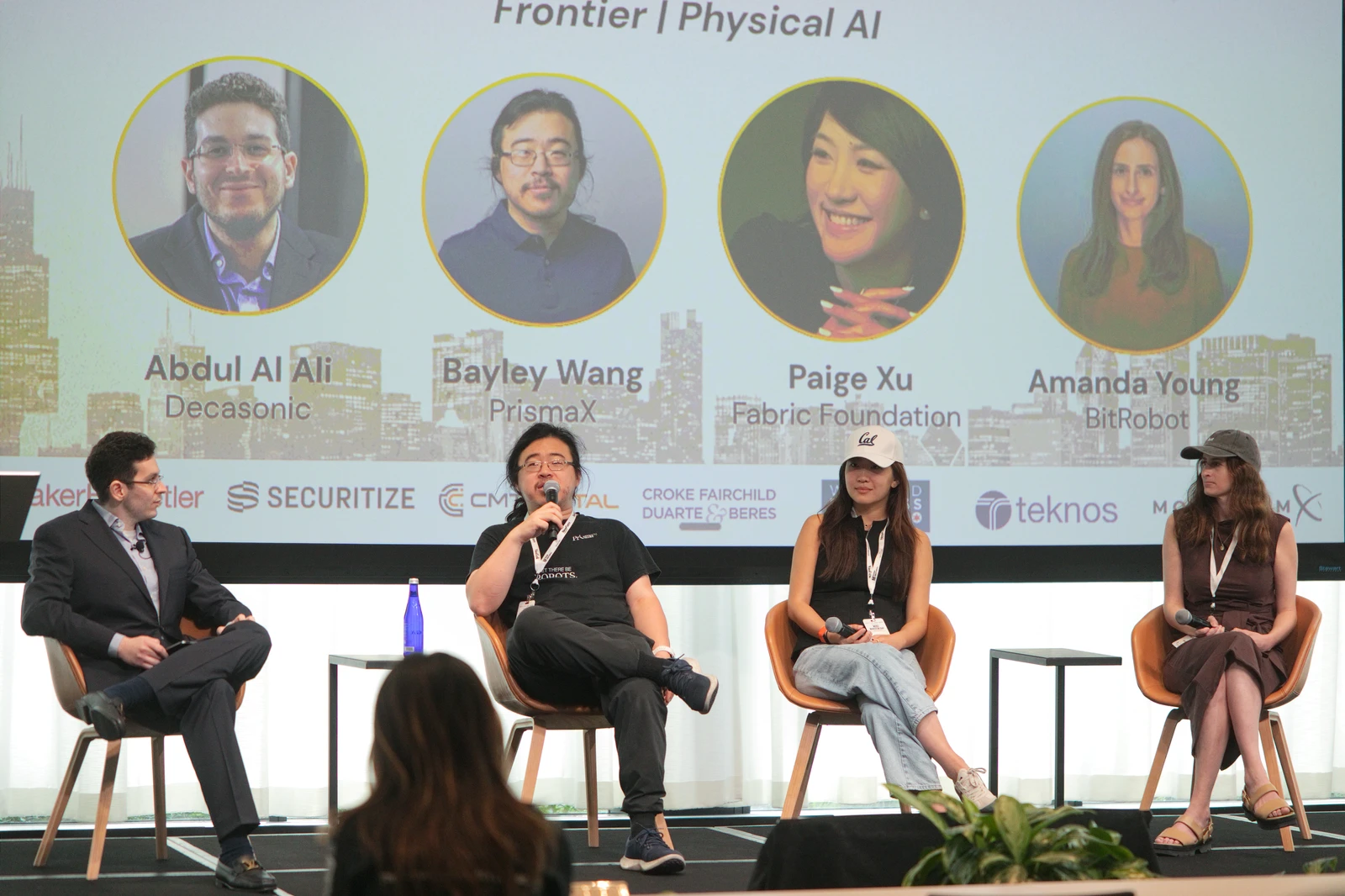
At Decasonic, we believe the intersection of Web3 and physical AI is primarily manifested through an economic coordination layer. Individuals and firms alike contribute resources, own their contributions, and as deployment continues to accelerate (and software AI expands to physical AI) we expect the emergence of machine identities, coordination, and machine payments. We discussed the use-cases and the value proposition that Web3 provides to physical AI during our panel.
What follows are the key takeaways from our conversation, alongside Decasonic’s perspective.
Introduction: The ChatGPT Moment for Robotics
There is no question that 2026 became the year the phrase "the ChatGPT moment for robotics" entered common use. Therefore, it was logical that the key question of the panel primarily centered on aiming to understand the reasoning behind the accelerated adoption of the phrase, and this was primarily assessed from the lens of changes in 2024 and 2025.
The primary reason for the accelerated usage of the phrase boils down to three core accelerants: (1) intelligence is rapidly becoming accessible (software models continue to improve in capabilities and accessibility), (2) data collection efforts across both scale and diversity are being addressed through egocentric data, synthetic data, and teleoperations data (with an emphasis on scale and diversity) (3) the cost of hardware is rapidly falling, allowing for an increase in experimentation.
Scaling Deployment of Intelligent Physical AI Systems
Bayley has been in the field since before it was called physical AI, when it was simply called robotics. His background includes being a Research Engineer at MIT, working on high performance field-oriented-control for robotics. His read is that the hardware problem is more or less solved, with a real caveat: putting more hours on machines through real world deployment keeps surfacing unglamorous failures in connector reliability and wiring harnesses, allowing for further experimentation associated with real world deployment of physical AI. Teams are aggressively purchasing readily available hardware devices to experiment on, personalize, and deploy.
That distinction changes what kind of company can get built. Hardware development and iteration cycles have largely been a bottleneck to rapid advancements made in the field. A large share of the money converts into manufacturing and tooling years before a product ships, and there is no clear signal that anyone wants the thing until it exists. Off-the-shelf hardware removes that constraint. Unitree is one of the clearest examples, supplying the quadrupeds and humanoids that teams build on rather than build themselves. As of the timing of this article, Unitree’s Shanghai IPO drew ~8,000x retail oversubscription and drawing on the enthusiasm regarding the potential market opportunity available for the physical AI market. This points towards: (1) the potential near-term size of the opportunity, and (2) the proxy for the demand associated with Unitree, considering its leading position in the current hardware market for robotics and physical AI more broadly.
The second unlock was primarily through foundational physical AI model advancements. In 2025, companies including Physical Intelligence demonstrated that end-to-end machine learning was suitable for physical AI: a model that takes vision as input and learns physical actions directly, rather than executing hand-written rules. This matters because machine learning scales with resources into larger fleets and the data those fleets generate. It converts an open research question into a resourcing problem the industry already knows how to work on. The alternative was the rules-based approach, where teams wrote endless scripts and still shipped machines that behaved unreliably the moment they left the lab.
The accessibility of hardware models resulted in the influx of (1) use-cases and (2) experimentation. The combination of which provides a feedback loop back to the underlying physical AI foundational models, allowing for their accelerated improvement and therefore unlocking the near-term opportunity associated with deployment of physical AI at scale.
Scaling Valuable Data for Physical AI
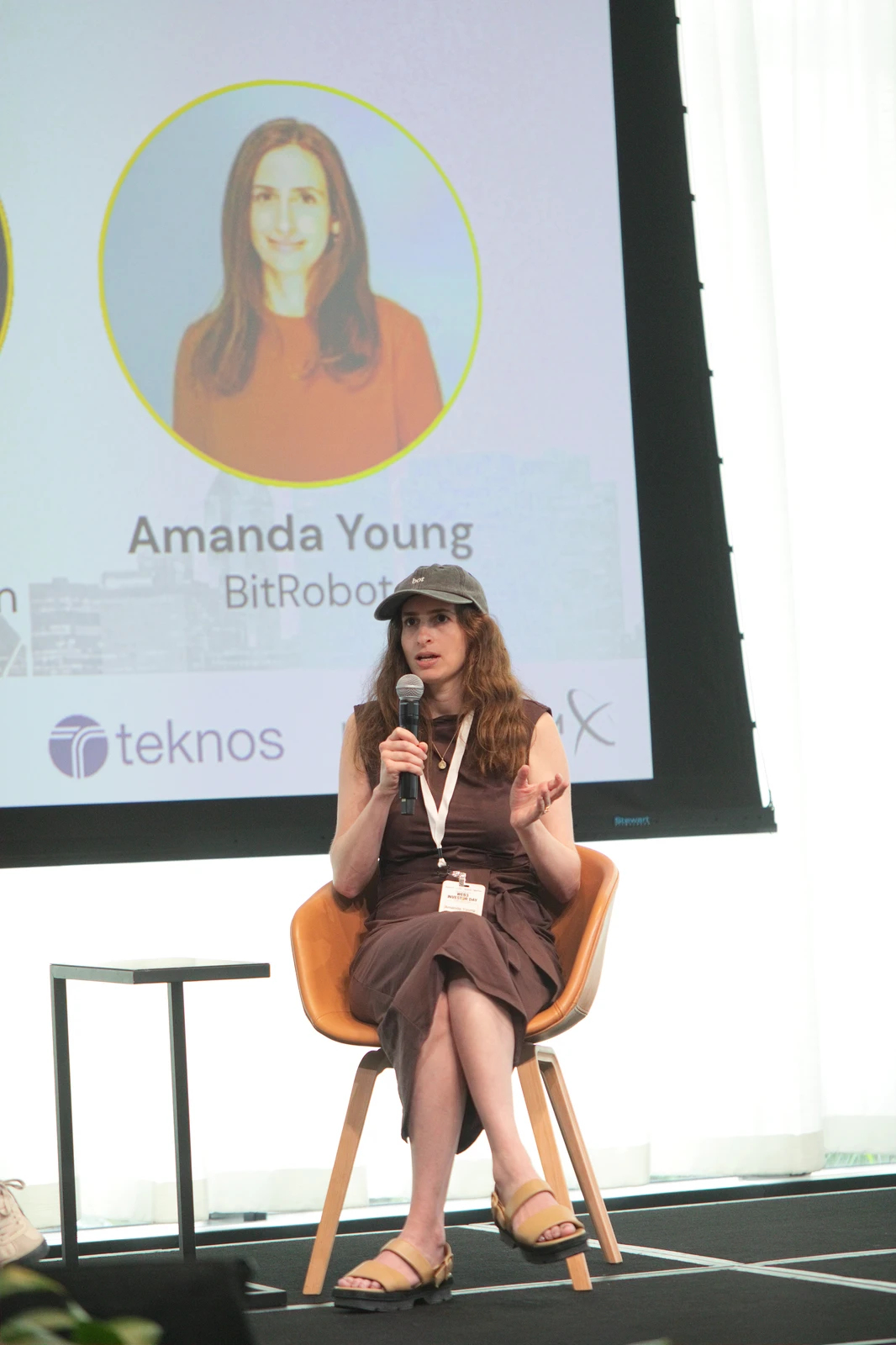
Amanda described three data types that robotics researchers rely on today.
The first is teleoperation: a human pilots a robot to teach it a task, one person to one robot. It offers the cleanest translation from collected data into a working model, and in Decasonic’s view continues to be valuable despite the promises of world model generated synthetic data and advancements in the sim-to-real-gap. The second is simulation, which is growing and far more scalable, but which still runs into the sim-to-real gap on highly dexterous tasks, with many companies actively aiming to address the sim-to-real gap to scale the amount of synthetic data created and deployed in foundational models. The third is egocentric video, where footage captured from a human's point of view is used to train robots.
BitRobot works across all three, and Amanda's read is that the single biggest shift of the past year has been the move toward human data. One person operating one robot for a full day does not scale to the hundreds of millions of hours these models will require. Pre-training results from Nvidia, Skild, and Figure have shown enough success translating human data into robot capability to mark a genuine departure from purely teleoperated collection. We are also increasingly seeing potential evidence of scale in data collection allowing for cross-embodiment deployment, most recently seen with Dyna, which was trained with over one million hours of egocentric human video data. This is further seen with Nvidia’s GR00T N1.7 release, whose EgoScale pre-training ran on 20,854 hours of human egocentric video across more than twenty task categories.
As data availability, collection, and generation increasingly becomes available, the bottleneck shifts towards the assessment of the quality of data utilized in the training of foundational models.
High Quality Physical Data from Evaluations and Benchmarks
Software AI and the scale of both iteration and advancements we have seen is unique, and this is primarily due to the widespread availability of internet text-data. Robotics arguably has no direct equivalent despite the presence of an enormous number of videos on the internet. This is primarily due to internet video carrying no action labels and relatively no “embodiment grounding,” from a perception and depth perspective.
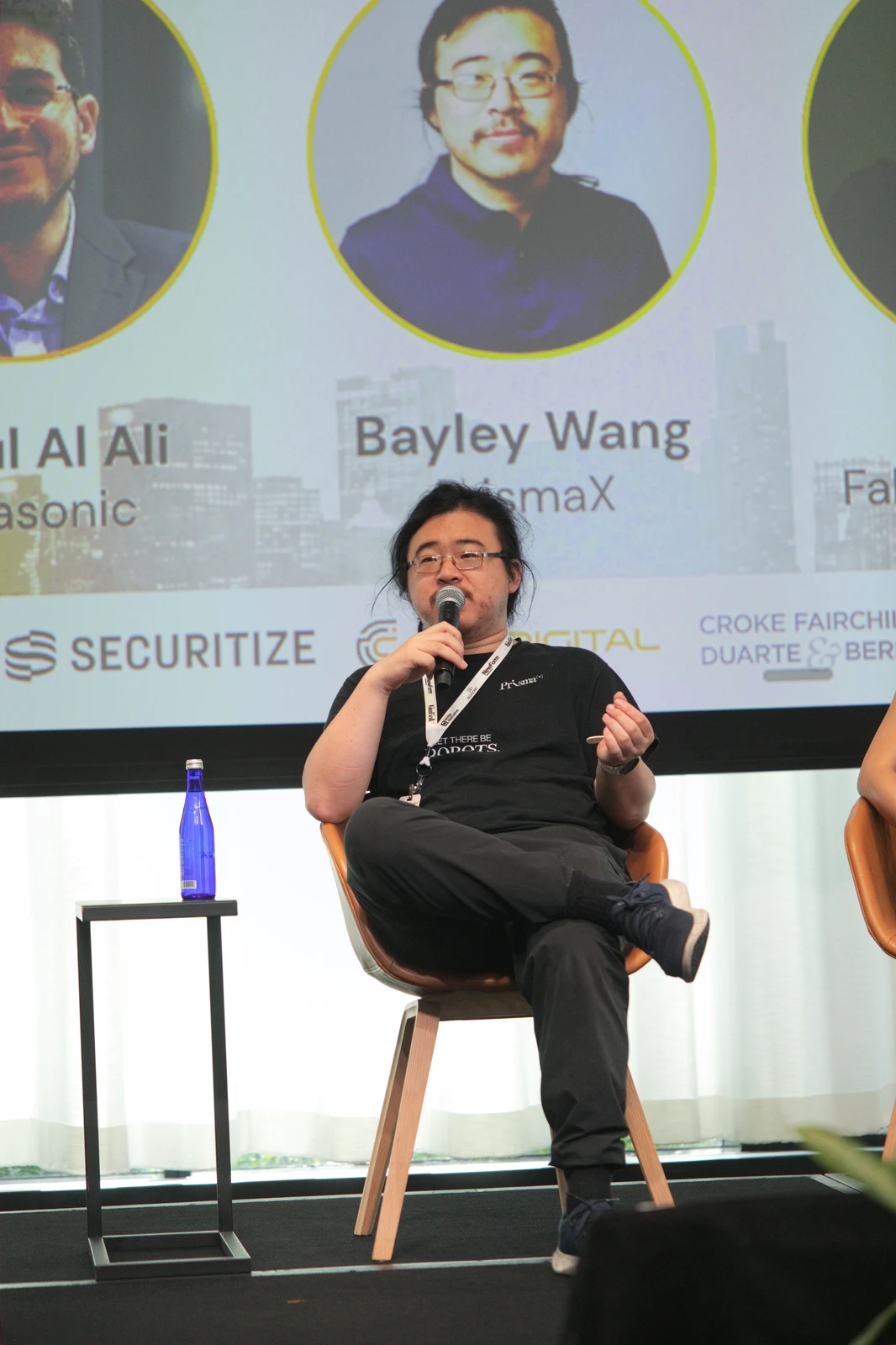
Bayley's read is that 2026 teams are actively prioritizing high-quality data inside their training sets. Where 2025 was spent pulling whatever datasets were available off Hugging Face or YouTube, current teams collect against specific use cases. There is an active movement from “scale at all costs,” towards quality-driven assessments for data collected for foundational model training. In this transition point, the market is dealing with the general lack of availability of standards and benchmarks associated with data-quality assessment.
On the scale of what makes a given dataset a high quality one, Bayley set requirements across every collected modality: hardware specifications, frame rate jitter, trajectory smoothness, and task diversity. Meeting them requires suppliers to build specialized tooling rather than simply staffing more operators. Early data factories optimized for hourly volume and produced exactly what that incentive rewards: a rice cooker loaded a thousand times, cables plugged in against a clean white background. Useful robots require complex, well-annotated, purposefully designed tasks.
Amanda primarily emphasized the environmental and task diversity of data as being a crucial unlock in the development of evaluations and benchmarks. Capturing economically valuable labor means sampling diverse settings and tasks globally, so that models generalize across real environments rather than mastering a narrow repetitive action in a single room.
This mirrors what happened in language models. Frontier systems now depend far less on raw internet text and far more on expert human-generated data (human expertise), an input category the labs have collectively spent enormous sums to acquire. High-quality, expert-driven data is what separates a competent demonstration from a system people actually rely on, and we believe the same separation is now in its early innings in physical AI - despite the general lack of availability of standards for quality data assessment.
Machines and Capital

Paige described Fabric's view of crypto primarily as a financial primitive for robots as a new kind of economic actor. A robot cannot open a traditional bank account or hold a wallet in order to transact with another robot, with a software agent, or with a human. Fabric's response was to build robo-financing and robo-pay.
The financing insight came from operating experience. Having originated as a distributor for major manufacturers, Fabric observed a working capital gap in the supply chain: buyers expect to pay thirty or forty-five days after delivery, while overseas manufacturers require payment in full before anything ships. Treating deployed robots as cumulative, cash-generating assets rather than as depreciating equipment is what allows the spread to be financed, and it echoes how early data center infrastructure was underwritten before that asset class was legible to lenders. Doing it in practice requires cross-border underwriting, cash upfront, and tracking how much a robot is actually used once deployed.
The payments side is further along. Fabric is building agentic payment rails adopting the x402 standard for per-API-call micropayments settled in stablecoins. Working with Circle, OpenMind demonstrated a quadruped that walked to a charging station and paid for its own electricity through a USDC micropayment in February 2026. This demonstrated a machine payment with no humans in the loop, and provides an early glimpse of the potential market opportunity associated with the “machine economy.”
Orchestration of Physical AI Swarms
A question that continues to be on my mind, especially with the accelerated availability of “orchestration,” and “agentic swarms,” for software AI agents is the potential equivalent in physical AI. I asked the panelists for their respective views on the opportunity available for machine coordination.
Bayley's answer is that the shape is clearer now that working software agent fleets exist. The first production physical AI systems will likely resemble a coding agent equipped with physical sub-tools, commanding simple repetitive actions such as turning a screwdriver or pressing a button. Routing the reasoning through software reduces what the end-to-end model has to carry, and it solves genuine bottlenecks in laboratory, research, and biology settings where a person is currently paid to push a button on a schedule.
Amanda's addition is that teleoperation is the bridge to field deployment rather than a stage the industry passes through on the way to something better. 1X plans to deploy home robots alongside teleoperators who handle setup variability, lighting, and unfamiliar layouts, in an environment where a minor error is not critical and every intervention generates data.
As reliability continues to improve, a single teleoperator could supervise a fleet rather than a single machine, and this “ratio,” will increasingly accelerate the movement towards autonomous physical AI swarms. Web3 as an economic coordination layer provides a relatively neutral layer for physical AI agents to coordinate, communicate, and potentially transact in the future.
Partner with Decasonic
We at Decasonic are active investors looking to partner with founders pushing the frontier of physical AI, Web3, and the intersection. Reach out to me or the wider team if any of the insights resonated with you and if you are actively building in Physical AI.
The content of this material is strictly for informational and educational purposes only. It is not intended to constitute investment advice, nor should it be considered a recommendation or a solicitation to buy, sell, or hold any asset. Decasonic does not endorse investments in any specific tokens, and nothing in these blog posts should be construed as legal, tax, or financial advice. Please consult with a qualified professional advisor before making any financial decisions. Decasonic provides no warranties, whether expressed or implied, on the content provided in these blog posts, including its accuracy, completeness, or correctness. The opinions expressed here are those of the authors and do not necessarily reflect the views of Decasonic. Please note that Decasonic may hold a position in some of the tokens mentioned, including Virtuals. Decasonic is not liable for any errors or omissions in the content of this material or for any actions taken based on the information provided herein.