


in this piece
all perspectivesOur thesis this quarter rests on three beliefs. First, AI is exponentially accelerating the pace of product innovation. Second, abundance in intelligence creates an abundance of opportunities, for more founders and for new kinds of customers, including AI agents and machines. Third, value accrues to the companies that deliver and sustain differentiated experiences in emerging interfaces, digital and physical.
We also believe that at scale, Web3 and AI are synergistic technologies that strengthen ownership, coordination, and trust. Today that shows up most clearly in fintech, where AI agents are becoming economic actors on upgraded financial rails, and early in Physical AI, where open networks help supply the real-world data machines need.
That view leads us to four sector priorities for Q4 2026:
- AI Interfaces that differentiate at the point of presence
- Consumer AI that enables new experiences
- Physical AI that accelerates the deployment of autonomous machines; and
- AI x Fintech that empowers new economic actors.
Let’s first begin by detailing the context of this investment thesis.
Today: AI exponentially accelerates product innovation.
AI exponentially accelerates the pace of product innovation. Frontier releases now arrive weeks apart. In Q3 2026 alone, Google announced Gemini 4 Argon, Anthropic released Claude Opus 5.5 at a price 20% below its predecessor, and OpenAI released GPT-6 Sol and Luna at prices 50% below GPT-5.6. Each release raises what a small team can build, and each price cut lowers what it costs to run.
Adoption followed the capability. ChatGPT reached 1B weekly users and Gemini 1B monthly users, 90% of professional developers now use AI coding agents at least weekly, and Anthropic's annualized revenue run rate reached about $65B by the end of July. Consolidation priced the products that won, with SpaceX closing its $60B acquisition of Cursor, Nvidia agreeing to acquire Hugging Face, AMD agreeing to acquire World Labs, and Stripe agreeing to acquire OpenRouter.
Capital moved in the other direction. The 10-year Treasury reached 5.22% on September 24, its highest level since 2007, and the cost of the AI buildout is moving into the bond market, with hyperscaler debt issuance projected at about $420B in 2027. Oracle shows the strain, with its credit rating cut to one notch above junk in July. With intelligence getting cheaper in the same quarter that capital got more expensive, we believe the advantage shifts toward teams building products on top of models, where a seed-stage check still buys meaningful ownership.
Abundance of Intelligence creates Abundance of Opportunities
Abundance in intelligence creates an abundance of opportunities. When a capable model costs less each quarter, more people can build, and they can build with smaller teams. 53% of companies in Y Combinator's Summer 2026 batch listed one or two team members, up from 39% in the Spring batch.
The opportunities are also widening in who the customer is. Seed stage companies selling to AI agents, or to agents and humans together, rose from ~11% to ~19%. Machines are becoming customers as well. Robotics was the largest AI theme by number of venture rounds in Q3 at ~12.9% of AI rounds, up from ~10.0% in Q2, with more of that capital going to the software, data, and evaluation companies that robots depend on.
More products also means more competition for the same user. The largest platforms now reach a billion people with capable assistants they give away for free. For us, that makes the central question of this quarter where value accrues when every team has access to the same intelligence.
Value Accrues to Differentiated Experiences
Value accrues to companies that deliver and sustain differentiated experiences in emerging interfaces, digital and physical. When every team can call the same models and new frontier releases land every few weeks, the experience a product delivers becomes the main way it stands apart from the products around it.
We see four kinds of differentiated experiences. Real-time AI responds instantly in the moment of interaction. Runtime AI adapts and generates output as it runs, through generative UI and localization. Personalized AI is shaped by the user's context and point of presence. Predictive AI anticipates needs before the user expresses intent. These experiences show up in digital interfaces like chat, voice, browsers, and messengers, and in physical ones like wearables, robots, and vehicles. Sustaining them matters as much as delivering them once, since a product that improves with each use is harder to replace.
That is the lens we bring to every company we evaluate at Decasonic. We are product-first investor-operators investing in AI, digital assets, and the intersection of the two, and we build with AI every day inside our own firm. This article is dedicated to exploring where our focus sits for Q4 of this year, and it is an open letter to the founders and partners who want to be part of our journey.
Sector Priorities for our Q4 2026 Investment Thesis
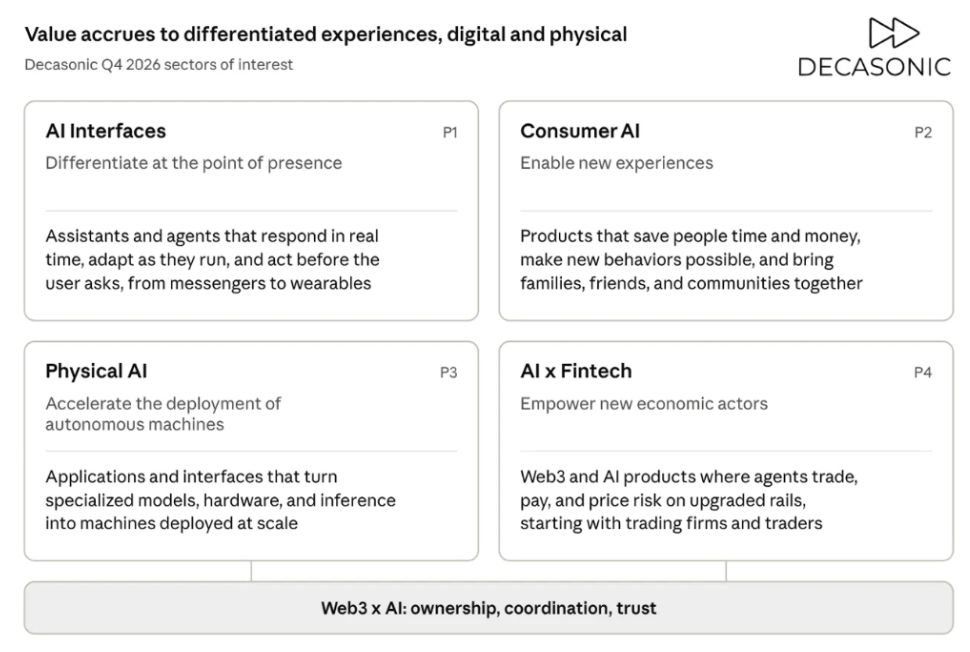
AI Interfaces: The communication layer of human and AI collaboration, delivering differentiated experiences at the point of presence across chat, voice, browsers, messengers, and wearables.
Consumer AI: AI for mainstream people to enhance their lives across the personal, the professional, and play, helping them do old things better and take up new behaviors AI makes possible.
Physical AI: AI embodied in the physical world and acting autonomously, the expansion of software AI into machines and devices such as autonomous vehicles, humanoids, and home and industrial robots.
AI x Fintech: The financial and economic layer where Web3 and AI meet, as financial infrastructure upgrades from .com-era rails to programmable, real-time rails and AI introduces a new economic actor.
We map our four sectors of interest below, along with the themes we are actively tracking within each.
AI Interfaces
We see AI Interfaces as the communication layer of human and AI collaboration, and the place where differentiated experiences are delivered to a user.
What Q3 2026 clarified is that the general-purpose assistant is now given away at a massive scale. OpenAI launched dots, xAI released grokbot, Instinct raised at a $10B valuation and Meta's Muse personal agent became the No. 1 free app in Apple's App Store within two weeks of its September 8 launch. Apple shipped a new Siri, built on models developed with Google, in its iOS 27 beta. The interface people use is also shifting toward voice and devices: 63% of Gemini app users talk to it by voice, and AI devices and wearables were the largest consumer sub-theme by number of venture rounds in Q3.
Access is becoming a question of who controls the point of presence. Amazon blocked Muse from shopping on Amazon.com on September 20, and Shopify enabled agentic checkout for Muse across its stores the next day. An interface's value depends on where it sits and what it is allowed to do on the user's behalf.
Where we think value accrues here is in interfaces that deliver differentiated experiences at the point of presence: real-time responses in the moment of interaction, generative UI that adapts as it runs, personalization shaped by the user's context, and predictive agents that act before the user asks. We are most interested in proactive personal and household agents, multiplayer agents that live inside the messengers people already use, vertical agentic browsers, developer interfaces for running agents in parallel, and AI wearables where on-device agents make the hardware useful every day.
Two Decasonic portfolio companies are building for this shift. TestMachine, built on reinforcement learning and attack simulation, enforces guardrails on every action an AI agent takes, including agents that handle money. Scenario's MCP server brings its image, video, 3D, and audio generation, plus users' own trained models, into AI tools like Claude, Cursor, and VS Code.
Consumer AI
Consumer AI is AI for mainstream people to enhance their lives across the personal, the professional, and play. As AI agents reach the mainstream, the sector covers the everyday use cases that help people do old things better and take up new behaviors AI makes possible.
What Q3 2026 showed is that incumbents own consumer scale. With the largest platforms giving capable assistants away for free, a new consumer product needs a specific reason for people to use it. The venture data points to where those reasons are forming. Consumer AI raised about $2.9B across 113 rounds in Q3, and creator tools posted the largest gain in share, rising from 2.7% to 10.5% of consumer rounds at a median round size of about $3.4M. Consumer AI is also 2% or less of every 2026 Y Combinator batch, which means many of the consumer founders we want to meet are building outside the main accelerator pipelines.
We believe the opportunity is in use cases that empower people, and we group them into three experiences. The first is old behaviors done better, where AI finishes everyday tasks like in a few clicks. The second is new behaviors that abundant intelligence makes possible, like making a game, show, or song with friends, or translating a conversation in real time while traveling. The third is multiplayer and social experiences shared with family, friends, and communities, from group plans and meetups to fan communities and family activities.
Giant, a Decasonic portfolio company, is an example of a new behavior. It turns each child into the star of their own story through content generated around them, an activity families could not do before generative AI.
Where we think value accrues here is in products that measurably save people time and money or open up new things to do. We are most focused on multiplayer experiences, since a product used with the people in someone's life gets used more often and kept longer than one used alone.
Physical AI
Physical AI is AI embodied in the physical world, acting autonomously. It is the expansion of software AI into machines and devices, from autonomous vehicles and industrial humanoids to home and companion robots.
Q3 2026 showed deployment and valuation moving at different speeds. Waymo reached ~500,000 paid rides per week across 15 US markets, and Figure manufactured its 1,000th Figure 03 humanoid. At the same time, over 60% of the ~22,000 humanoids shipped in the first half of 2026 went to entertainment, data production, and research, with manufacturing at 13% and logistics at 5%. Unitree's public debut valued the company at ~$66B at its peak before its shares fell ~45% within a week. Physical AI was also the fastest-growing sector in our own deal flow this quarter, led by companies producing training data for robots.
Where we think value accrues here is in the applications and interfaces that turn specialization across the model, hardware, and inference stacks into high-value deployment at scale.
Specialization is emerging at every layer: specialized hardware and form factors, routing across open-source and closed-source models, inference split across on-robot, on-premise, and cloud compute, data orchestration and model optimization for each task, and shared learnings from deployments across fleets.
We are focused on the products that coordinate those layers, including model gateways and routers, learning and simulation environments, and data quality evaluations across egocentric, teleoperation, and simulation data. Robocurve, a Decasonic portfolio company, builds evaluation for robots, the testing layer that deployment depends on.
Web3 plays an early role here in supplying the real-world data and human operators that deployment needs. PrismaX, a Decasonic portfolio company, runs a decentralized teleoperation network that connects human operators to the companies deploying Physical AI and supplies the real-world operation data those deployments depend on.
AI x Fintech
AI x Fintech is where Web3 and AI transform financial and economic relationships. Financial infrastructure is upgrading from legacy rails to rails that are programmable, flexible, and real time, and AI introduces a new economic actor that can trade, pay, and price risk on behalf of people and firms. We believe Web3 and AI together move money faster, smarter, and cheaper than either can alone.
What Q3 2026 made clear is how quickly that upgrade is reaching core market infrastructure. DTCC processed production trades with tokenized DTC securities alongside more than 30 firms in July, and the SEC's Innovation Exemption in September allowed permissioned AMM trading of tokenized US stocks through 2031. Circle launched its Arc mainnet with BlackRock, DTCC, Visa, and Mastercard among its founding validators, Visa's stablecoin settlement passed a $20B annualized run rate, and 21 banks committed to launch a joint USD stablecoin in the first half of 2027. Tokenized real world assets are near $40b and are one of the fastest growing sectors.
We believe trading firms and active traders adopt first, and Q3 supported that view. In the week of July 13, stock, index, and commodity contracts made up 52% of Hyperliquid's volume, the first week they out-traded crypto on the exchange, and Hyperliquid's open interest reached a record $18B in September. Kalshi recorded its highest weekly volume of 2026 in September, Robinhood's event contracts revenue grew more than 10x year over year, and Coinbase, Kraken, Kalshi, and Robinhood are each launching or filing for perpetual futures products.
Fast-moving traders give every asset a reference price that slower, long-term capital can use, which is why we expect the deepest liquidity to form here first. Opinion, a Decasonic portfolio company, is building a crypto-native prediction market, part of the shift toward 24/7 markets where people can express a view on any event.
AI agents are becoming economic actors on these rails. The payment layer for agents moved quickly toward incumbents, with Visa, Mastercard, American Express, Stripe, Google, AWS, Coinbase, and Circle joining the x402 Foundation at its July launch. Agent payment volume is still early, so we focus on the products where agents already do useful financial work: analysis, trading, spending within set limits, and paying per call for data, APIs, and compute. Orthogonal, a Decasonic portfolio company, gives AI agents access to skills and APIs they pay for per call.
The financing behind AI is also becoming a market of its own. AI-related issuers paid ~115 bps of spread against ~78 bps for the broader investment-grade market, and Nvidia set up compute financing platforms with Apollo, BlackRock, Blackstone, Brookfield, Goldman Sachs, and KKR aimed at more than $500B of third-party capital.
Where we think value accrues here is in the products that combine Web3 and AI, starting with trading firms, market makers, and active traders. We are focused on advisor and analyst agents, agentic trading and spending, event contracts, tokenized equities and collateral, cross-border stablecoin payouts, compute markets and AI infrastructure credit, and the agent identity and spend controls that let firms trust an agent with money.
Building and Investing in the Future
Our underwriting remains grounded in Product Market Fit, Narrative, and Execution. This quarter we put more weight on narrative, meaning a founder's ability to evangelize a product and hold attention. With more products competing for the same users, the founders who stand out tell one story that brings in both customers and capital. We are thesis-driven early-stage investors in AI and digital assets, and we move with conviction, clarity, and speed in our founder partnerships.
We are also an AI-native team. We have built 400+ AI teammates that augment our 4 human teammates, including an internal AI OS with 35+ AI applications and an AI Engines Portal for our portfolio companies. This quarter we expanded our own work on AI interfaces and rolled out an AI mobile app that brings three AI assistants into our mobile workflows. Building with the same tools our founders use shapes how we provide enhancement capital, activating strategic value when it matters most to a founder.
A Call to Builders
We are actively looking to invest in founders building across our four sectors: AI Interfaces, Consumer AI, Physical AI, and AI x Fintech. We lead or co-lead rounds with checks of $1-2M, and we structure financings with aligned upside and governance. Our team, Justin and Abdul, will be in San Francisco for Tech Week from October 5 to 9. If you are building at the frontier and want a value-add, investor-operator partner, reach out to us at Decasonic.
The content of these blog posts is strictly for informational and educational purposes and is not intended as investment advice, or as a recommendation or solicitation to buy or sell any asset. Nothing herein should be considered legal or tax advice. You should consult your own professional advisor before making any financial decision. Decasonic makes no warranties regarding the accuracy, completeness, or reliability of the content in these blog posts. The opinions expressed are those of the authors and do not necessarily reflect the views of Decasonic. Decasonic disclaims liability for any errors or omissions in these blog posts and for any actions taken based on the information provided.