
in this piece
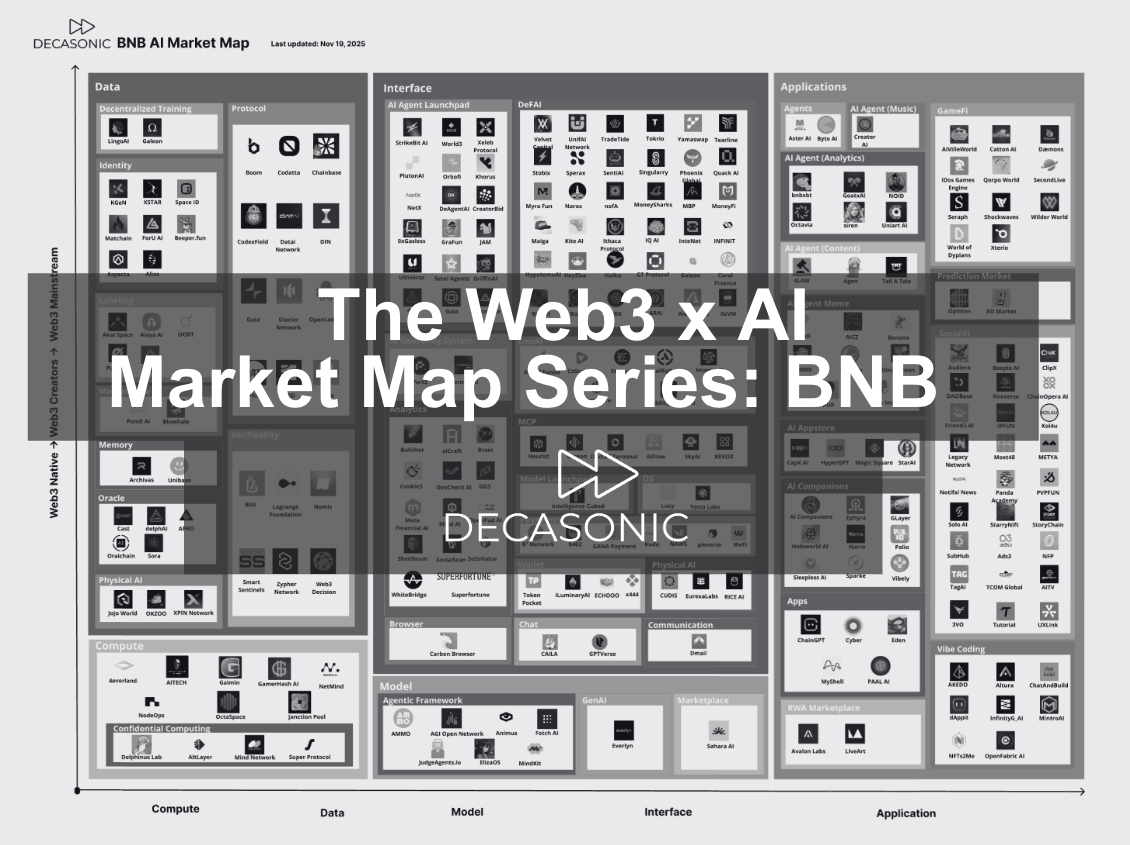
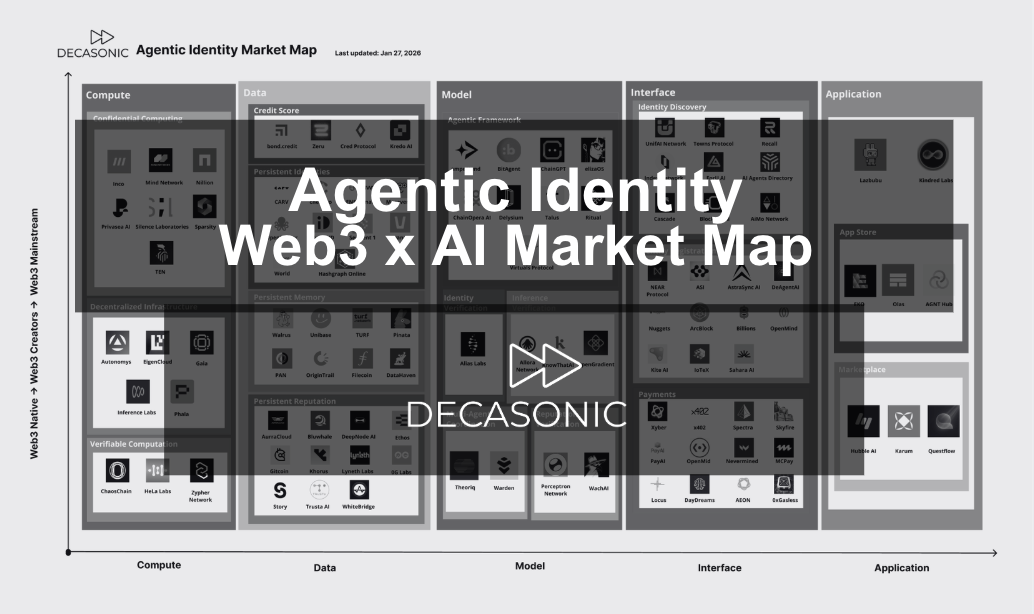
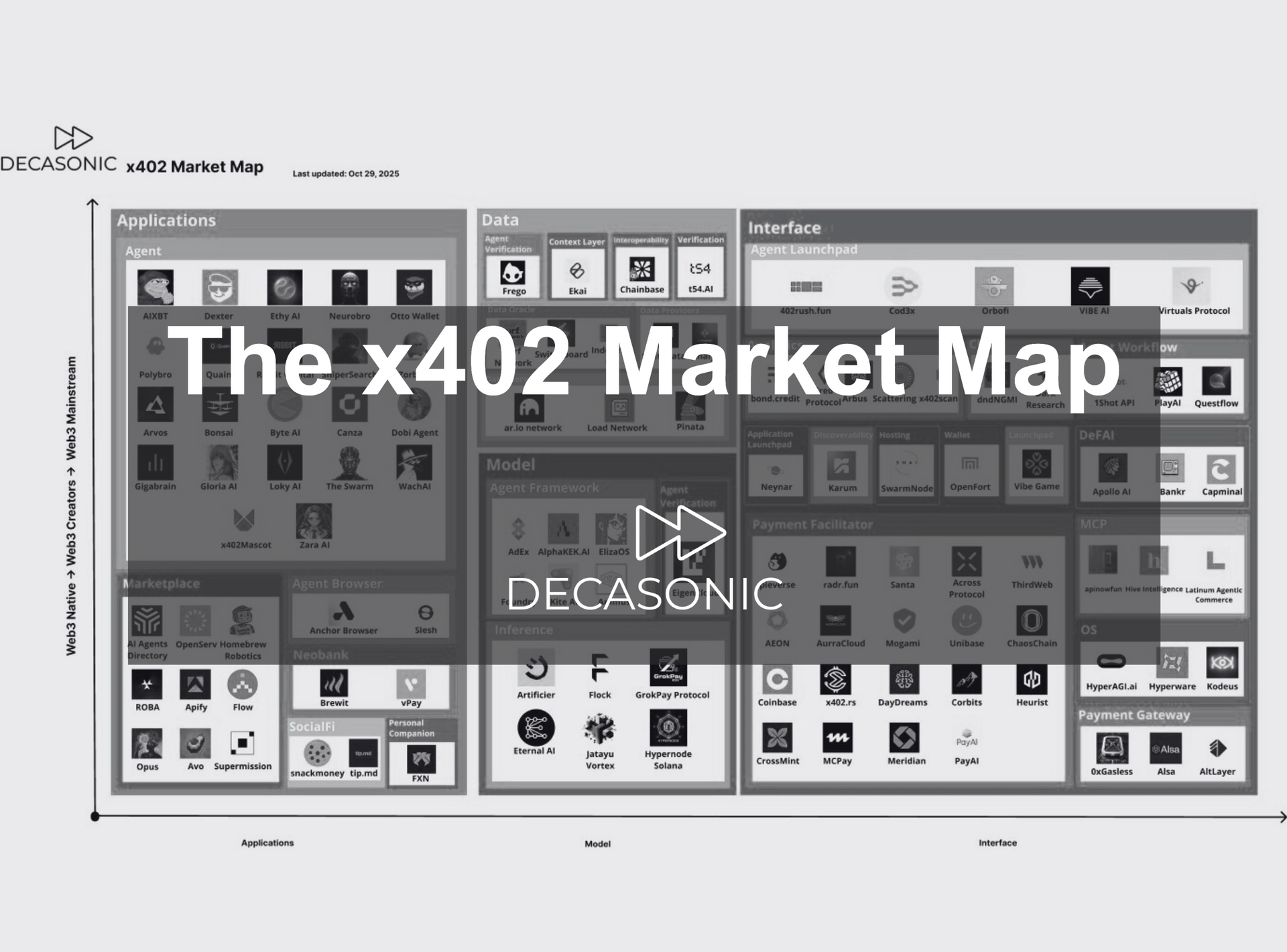
all perspectivesArc officially debuted its public mainnet on September 16, 2026, bringing the vision of the ‘Economic OS,’ chain to life. Developed by Circle, the issuer of USDC, the chain is designed to unify global financial markets, offer real-time money movement, tokenized assets, and automated AI agent transactions on a single shared ledger. We debut our Arc AI Market Map in this article, our seventh installment of the Web3 x AI Ecosystem Market Map Series. Our previous market maps can be found here: link.
Over the past two years, we have seen the emergence of a new type of blockchain that benefits from existing distribution channels in the form of corporate blockchains. Those blockchains include: Hood, Base, Ink, and now Arc. Traditionally, those distribution channels often come from exchanges. Arc’s advantage is liquidity itself in the form of its relationship with USDC.
USDC is the native token on Arc. USDC’s circulating supply market cap is ~$75.43B, representing nearly ~25% of the collective stablecoin market cap as tracked by DeFillama. In relation to the role of the USDC at the intersection of Web3 and AI, it is the leading asset for agentic payments settlement value - representing ~99.6% of the x402 collective settlement value.
This comes at no surprise for two primary reasons: (1) Circle is increasingly positioning Arc (and by proxy USDC) as the Economic OS for the internet, with a core view that AI agents are becoming economic actors that hold, move, and settle funds. (2) Coinbase is the creator and primary driving force behind x402, and maintains a long-term relationship with Circle. We at Decasonic believe Arc is well positioned to become the settlement and liquidity layer for the agentic economy: enabling AI agents to earn, hold, spend, and transact in a simplified native token that enables (1) predictability associated with settlement value and (2) accelerated speed to settlement.
The State of Arc
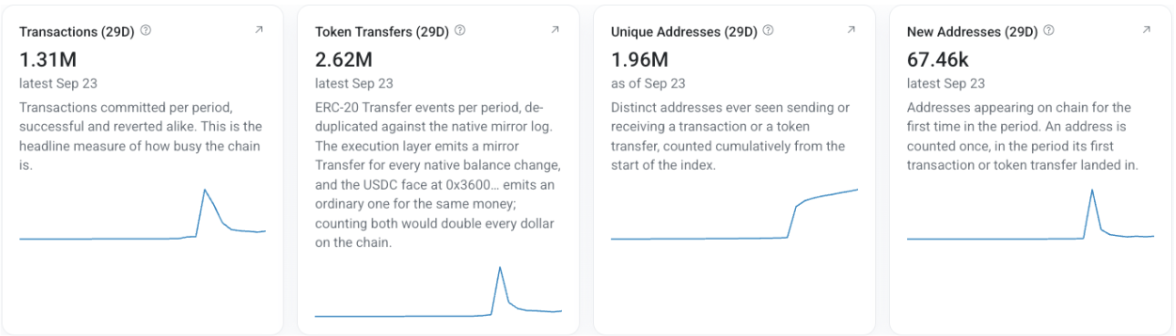
As of the time of writing, Arc is nine days into its mainnet. The chain has processed 1.31M transactions with 1.96M unique addresses created on the chain. The number of active addresses stands at ~89.17k, with the chain currently having ~$450.3M in TVL.
Agentic Liquidity
Payment standards for the agentic economy on crypto rails are consolidating around (1) x402 and (2) MPP. Both payment standards primarily leverage the dormant HTTP 402 status code to enable AI agents (and software more broadly) to pay for APIs, data, and services on a per-request basis. Once standardization in the payment standard emerges, the considerations around liquidity emerge: (1) where money is held by agents, (2) the speed to settlement, (3) the predictable nature of fees associated with payments, (4) liquidity value accrual across the token payment standard of choice.
Arc benefits by primarily providing answers to the considerations listed above, with an emphasis on agentic liquidity that enables and simplifies the ability for AI agents to access, hold, move, and settle funds at machine speed:
- Stable Gas: USDC is Arc’s native gas token. There is a clear and predictable fee for their target settlement, defined in their referenced machine-readable docs as $0.001 per ERC-20 transfer.
- Speed to Settlement and Deterministic Finality: Arc’s consensus is built on Malachite, with an average block time of ~0.505 seconds (delivering deterministic sub-second settlement finality). In essence, the chain is fast.
- Nanopayments: Circle enables gas-free USDC transfers in the form of nanopayments, offering extremely small, high-frequency transactions primarily positioned for AI agents, paid APIs, compute, data, and machine to machine commerce. This supports USDC transfers as small as $0.000001 batched into single on-chain settlements.
- Stable FX: Provides 24/7 payment-versus-payment FX across 20+ stablecoins for eligible businesses. This provides a stable foundation for cross-border agentic neobanking and cross-border agent to agent commerce.
Arc further benefits from the liquidity and support of its 11 founding validators, including DTCC, ICE, Mastercard, Standard Charter, Visa, and BlackRock - providing a pathway towards bootstrapped economic liquidity from the mainnet of the chain.
Arc: Agent Product Stack
In anticipation of the release of (1) Arc’s mainnet and (2) the advancement of USDC’s role in the agentic economy, Circle released their ‘Agent Stack,’ in May, 2026. This stack highlighted products including:
- Circle’s CLI: Enabling developers and AI agents to build applications on top of Circle’s platform.
- Agent Wallets: Enabling agents to hold, transfer, and manage assets under policies and guardrails.
- Agent Marketplace: Services for AI agents across both tools and skills.
The unique positioning behind the Arc ecosystem suite is primarily the verticalized approach. They provide the (1) native token for agentic settlement, USDC (2) the wallet that enables AI agents to transfer, transfer, and hold assets, and (3) the marketplaces and applications that allow AI agents to discover services.
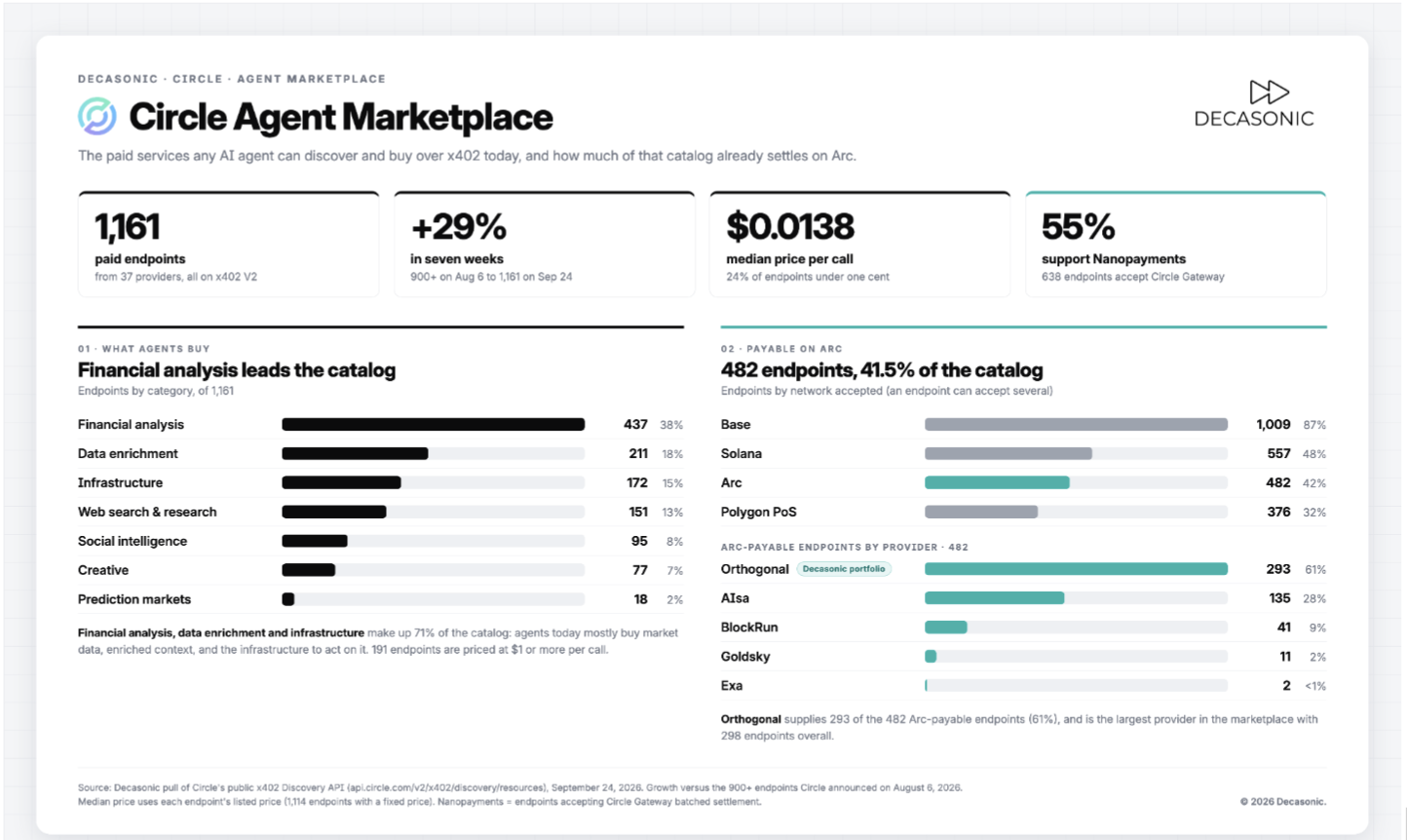
We queried the Discovery API behind the Agent Marketplace, which enables AI agents to search the full catalog of available paid APi services offered by first party and third party providers. The marketplace aggregates endpoints across multiple chains, including (1) Base, (2) Solana, and (3) Polygon. The current breakdown is noted below:
- Unique Paid Endpoints: 1,161 paid endpoints; a ~30% growth from the 900 endpoints announced on August 6, 2026.
- Median Price per Call: Across the breakdown of the catalog of services offered, the median price per call is $0.0138 with ~24% of the endpoints coming under one cent per call.
- Nanopayments Acceptance: Nanopayments is a unique and defining differentiator for Arc agentic payments. Out of the endpoints surveyed, ~55% of them support Nanopayments.
- Arc Endpoints Offered: As of the time of writing, there are 482 endpoints (across 57 services) available and accepted on the Arc network. Decasonic portfolio company, Orthogonal provides the majority (~61%) of the collective payable endpoints on Arc (293).
Circle (and by extension Arc’s roadmap) is primarily positioned to accelerate the advancement of the Agentic Economy and strengthen the USDC position as the native token for the agentic economy. In assessing the H2 2026 roadmap, Circle’s stated goal for the entirety of the second half of the year is to “complete a working turn of an open agent market,” and they are (very likely) going to leverage Arc in order to execute on their vision. This includes considerations around the development and deployment of:
- Agentic Identity: “Know your Agent,” and likely in the form of ERC8004.
- Agentic SDK: Enabling the development and deployment of AI agents with a native payment endpoint, enabling deployers to set the (1) price and (2) capabilities for their agentic services while enabling semantic discovery.
- Feedback and Reputation: Feedback and Reputation: Core to enabling price discovery and adoption. Each completed settlement becomes verifiable feedback on the service, compounding into a reputation (track record and completion rate) that improves discovery and pricing for every future transaction.
Founder Advocacy and Ecosystem Support
Arc benefits from the (1) operational deployment of AI at Circle and (2) the vocal advocacy of their leadership team behind the wider vision of the Agentic Economy. Jeremy Allaire, the CEO of Circle, published the “Agentic economy,” thesis which primarily aims to highlight the increasing overlap between the agentic and the onchain economy - describing them as being the “same economy.”
Core to their operational deployment of AI is what was highlighted during Circle’s most recent earnings call, where the leadership team highlighted how AI is being adopted and deployed internally. This is spread across (1) “1,100 AI applications,” shipped by Circle team members, (2) ~86% of their global workforce being WAUs of internal AI automation and coding tools, and (3) 54% of the deployers of their AI applications being non-technical builders.
Arc maintains an active and supportive ecosystem builder community. More than 100 institutional and ecosystem builders were identified as being “live or exploring Arc’s private mainnet,” as of their launch announcement found here: link.
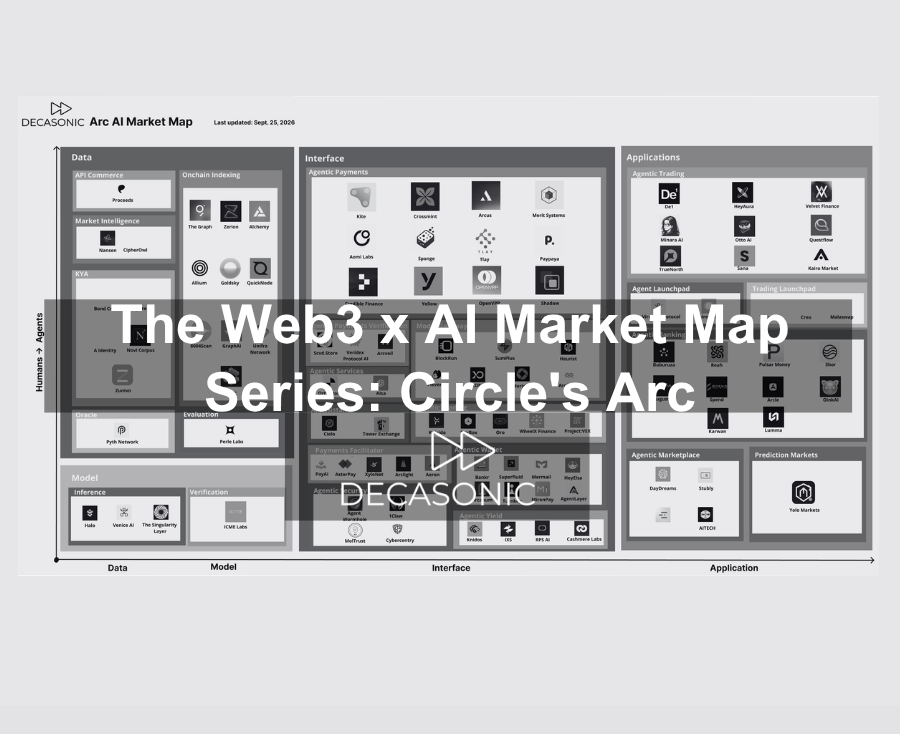
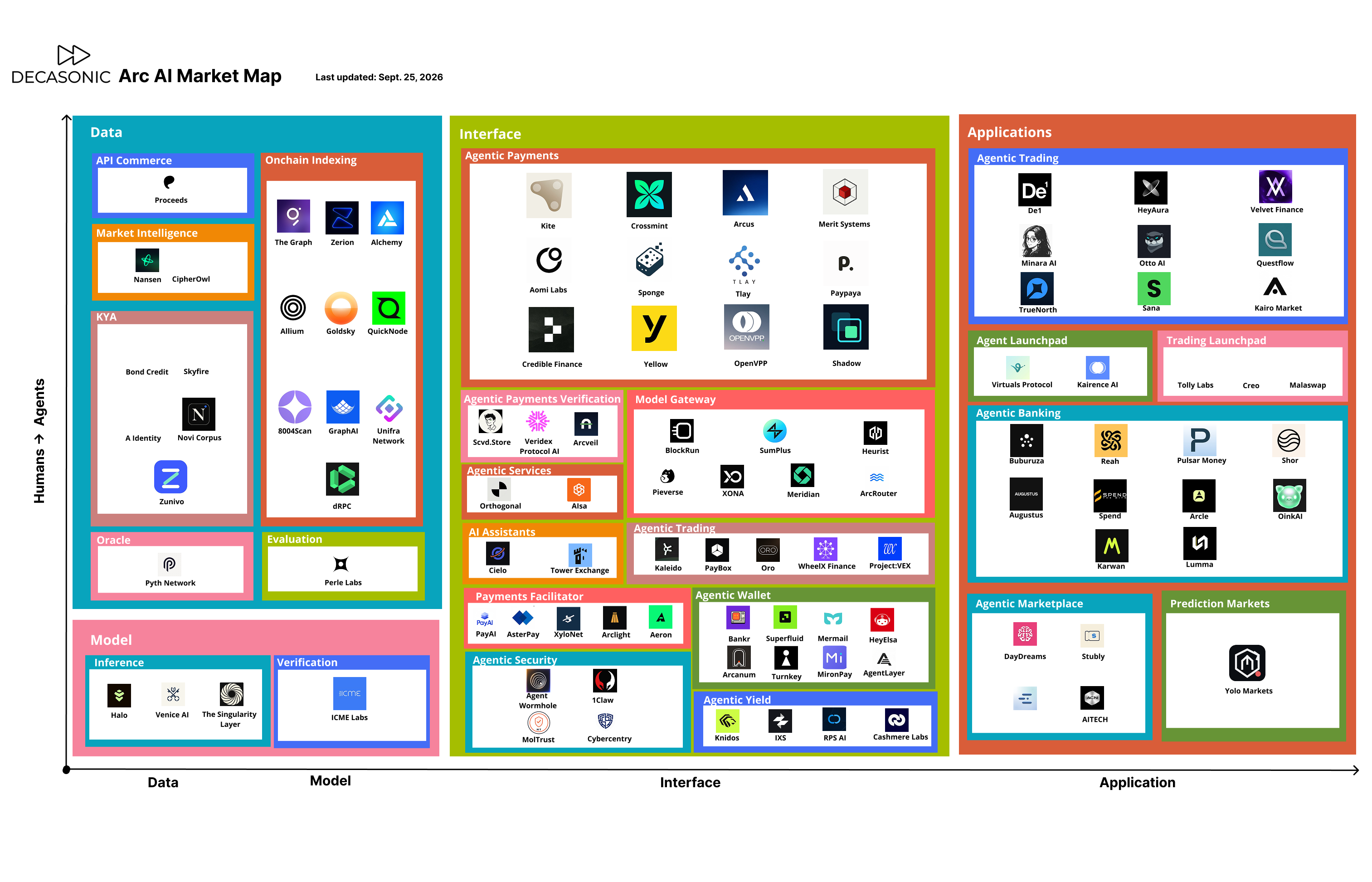
Arc Web3 x AI Market Map [September 2026]
Similar to our other market maps focused on Web3 x AI, we map the Arc AI ecosystem across two axes:
- X-Axis: AI standard layers: Compute → Data → Model → Interface → Application.
- Y-Axis: Target audiences: Web3 Natives, Developers, Users, and Mainstream Audiences.
Note: as with our other market maps, this is a continued iteration and a rapidly evolving, dynamic landscape. The current state of the ecosystem is unlikely to be the same over the next few quarters and years to come. To date, we have identified 107 projects building on Arc, identified through our three pillars noted below.
The Pillars of Arc AI Ecosystem Market Map
Infrastructure
1. Model Layer
a. Inference: Infrastructure that enables running AI models, with an emphasis on privacy and verifiability of access.
i. A key project operating at this intersection is Venice AI, which provides private and unrestricted AI inference.
b. Verification: Mechanisms that verify model behavior and outputs, including guardrails and formal methods for AI agents.
2. Data Layer
a. Onchain Indexing: Infrastructure that indexes and serves on-chain data to applications, AI models, and agents.
i. 8004Scan operates at this intersection, providing an explorer for agents registered under the ERC-8004 standard, which Arc carries from day one.
ii. Goldsky is one of the five providers whose endpoints are payable on Arc in Circle's Agent Marketplace.
b. KYA (Know Your Agent): Identity, reputation, and governance frameworks that allow agents to be verified before they transact.
i. Novi Corpus is building identity, money, governance, and enforceable rules for AI agents.
c. Market Intelligence: AI-powered analytics that surface market data, flows, and signals for traders and agents.
i. Nansen provides on-chain intelligence for traders, and is repositioning towards AI-powered trading with the goal of enabling users to "trade everything onchain with AI."
d. API Commerce: Infrastructure that allows data and API providers to monetize their services with agent-native payments.
i. An example of a project operating at this subcategory is Proceeds, which helps companies monetize their APIs through x402 and Circle Nanopayments.
e. Oracle: Provides infrastructure for verifiable, on-chain data for dApps, assets, and risk metrics, amongst other sources, enabling smart contracts and agents to access real-world data.
i. Pyth Network powers this intersection on Arc, providing market data feeds used by AI projects in the ecosystem.
f. Evaluation: Networks that evaluate, label, and score data and model outputs for AI.
Interface Layer
1. Agentic Payments: Interfaces and protocols that allow AI agents to initiate, route, and settle payments, including machine-to-machine transactions.
a. Kite AI, one of the agentic partners Circle named at mainnet, is building agentic payment infrastructure.
2. Agentic Wallets: Wallets that allow agents to hold assets, sign transactions, and execute on-chain actions within defined policies.
a. Bankr is building financial infrastructure for agents to fund themselves, including wallets, tools, and treasury automation.
3. Model Gateway: Gateways that allow agents to pay per call for access to models, tools, and data.
a. BlockRun enables agents to pay per call for LLMs, tools, and data sources, and is one of the five providers payable on Arc in Circle's Agent Marketplace.
4. Agentic Trading: Autonomous execution layers that apps and agents plug into in order to trade on-chain.
a. Kaleido is building an AI-native operating system for autonomous on-chain finance.
5. Payments Facilitator: x402 facilitators that verify and settle agent payments on behalf of sellers.
a. Two projects operating at this intersection include XyloNet and Arclight. XyloNet launched XyloFacilitator, an x402 facilitator on Arc, and Arclight is building a liquidity and payments layer for Arc.
6. Agentic Security: Security, key management, and signing infrastructure for AI agents.
a. 1Claw provides secure infrastructure for AI agents, and is a member of the Circle Alliance program.
7. AI Assistant: AI assistants that support users with on-chain research, execution, and portfolio management.
a. Cielo provides a trading terminal with agentic copy-trading and wallet intelligence.
8. Agentic Yield: Interfaces that allow agents to allocate capital towards yield strategies, often with verifiable performance.
a. Knidos is building AI-native on-chain asset management with ZK-verified execution, with its testnet live on Arc.
9. Agentic Payments Verification: Privacy and verification layers for agent payments.
a. Arcveil is building the first privacy layer for AI agents on Arc.
10. Agentic Services: Tools and services that agents can discover and pay for on demand.
a. Orthogonal (YC W26), a member of the x402 Foundation, is the largest provider in Circle's Agent Marketplace with 298 endpoints, and supported Nanopayments on Arc from day one.
11. Agentic Banking: Banking and governance platforms that agents and businesses plug into.
a. Catena Labs is building a banking and governance platform for AI agents.
Application Layer
1. Agentic Banking: Consumer and business financial applications where an AI agent saves, spends, sends, or manages money on behalf of the user.
a. Sana is building a money layer for humans and agents, and launched its Trade Desk on Arc on September 21, 2026.
2. Agentic Trading: Trading agents and AI-powered trading applications that users interact with directly.
a. HeyAura is a Web3 AI assistant that allows users to swap, trade, and bridge on Arc mainnet with a simple prompt.
3. Agentic Marketplace: Marketplaces for hiring AI agents and purchasing agent-delivered services.
a. A key marketplace for AI agents on Arc is Stubly, which allows users to hire AI agents for small jobs, with USDC held in escrow until the work passes.
4. Trading Launchpad: AI-assisted launchpads for the creation and trading of tokens.
a. Creo is an AI launchpad on Arc and Robinhood Chain, where AI drafts and launches tokens.
5. Agent Launchpad: Launchpads specifically built to fund, deploy, and distribute AI Agents.
a. Virtuals Protocol is a key innovator and first mover at this intersection, and was named by Circle among its agentic partners at mainnet.
6. Prediction Markets: AI-enhanced prediction platforms where users or agents stake on future outcomes, leveraging model-driven forecasting and real-time data feeds.
a. Yolo Markets is building an AI-powered prediction market with agentic trading on Arc.
The ARC AI Positioning
There are many chains actively aiming to become the “settlement layer,” for the agentic economy. In our conversation with ecosystem founders - we primarily identified the following areas for why the AI ecosystem is growing at Arc:
- Verticalized Suite: Offering a comprehensive stack for AI builders. This includes the CLI, Skills, Wallets, and the Circle Marketplace for AI services.
- Extending the “products,” offered to the “demand,” side of the Agentic Economy is the “x402 batching,” offered to suppliers of APIs and services (enabling batched settlement to seller-provisioned wallets to be paid for endpoints consumed).
- Speed and Fee Predictability: As previously noted, agents can confirm payments through sub-second finality (which is important as agents start implementing parallel tool calls and machine scale transactions continue to accelerate in speed and utilization). This accompanies the nature of fee predictability, allowing agents to rapidly “budget,” the cost per transaction settled.
- Liquidity and Institutional Validation: Arc launched with deep USDC liquidity, allowing for the ease of deployment of AI agents with enhanced liquidity.
- Yield: This is primarily speculative, but potential “yield-sharing,” opportunities at the (1) application or (2) network layer could accelerate agentic treasury and yield offerings.
- USDC as the Native Gas: Fees are paid in USDC on Arc, simplifying payments for AI agents. USDC is already the “dominant,” choice of payment on x402 - and the general belief is that this will continue to be the case in the future.
Interfaces and Applications
Given our understanding of the Arc ecosystem, it comes at no surprise that the majority of identified AI ecosystem projects today are building for (1) payments, (2) banking, (3) trading, and (4) yield-earning use-cases.
In our assessment of the breakdown, ~54% of the identified projects are Interface-projects, with ~27% identified as Application-projects. In the subsequent breakdown of the categories by sub-categories; 43% of Interface projects and ~72.4% of Application projects are building for the use-cases aforementioned.
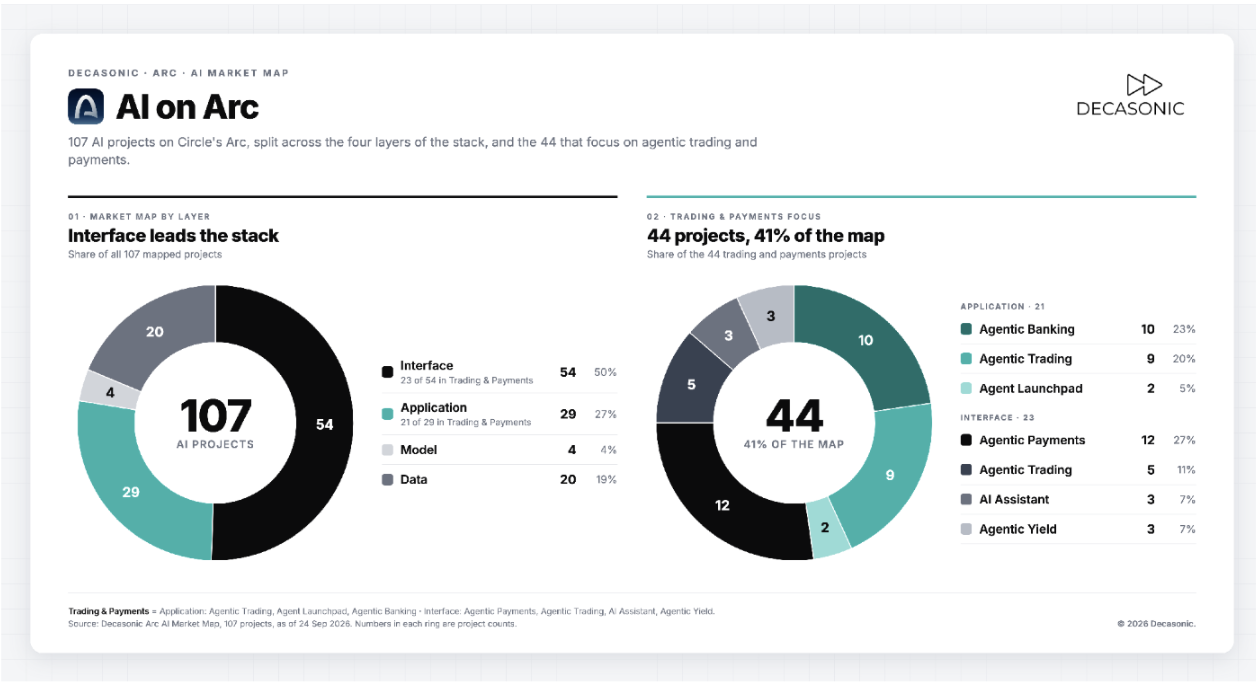
This is uniquely differentiated from the other Web3 x AI ecosystems we landscaped. On Arc, the Application and Interface layer(s) are dominated around (1) money and (2) the velocity of money transfer(s) in the form of transactions.
Opportunities
Despite the increasing number of builders choosing to build AI projects on Arc, we believe the ecosystem remains early in its growth trajectory. Opportunities for builders include:
- AI Agent Credit Scores: Providing AI agents with universal credit scores, enabling credit underwriting.
- Agentic Credit: Providing credit lines for AI agents. Arc already has projects building KYA and their H2 2026 roadmap is focused on adoption and trust for (1) AI agents and their services.
- Immutable Agentic Identity: There continues to be a whitespace opportunity to combine (1) KYA for AI agents (“Know your Agent”) and (2) ledger-stored feedback provided to AI agents and discoverable services.
- Cross-Border Agentic Transactions: Enabling cross-border agentic transactions across jurisdictions, organizations, and individuals.
- Compute Markets: Short-lived pay-per-inference and pay-per-run markets, leveraging Circle’s Nanopayments.
- Agentic Yield: The pathway towards self-sustaining AI agents relies on Agentic Yield opportunities. Delegate or provide an (1) agentic wallet or (2) AI agent with $X amount of funds, and allow it to self-sustaining to pay for related costs [inference, tool, hosting, and model-usage].
- Agentic Assistants: Clearly at an inflection point right now with Meta’s Muse and Instinct. Consumer-focused AI agents are accelerating towards being (1) proactive, (2) always on, and (3) enabling purchases on behalf of users. Agentic Assistants leveraging Circle's (and by extension, Arc’s) ecosystem of agentic products + nanopayments can expand the potential use-cases offered.
- Agentic Treasuries: Enabling agent managed treasuries to maximize yield (with a risk-profile personalized to a user and leveraging jurisdictional guidelines). This includes asset-expansion beyond stablecoins to account for tokenized equities and tokenized commodities.
- Personalized Portfolios: Intelligent portfolio management personalized for users and organizations.
- Agentic FX: StableFX brings 24/7 FX across 20+ stablecoins to Arc. There is whitespace for a project built on StableFX that automates FX through a network of AI agents.
Conclusion
The ARC AI ecosystem continues to grow and evolve. Arc benefits from a distribution advantage of being the home of the preferred form of payments for AI agents today, USDC. It offers a full-stack verticalized suite of products for (1) developers and (2) AI agents across their Agent Marketplace, CLI, Skills, and Nanopayments. Arc is well positioned to be the agentic liquidity layer for AI agents.
At Decasonic, we are active Web3, AI, and intersection investors. If you are actively innovating at the frontier and seek an aligned investor-operator partner, reach out to me.
Disclaimer
The content of this material is strictly for informational and educational purposes only. It is not intended to constitute investment advice, nor should it be considered a recommendation or a solicitation to buy, sell, or hold any asset. Decasonic does not endorse investments in any specific tokens, and nothing in these blog posts should be construed as legal, tax, or financial advice. Please consult with a qualified professional advisor before making any financial decisions. Decasonic provides no warranties, whether expressed or implied, on the content provided in these blog posts, including its accuracy, completeness, or correctness. The opinions expressed here are those of the authors and do not necessarily reflect the views of Decasonic. Please note that Decasonic may hold a position in some of the tokens mentioned, including Virtuals. Decasonic is not liable for any errors or omissions in the content of this material or for any actions taken based on the information provided herein.