How Decentralized Data Ecosystems Empower AI Innovation and Reliability -– Eugene Tsai, Venture Data Analyst at Decasonic
In the rapidly evolving digital landscape, the convergence of Web3 data and AI is set to redefine how we interact with technology, manage information, and build trust in digital systems. Web3, often called the decentralized internet, leverages blockchain technology, decentralized protocols, and distributed networks to create a new paradigm for data ownership, security, and accessibility. Unlike the centralized data silos common in Web2, Web3 data is transparent, user-controlled, and inherently verifiable. This shift has profound implications for AI, which depends on high-quality, diverse, and trustworthy data to deliver accurate and meaningful results.
This blog post explores the transformative potential of Web3 data for AI. We will examine the nature of Web3 data, compare how AI utilizes traditional versus Web3 data, and outline the key ways Web3 data can enhance AI systems, including Digital Intelligence, Digital Trust, Data Verification, Aligned Economics, Decentralized Data Governance, and Enhanced Privacy. By understanding this synergy, we can imagine a future where AI is not only smarter but also more equitable and trustworthy.
Understanding Web3 Data: The Foundation of a Decentralized Future
Web3 data marks a fundamental shift away from the centralized data models of Web2. In traditional systems, data is collected, stored, and controlled by centralized entities such as leading tech companies. These organizations act as gatekeepers, determining how data is used, shared, and monetized, often at the expense of user privacy and control.
In contrast, Web3 data is decentralized and stored across distributed networks like blockchains or peer-to-peer systems. This ensures that no single entity has complete control, and users retain ownership through cryptographic mechanisms such as private keys. Web3 data is also transparent and immutable, allowing anyone on the network to verify it without intermediaries. Protocols such as IPFS (InterPlanetary File System), The Graph, and decentralized identity systems support secure, scalable, and user-centric data ecosystems.
For AI, which thrives on large datasets for training and insights, Web3 data offers a new frontier. By accessing decentralized data sources, AI can work with more diverse, high-quality data while aligning with principles of transparency, security, and user empowerment.
AI and Traditional Data: The Status Quo
To appreciate the potential of Web3 data for AI, it’s important to understand how AI currently relies on traditional data. Most AI systems today use centralized data sources, which are often proprietary and controlled by corporations, governments, or research institutions. These databases are frequently limited in scope and can reflect the biases of those who curate them. For example:
- Centralized platforms restrict data access, which limits the diversity available to AI developers and can result in narrowly trained, less adaptable models.
- Users have little control over their data usage, raising ethical issues and regulatory challenges such as GDPR (General Data Protection Regulation) violations.
- Centralized datasets can perpetuate bias and inaccuracies, lacking robust mechanisms for data verification.
- Data providers, often users themselves, are rarely compensated, while organizations profit from AI models built on their data.
While traditional data has fueled significant AI progress, from image recognition to natural language processing, these challenges highlight the need for a better approach. Web3 data addresses these limitations directly.
AI and Web3 Data: A New Paradigm
Web3 data fundamentally changes how AI accesses, processes, and leverages information. By decentralizing data storage and management, Web3 allows AI to tap into a global, permissionless pool of information while respecting user autonomy and system integrity. Here’s how AI can benefit from Web3 data:
- Decentralized data marketplaces like Ocean Protocol and Filecoin let providers share data on open networks, giving AI access to broader and more diverse datasets.
- Smart contracts automate data-sharing agreements, ensuring AI systems access data only with explicit user consent and under set conditions.
- Blockchain-based systems provide tamper-proof records of data origins and changes, helping AI verify the authenticity of its training data.
- Tokenized incentives in Web3 ecosystems encourage users to share valuable data and allow AI developers to access these resources.
By integrating with Web3 data, AI can overcome the limitations of centralized systems, creating models that are more inclusive, transparent, and aligned with user interests.
How Web3 Data Enhances AI
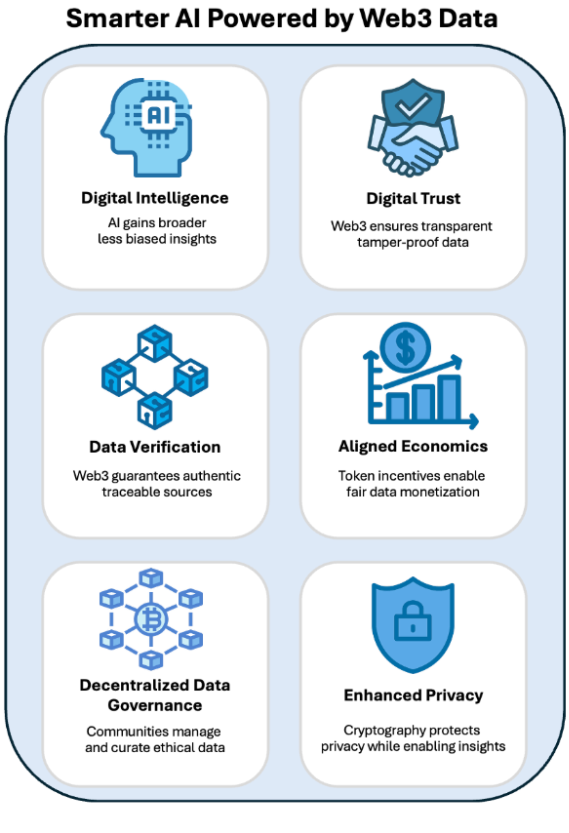
Web3 data not only supplies new data sources for AI but enhances AI in transformative ways. Here are six key areas in which Web3 data can revolutionize AI systems, each described concisely:
- Digital Intelligence: AI gains wider, less biased insights by accessing global, decentralized datasets, leading to better generalization and accuracy.
- Digital Trust: Web3’s transparency and immutability ensure AI uses verifiable, tamper-resistant data, building greater user confidence.
- Data Verification: Blockchain infrastructure guarantees data authenticity and traceability, enabling AI to rely on more robust, trustworthy sources.
- Aligned Economics: Token-based incentives let users monetize their data, supporting a fairer ecosystem for both users and AI developers.
- Decentralized Data Governance: Communities manage and curate data, reducing bias and ensuring AI reflects diverse perspectives and ethical standards.
- Enhanced Privacy: Cryptographic tools protect user privacy, allowing AI to glean insights from data without exposing personal information.
Companies Shaping the Future with Web3 Data and AI
Dune: Web-based platform for SQL queries on blockchain data, creating interactive dashboards for 100+ blockchains.
Flipside: Blockchain analytics platform offering transparent on-chain data and insights across networks, supporting investment research without coding.
Nansen: Blockchain analytics tool for on-chain insights, wallet tracking, and real-time dashboards across 20+ chains, with smart alerts.
Kaito: AI-powered Web3 search engine delivering crypto insights via AI analysis and tokenized incentives for InfoFi.
Messari: Crypto research platform with data services, market intelligence, and tools for tracking price and blockchain metrics.
Arkham: AI-driven blockchain analytics linking wallets to entities, offering Intel Exchange and transaction tracking with ARKM token.
Token Terminal: Crypto analytics platform tracking financial metrics like revenue and TVL for DeFi and Web3 projects.
Chainalysis: Blockchain data platform for compliance and investigations, tracking fund flows and ensuring regulatory adherence.
Cookie: AI-powered Web3 analytics platform for real-time crypto market insights, community-driven, with privacy-focused solutions.
LunarCrush: Social intelligence platform analyzing crypto social media and on-chain data for sentiment and market trends.
By leveraging these advantages, the integration of Web3 data and AI promises a future where AI is not just more intelligent, but also fundamentally fairer, more transparent, and more aligned with the interests and rights of individuals.
If you are a founder innovating in this space, now is a critical time to act. The intersection of Web3 x AI is transforming data ownership, monetization, and application. By building transparent, user-focused solutions, you can solve current challenges in the data economy and help shape a more equitable and dynamic digital future.
The content of this material is strictly for informational and educational purposes only. It is not intended to constitute investment advice, nor should it be considered a recommendation or a solicitation to buy, sell, or hold any asset. Decasonic does not endorse investments in any specific tokens, and nothing in these blog posts should be construed as legal, tax, or financial advice. Please consult with a qualified professional advisor before making any financial decisions. Decasonic provides no warranties, whether expressed or implied, on the content provided in these blog posts, including its accuracy, completeness, or correctness. The opinions expressed here are those of the authors and do not necessarily reflect the views of Decasonic. Please note that Decasonic may hold a position in some of the tokens mentioned, including Virtuals. Decasonic is not liable for any errors or omissions in the content of this material or for any actions taken based on the information provided herein.