
in this piece
all perspectivesThis weekend, a post on X about how much the crypto fundraising market has changed over the past six months spread quickly across the crypto venture ecosystem. The core point was simple: fewer firms are consistently writing early checks, deals are taking longer, weaker copy-paste companies are getting filtered out, and the firms still deploying have more room to do real diligence. A lot of investors quote-tweeted it to say they are still funding. We are too.
We are publishing this because it is a useful moment to share how we see the market at Decasonic and where we are focusing our effort across Web3 x AI. More importantly, this is not a one-off market reaction. We are fundamental early-stage venture investors, and part of our process is regularly updating our priors as new information comes in. We build internal outlooks, market maps, and theses. We compare product truth, adoption, valuation, and timing across sectors. Then we update conviction where the signals are getting stronger. This is one piece of a repeatable process, not a reactive market note.
Our thesis for Q2 2026 is not a departure from our prior work. It is a refinement of it.
At a high level, we believe Web3 unlocks economic coordination and user-aligned AI.
We believe AI Interfaces and Agents become the primary value-capture and orchestration layer for productive intelligence. AI Applications and Services become the primary layer for AI experiences. Web3 is strongest where AI systems need user-owned assets, verifiable identity, incentive alignment, or onchain economic coordination. That shows up most clearly in crypto AI networks, agentic finance, Internet Capital Markets, and Physical AI, where users, agents, or machines contribute resources and share ownership of output.
That view leads us to six priorities for Q2 2026: AI Interfaces and Agents, AI Applications and Services, Internet Capital Markets, AI Networks, Platforms, and Marketplaces, Physical AI, and Consumer AI.
What Q1 2026 clarified for Q2 2026
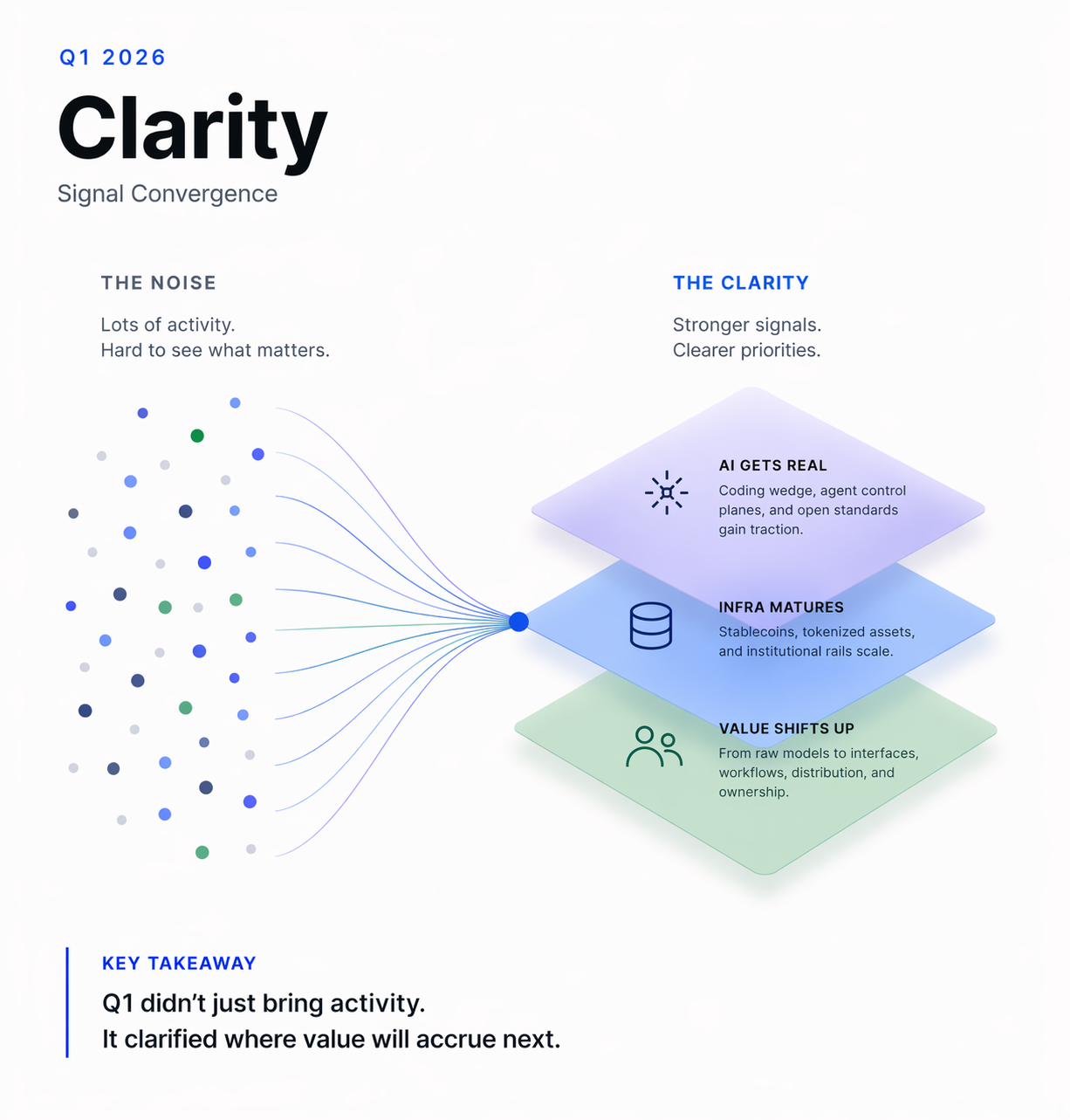
Q1 2026 did not just bring more activity. It further clarified where value is likely to accrue over the next leg of Web3 x AI.
The clearest AI signal was that coding emerged as the first serious wedge for agentic software. Developers sit inside high-context, iterative environments where even partial automation creates immediate value. OpenAI’s Codex app made multi-agent software production more legible by turning coding agents into a real product surface rather than a research concept. Anthropic’s enterprise momentum has been strongly tied to Claude Code. The takeaway is not that the whole agent market is mature. It is that one wedge already has very real product pull.
Q1 2026 also clarified that the control plane around agents is becoming as important as the agents themselves. As more teams build agents, the question shifts from whether an agent can complete a task to how agents are governed, permissioned, evaluated, persisted, and coordinated across environments. OpenClaw made always-on agents feel more concrete in the open-source world. NVIDIA’s NemoClaw responded with a stronger deployment and control layer around that ecosystem. The important signal here is not just that more frameworks exist. It is that the market is starting to care about the runtime layer: state, safety, observability, identity, memory, and execution control.
Standardization matters for the same reason. Anthropic’s donation of MCP to the Linux Foundation’s Agentic AI Foundation made the protocol look less like one company’s interface and more like shared ecosystem plumbing. The Linux Foundation said MCP had already grown to more than 10,000 published MCP servers. When the integration layer stabilizes, developers spend less time rebuilding connectors and more time building differentiated products on top.
Q1 2026 also clarified that raw model capability is becoming less differentiated than product position. The 2026 Stanford AI Index makes clear that open-weight models are increasingly competitive. That does not weaken the case for AI investing. It sharpens it. As raw model capability becomes more available and more comparable, durable value moves higher in the stack toward interfaces, applications, memory, workflow ownership, proprietary context, and distribution.
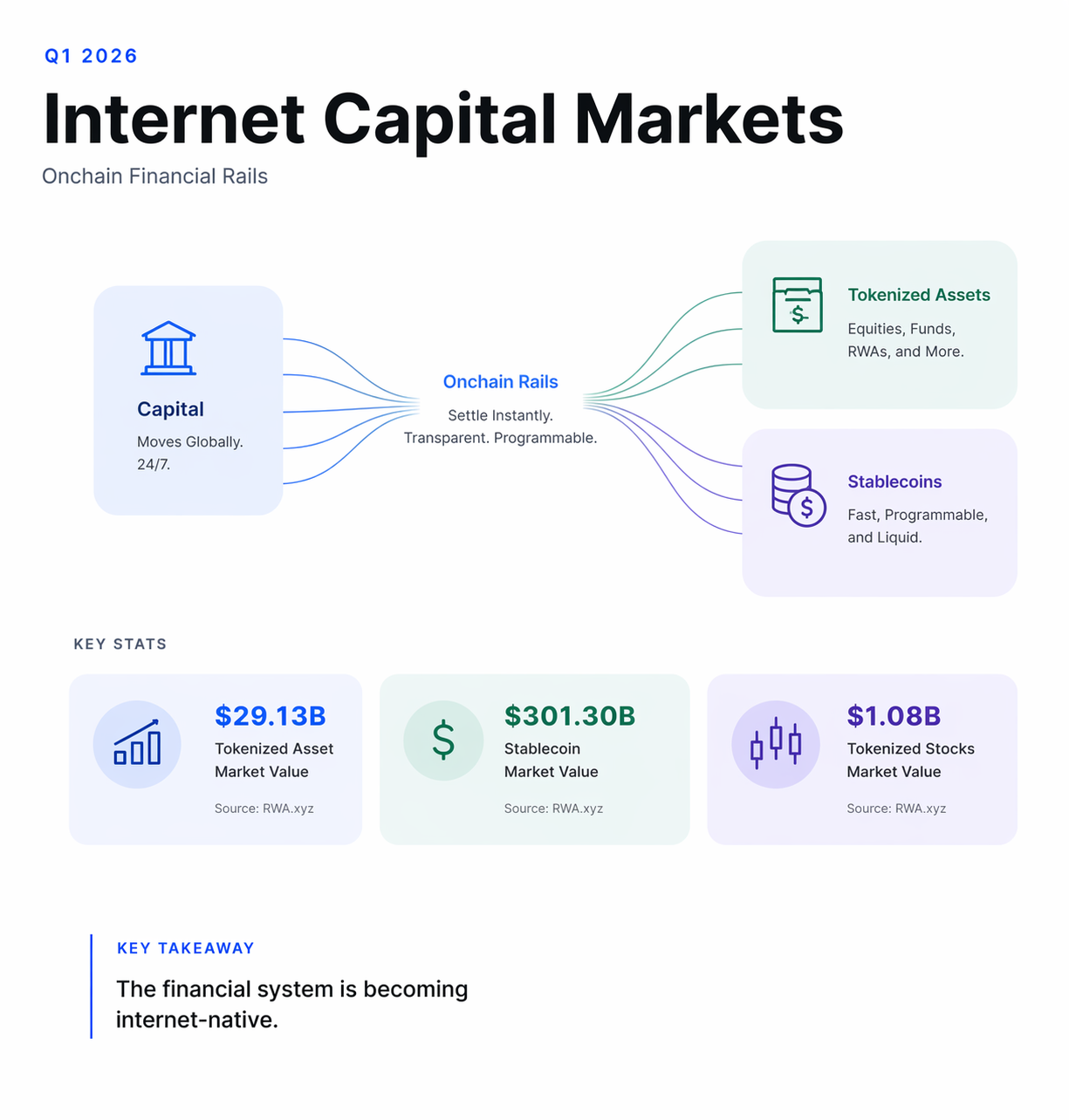
Crypto clarified something equally important, but on a different axis. The strongest crypto signal in Q1 2026 was not a broad return to speculation. It was the continued maturation of internet-native financial infrastructure. RWA.xyz now shows roughly $29.13B in distributed asset value, $301.30B in stablecoin value, and $1.08B in tokenized stocks. NYSE announced a blockchain-based tokenized securities platform. Nasdaq received approval for tokenized securities trading. ICE invested into OKX with tokenized stock ambitions. The relevant insight is not simply that tokenized assets got larger. It is that crypto is becoming easier to underwrite as market structure, settlement infrastructure, and programmable asset rails.
Stablecoins reinforced the same point. BlackRock expanded BUIDL to Solana and Base. JPMorgan and Goldman received OCC approvals for stablecoin issuance and custody pilots. Base and Arbitrum captured 68% of new stablecoin inflows in Q1 2026. Circle expanded USDC native support to eight new L2s. The important point is not just that stablecoin’s market cap increased. It is that stablecoins are increasingly functioning as distribution, settlement, and collateral plumbing for both institutions and software-native systems.
Q1 2026 also clarified that onchain markets are widening beyond crypto-native use cases. Hyperliquid’s HIP-3 markets for equities, indices, and commodities, plus non-crypto volume reaching roughly 45% of platform activity, suggest that onchain markets are evolving into always-on financial infrastructure rather than remaining crypto-only venues. The same goes for prediction markets, where the CFTC swap framing and record growth in volumes point to information finance moving closer to durable market structure. The predictive takeaway is that the strongest crypto products in Q2 2026 are more likely to look like global, API-native market rails than like isolated token products.
This is also where x402 and ERC-8004 matter, as supporting signals. x402 points to the payment rail for machine-native commerce. ERC-8004 points to the identity and trust layer for software agents. They show that the crypto x AI stack is starting to form around payments, identity, and coordination. But they sit on top of the bigger Q1 2026 insight, which is that crypto is becoming more useful first as financial infrastructure, and then increasingly as agent infrastructure.
The broadest read-through is the one that matters most for investing. Q1 2026 tightened the market’s filter. It became easier to spot shallow differentiation and easier to build conviction around products with workflow ownership, distribution leverage, or real financial utility.
AI Interfaces and Agents
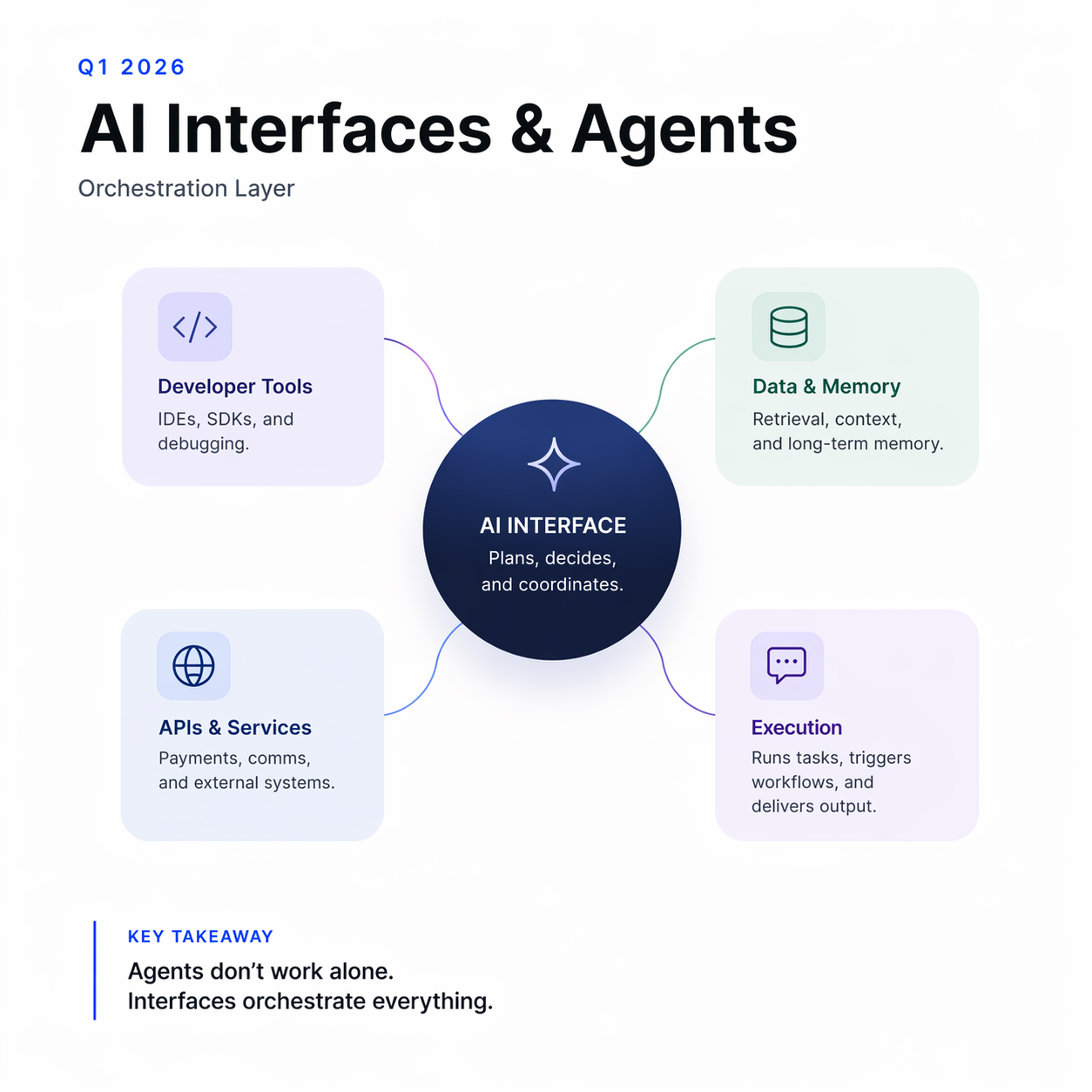
This remains the clearest priority in our thesis because we increasingly see AI Interfaces and Agents as the primary value-capture and orchestration layer for productive intelligence. This is where intent gets translated into coordinated output across humans, agents, tools, memory, and workflows. The interface matters more when the work is no longer answering a question but managing state, preserving preferences, coordinating action, and carrying tasks over time.
What changed in Q1 2026 is that this category became much easier to see as a real product layer. The rapid agentic adoption that occurred across different sectors were not disconnected stories. They are evidence that value is moving from chat toward orchestration.
Where we think value accrues here is in products that own memory, permissions, context, coordination, and trust. We are interested in interfaces that route intent across multiple tools or agents, products that make human-agent collaboration durable, and systems that become harder to leave as they accumulate state and workflow knowledge.
Web3 matters in this category when interfaces need portable identity, user-owned memory, verifiable permissions, or economic coordination across agents, teams, and marketplaces. Not every interface needs crypto. The ones that do tend to be the ones coordinating across open systems rather than closed software surfaces.
AI Applications and Services
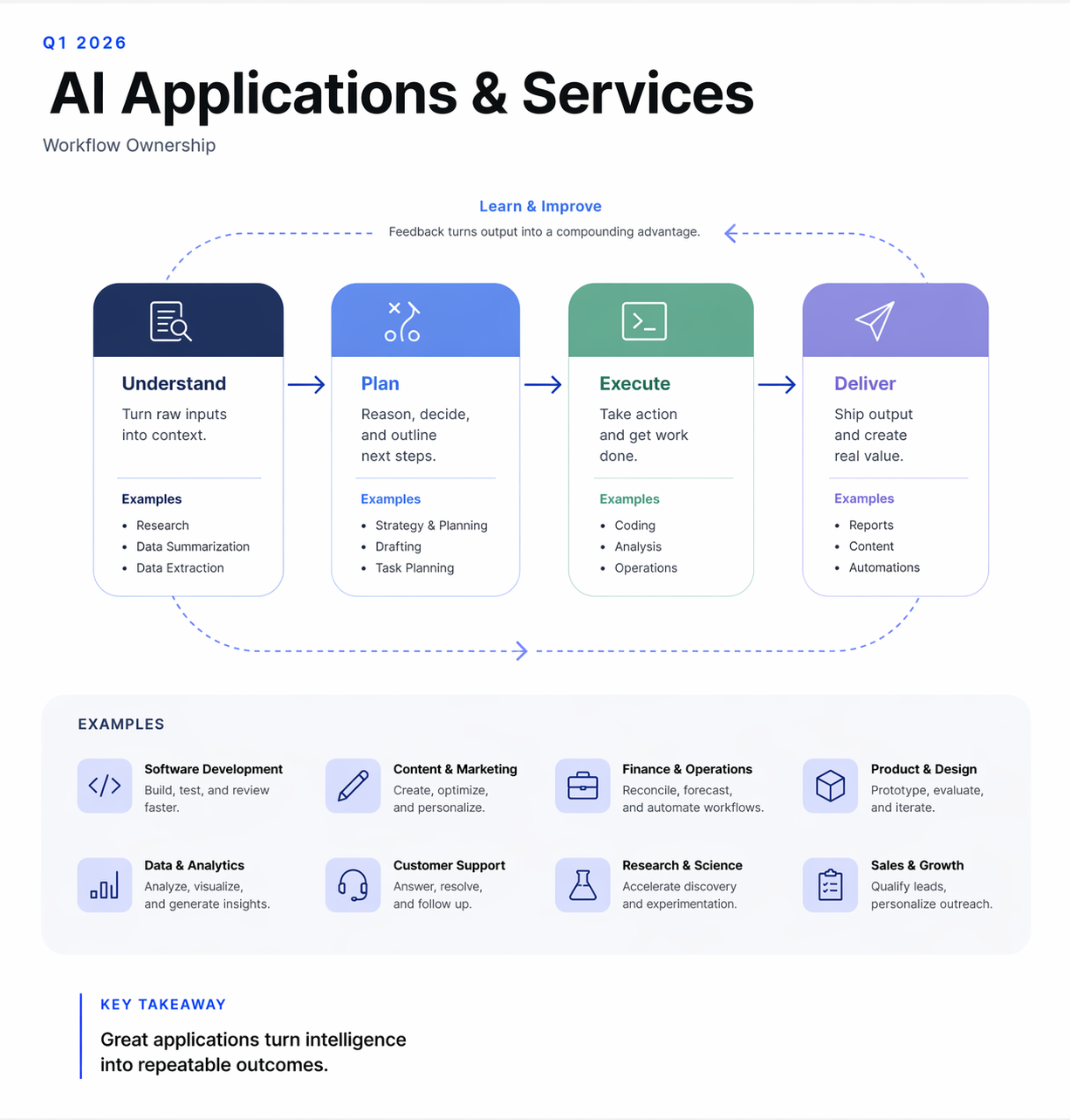
AI Applications and Services are where capability becomes domain execution. This category matters because it is where expertise, workflow design, and proprietary context turn general-purpose intelligence into specific outcomes. As raw model access broadens, durable product value increasingly lives in the layer that owns the user problem rather than the layer that merely exposes a model.
Q1 2026 reinforced that direction. As models got more competitive and open-weight systems kept improving, it became harder to defend the idea that most startups should be valued on raw model adjacency alone. That does not make applications less interesting. It makes them more important. The strongest products are more likely to be the ones that own the vertical workflow, the user relationship, the domain context, and the feedback loop that improves the product over time.
Where we think value accrues here is in products with a real workflow wedge, measurable repetition, and proprietary context accumulation. That includes vertical AI systems, workflow software, creator tools, domain-specific operating systems, and products where the user experience compounds with memory, usage, and integration depth.
Web3 matters here when ownership, provenance, creator economics, or user-aligned value capture strengthen the product. The product still has to carry the weight first. That remains central to how we underwrite this category.
Internet Capital Markets
Internet Capital Markets remain one of our highest-conviction areas. We define this category broadly: internet-native financial rails for payments, settlement, asset issuance, collateral movement, lending, trading, and programmable capital formation.
Q1 2026 gave this category some of the strongest institutional validation in the market. Tokenized stocks crossing a threshold, Nasdaq receiving approval for tokenized securities trading and settlement, and NYSE partnering with Securitize all point in the same direction. The next phase of crypto’s relevance increasingly looks like financial market plumbing rather than token issuance in search of a use case.
Stablecoins matter just as much. They are increasingly functioning as settlement infrastructure for tokenized assets, cross-border capital movement, collateral efficiency, and programmatic financial systems. As more assets move onchain and more financial operations become software-native, stablecoins become more central to how value moves through the stack.
Where we think value accrues here is in the rails rather than the wrappers: issuance infrastructure, settlement layers, treasury tooling, compliance systems, agent-native payments, and products that let software participate in markets more efficiently. The more finance becomes machine-readable, API-native, and always-on, the more natural it becomes for AI agents, automated treasury systems, autonomous compliance tooling, and software-native market participants.
That is why we care especially about AI-enhanced financial rails and agent-native primitives rather than treating Internet Capital Markets as a generic crypto sector.
AI Networks, Platforms, and Marketplaces
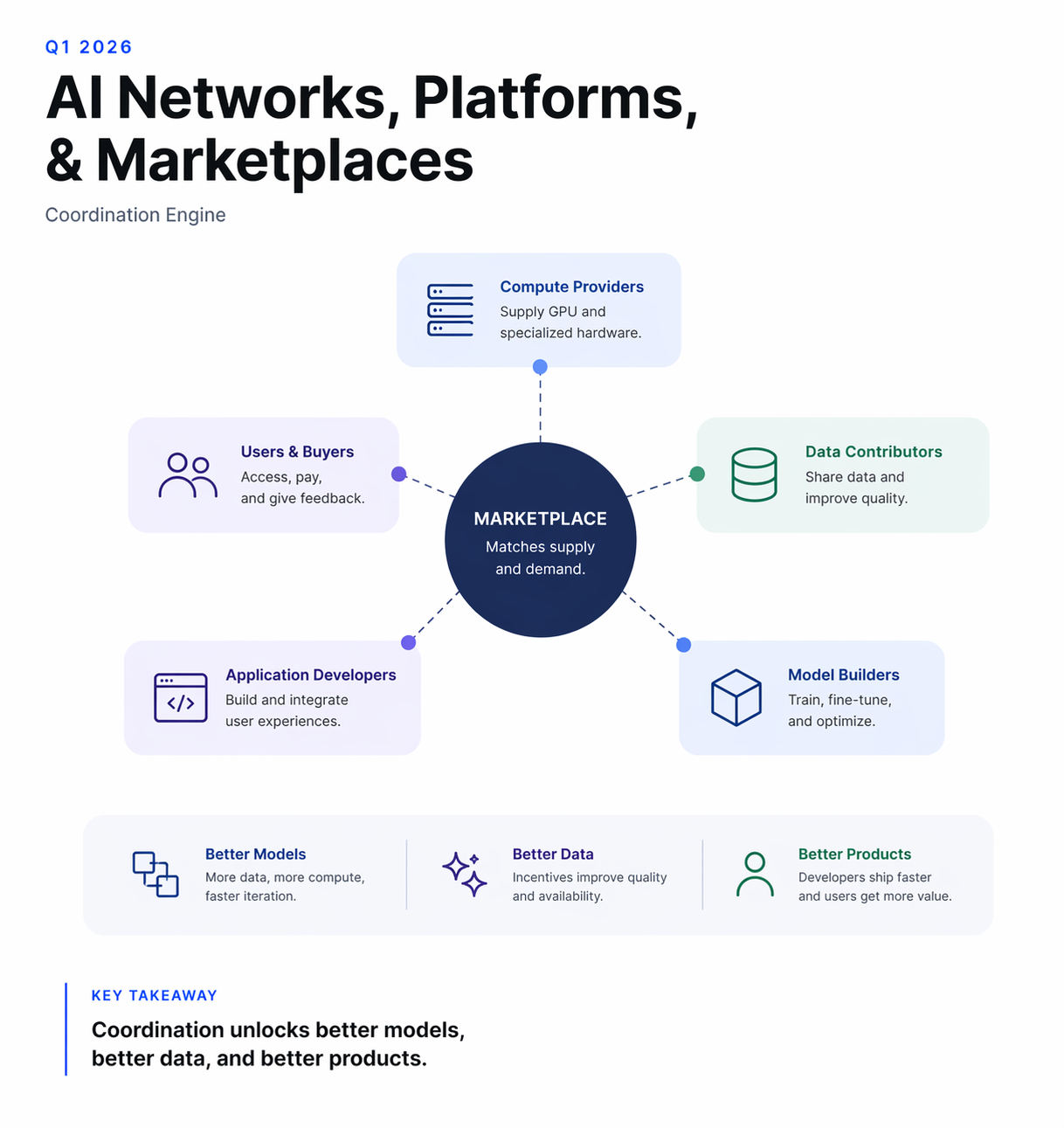
AI Networks, Platforms, and Marketplaces are increasingly about coordination. AI systems need compute, inference, data, skills, reputation, and workflows. The infrastructure that helps them discover, price, evaluate, and procure those resources efficiently becomes more valuable as the ecosystem expands.
Q1 2026 strengthened this category from two directions. The first was standards. The second was scale. The market’s capital intensity, broader AI adoption, and rising demand for orchestrated agent workflows all pointed in the same direction: more need for open, programmable coordination layers that help software systems access resources and capabilities across environments.
Where we think value accrues here is in pricing, discovery, trust, performance data, and reputation. We are especially interested in markets and platforms where participation generates proprietary operating data and where that data can compound into a flywheel.
Crypto matters most here when they are integral to coordination. If a token helps price resources, reward contribution, carry reputation, or enable permissionless participation, it can strengthen the system. If it sits off to the side as a monetization afterthought, the edge gets much thinner.
Physical AI
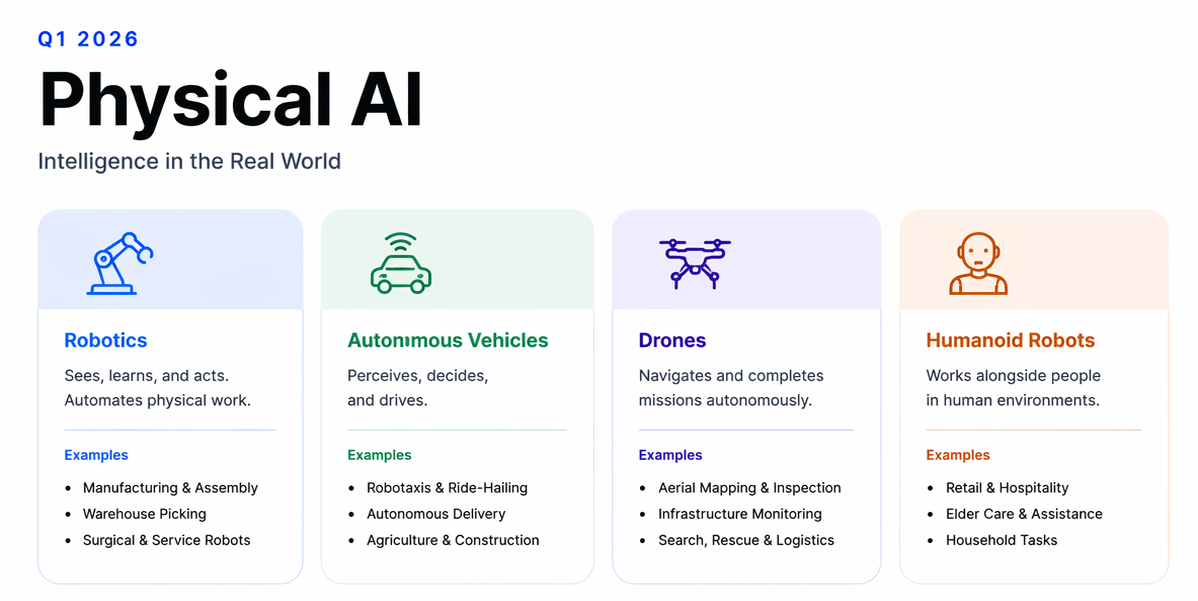
Physical AI moved further from research only narratives toward deployment in Q1 2026. GTC 2026 centered agentic AI, inference, and physical AI. There is a turning point where robots, vehicles, and factories are moving from isolated deployments into broader real-world systems. That matters because the category’s distance to deployment is shrinking.
Where we think value accrues here is in systems that coordinate machines, data, energy, and capital more effectively than legacy industrial software or siloed robotics stacks. We care about machine coordination layers, fleet systems, machine identity, shared data systems, simulation-to-reality workflows, and machine-to-machine commerce.
Web3 matters when it helps coordinate distributed resource contribution, machine identity, machine-to-machine value exchange, and shared machine economies. This remains one of the more underappreciated intersections in the thesis because it requires understanding both deployment reality and coordination design.
Consumer AI
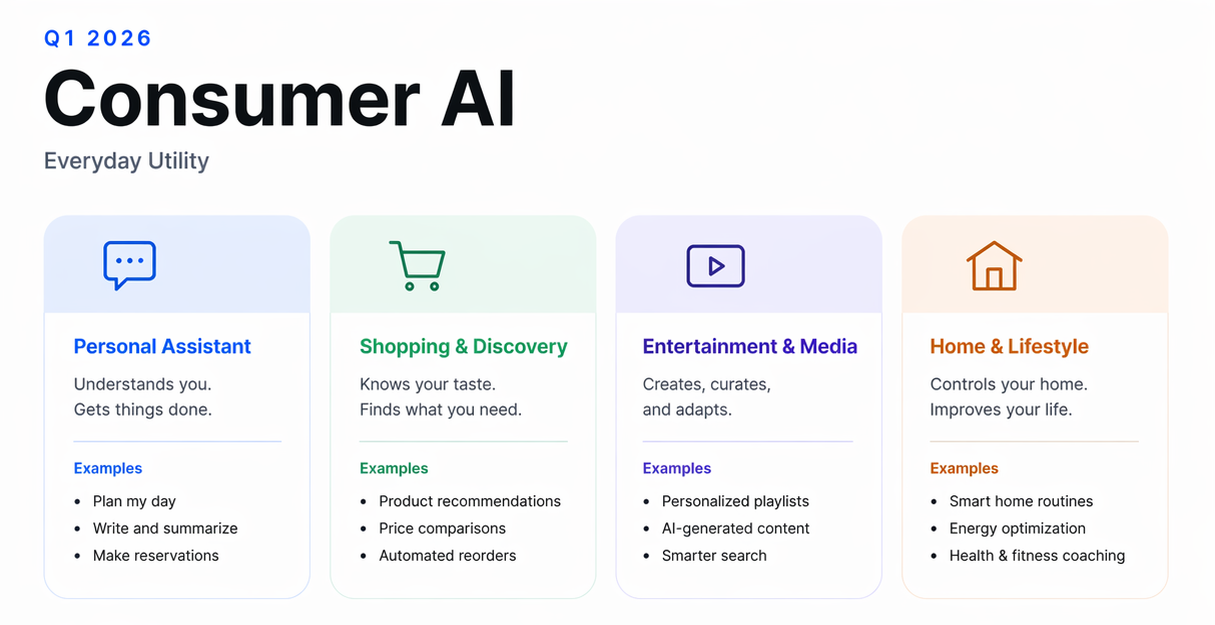
Consumer AI wins through attention, relationship, personalization, and memory. The strongest products in this category are likely to build switching costs, creator or character-based engagement, and user identity over time.
As models improve and distribution expands, the strongest consumer AI products will be the ones that turn capability into habit and memory into loyalty.
Where we think value accrues here is in products that own attention, emotional context, creator relationships, and memory over time. Crypto fits best when it is structurally useful but mostly invisible: ownership, portability, creator monetization, and aligned user economics can matter a lot, but the product still has to be compelling first.
What ties the six sectors together
These six sectors are connected by more than AI and crypto as broad themes. They are connected by a shared pattern: usage compounds, ownership matters, and economic coordination creates defensibility.
That is why Web3 shows up unevenly across our thesis. In some categories it is foundational, especially around financial rails, incentives, identity, marketplaces, and coordination. In others it is optional or invisible. We are comfortable with that. Selectivity is a strength.
This also reflects how we invest. We are not publishing a one-off market opinion and moving on. We are regularly updating our priors through internal outlooks. That is part of how we do fundamental early-stage venture investing.
How we are underwriting the future
Our underwriting remains grounded in Product Market Fit, Narrative, and Execution. We combine that with a product-first view of what is actually compounding in the market and with a strong preference for signals over narrative drift.
We also care deeply about network effects and the longer arc of what we call the Double Unicorn: products and protocols that can build both equity value and token value over time. That opportunity matters most after the product, adoption curve, and market structure make sense first. The pace of development we have seen so far in 2026 only made that sequencing more important.
This is also where our view of capital matters. We do not want to be passive capital in these markets. We want to be enhancement capital. That means product depth, AI-native operating leverage, and speed brought into the relationship early.
One direction we are actively thinking about internally is an AI Run Time layer: context adaptive, predictive data integrated, and human RL with execution. The point is not to automate judgment away. The point is to run the thesis more consistently, update faster, and keep certain processes focused on augmentation and non-consensus insight.
A call to builders
We are actively looking to meet founders building in AI Interfaces and Agents, AI Applications and Services, Internet Capital Markets, AI Networks, Platforms, and Marketplaces, Physical AI, and Consumer AI.
We are actively deploying $1 million to $2 million checks and are ready to lead or co-lead rounds.
We also build inside the market we invest in. We have built 220+ AI agents and 30+ AI applications to augment our five-person team, and that operating posture shapes how we evaluate what is real, what is useful, and what can compound.
Q2 2026 looks like a quarter that will reward teams that convert technical possibility into adoption, monetization, and durable market position. That is where we are focused.
The content of this material is strictly for informational and educational purposes only. It is not intended to constitute investment advice, nor should it be considered a recommendation or a solicitation to buy, sell, or hold any asset. Decasonic does not endorse investments in any specific tokens, and nothing in these blog posts should be construed as legal, tax, or financial advice. Please consult with a qualified professional advisor before making any financial decisions. Decasonic provides no warranties, whether expressed or implied, on the content provided in these blog posts, including its accuracy, completeness, or correctness. The opinions expressed here are those of the authors and do not necessarily reflect the views of Decasonic. Please note that Decasonic may hold a position in some of the tokens mentioned, including Virtuals. Decasonic is not liable for any errors or omissions in the content of this material or for any actions taken based on the information provided herein.