

in this piece
all perspectivesWe are bullish on Robinhood Chain.
It is not the largest chain, and some of the activity from its first two months will likely taper. Our conviction rests on something else. Robinhood is showing what crypto adoption looks like when distribution comes first and the assets users already understand move onchain.
For most of the last decade, growing a chain followed a repetitive playbook: launch a network, fund incentives, recruit developers with grants, subsidize liquidity and compete for the same crypto-native users moving between ecosystems. Most chains never got much further than that, and the ones that did generally took years.
Robinhood has followed a different path. It went live on July 1 with no token and no airdrop. Nine weeks later, it is processing roughly 12 million transactions a day, has more than $800 million of DeFi TVL, nearly $1 billion of stablecoins and, on September 3, generated more fees than any other chain. The reason is relatively straightforward: Robinhood already had distribution.
Tokenized equities were the wedge
Robinhood launched the chain around tokenized real-world assets. At launch, 95 stock and ETF tokens were available to eligible users in more than 120 countries with 24/7 trading. Stock Tokens are debt securities issued through a Jersey entity (which has stirred up some drama), giving holders economic exposure without the shareholder rights of the underlying security, and they are unavailable to US users.
The distribution infrastructure was already in place. Robinhood had 28.4 million funded customers, native Wallet support, subsidized gas, Bitstamp and WonderFi distribution, and Paxos infrastructure behind USDG. In June, the chain had fewer than 1,500 daily users. By July 21, daily active accounts had reached more than 320,000 and passed Base.
Those users arrived and traded memecoins.
More than 80% of early DEX activity came from memecoin speculation, compared with roughly 4% from tokenized assets by mid-July. CASHCAT became the clearest example: an unofficial community token that at one point had a larger market cap than the combined value of every tokenized RWA on the chain. Token issuance reached 16,000-18,600 launches per day during July and later hit a record 22,600 on August 30.
We view that as the bootstrap rather than a failure of the tokenization thesis.
Speculation brought users, capital and liquidity onto the chain first. The important question was whether that activity could eventually make Robinhood's differentiated assets more useful.
That is what started happening next.
Someone changed the quote asset
In mid-July, projects like Bankr and LONG began letting users launch tokens against Robinhood Stock Tokens. Instead of pairing a new token against ETH or a stablecoin, users could pair it against tokenized NVDA.
That market-structure change matters. Every trade in one of those pools creates volume in the stock token sitting on the other side. Speculative liquidity began bootstrapping liquidity for tokenized equities, giving those assets depth they would have struggled to generate on their own.
Pools formed around Nvidia, Tesla, Intel, Roblox and other equities. Artificial Inu ($AI) against NVDA went from roughly $1.5 million on August 1 to a peak of $135 million by August 30. By late July, Robinhood Chain had passed Solana in tokenized-stock trading volume, and by late August combined Stock Token volume had crossed $1 billion.
Robinhood did not design that use case. We think that is part of what makes the chain compelling. Robinhood created an asset primitive and a permissionless environment around it, and developers figured out how to make those assets useful in ways the original roadmap did not anticipate.
The next shift is even more important for the bull case. The tokenized equities started generating activity without relying on the memes. Standalone Stock Token trades grew to 78% of RWA volume in August after memecoin pairs had represented more than half in July. What began as speculation started turning into a standalone market.
The financial stack is starting to form
Robinhood Chain is starting to look like a full onchain financial ecosystem.
More than 190 Stock Tokens are live with over $3 billion of cumulative volume. Holder count increased 3.8x over 30 days to roughly 230,000. RWA market capitalization on the chain now stands at $219.49 million on DefiLlama, against roughly $12.8 million in mid-July on Decrypt's earlier count. Memecoins paired against stocks were still doing $217 million of daily volume on September 1, while standalone tokenized equities were doing another $127 million. Both markets are growing rapidly.
At the same time, lending and derivatives are beginning to form around that liquidity. Morpho holds roughly $487 million, Ethena $323 million, Uniswap $248 million and Maple $94 million. Stablecoin supply is approaching $1 billion with USDG holding the largest share and Ethena's USDe growing quickly behind it, which tells us users are looking for yield rather than a settlement asset. Lighter is integrated directly into Robinhood Wallet and has grown from roughly $13.5 million of daily volume in late July to more than $400 million.
There is also a meaningful amount of automated activity already happening underneath the consumer experience. The chain processes roughly 650,000 bundled ERC-4337 operations per day. Arbitrage routers generate enough flow to materially move chain fees, and they are what holds tokenized NVDA within roughly 0.7% of the underlying equity. Those traders are paying about 0.65% of trade value in gas to do it, which tells us the mispricings they are closing are wider than that.
This progression is central to our view: assets bring users, speculation creates liquidity, liquidity enables credit and derivatives, and automation eventually sits on top.
If that continues, Robinhood Chain becomes much more valuable than a venue for trading tokenized shares.
Are the users actually staying?
The obvious pushback is that addresses are not users, memecoin activity inflates wallet counts and incentives inflate activity. We agree, which is why retention is more useful than headline account numbers.
Since mid-July, roughly 24-34% of active addresses in a given week were also active the week before. In the week of August 31, 349,466 of 1.07 million active addresses had transacted the prior week.
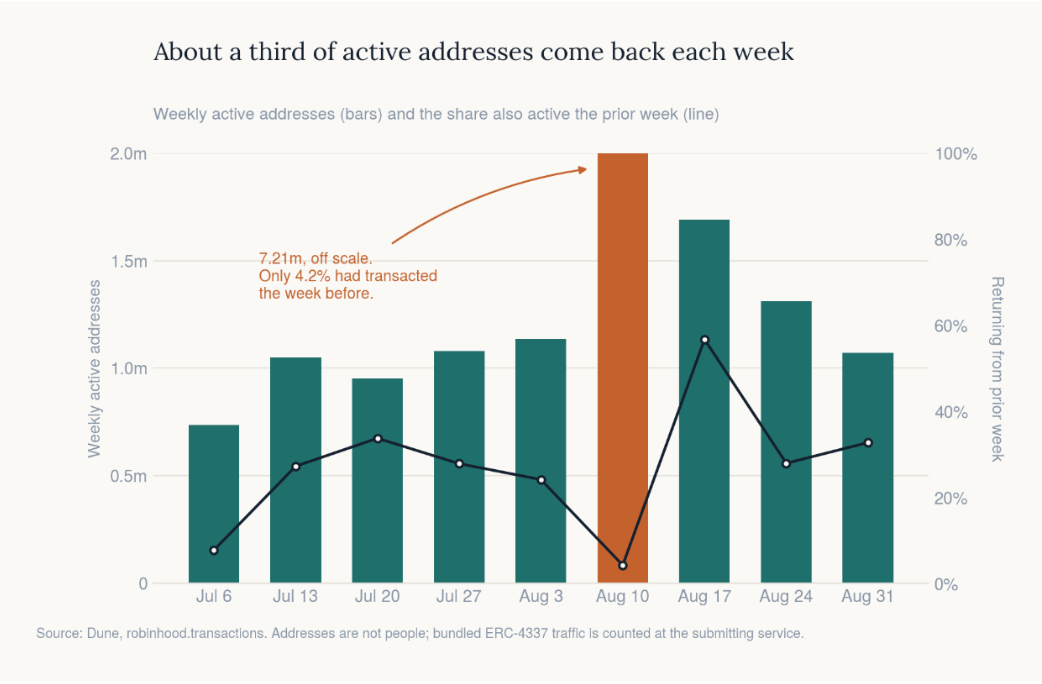
There was one obvious farming spike in mid-August, when weekly addresses jumped more than 500% and almost all of those new addresses disappeared immediately afterward. Only 4.2% of that week's addresses had been active before it. Strip that week out and weekly activity has held around one million addresses since late July, with roughly one-third returning week to week.
That is not perfect retention, and addresses are still not people. But it is meaningfully different from an ecosystem where activity disappears as soon as an incentive ends. There appears to be a recurring base of users beneath the speculative layer.
Why the agent angle matters
Robinhood itself describes the chain as AI-native. Most claims like that are easy to dismiss as marketing, but there is something more concrete happening here because a meaningful share of economic activity is already automated.
On September 3, the two largest fee payers were an arbitrage router at 24.3% of all chain fees and an order-settlement contract at 15.5%. Together they accounted for nearly 40% of everything the chain collected that day. The professional version of agentic finance is already operating on the network. What is missing is the consumer version.
Tokenized equities are particularly interesting in that context because software can interact with them much more easily than with traditional securities. An autonomous agent cannot independently open a brokerage account, complete KYC, establish custody and wait for market hours. It can hold an ERC-20 in a wallet, price it through an oracle, trade it 24/7 and eventually post it as collateral.
Robinhood already has nearly 100,000 accounts using Agentic Trading with more than $100 million in assets, but that product remains separate from the chain. Connecting the two creates a much more interesting product surface: agents managing actual financial portfolios rather than simply making machine-to-machine payments.
We do not think Robinhood Chain is necessarily the default network for agent micropayments. Typical transaction costs have moved toward roughly $0.20, with swaps closer to $0.48. Those economics are difficult when an agent is paying $0.30 for an API call, but they matter far less when that same agent is managing a $5,000 position. The opportunity we find more compelling is agents managing financial assets.
The next unlock is collateral
Stock Tokens today are still primarily traded assets. The next stage is making them productive.
There are roughly $113 million of tokenized equities sitting in protocol TVL, while Morpho alone has close to $500 million of deposits that are still overwhelmingly stablecoin based. NVDA, GOOG and AAPL have started appearing as collateral in limited markets, but the opportunity is much larger if that expands across the broader Stock Token universe.
The blocker is specific. Traditional equity markets close while onchain markets remain open, creating gap risk and periods where the underlying security is not actively price-discovered. Wider weekend haircuts, lower LTVs and more conservative liquidation logic can address much of that risk.
If those markets develop, Robinhood moves from having 190 assets people can trade to 190 assets people can borrow against. That opens up leveraged equity exposure, structured products, cross-asset collateral and agent-managed portfolios. We think this is one of the most important product unlocks ahead.
Tokenization matters most where existing markets are weak
Public equities already have excellent distribution. Private assets do not.
SPCX already has more than 70,000 holders despite there being no public equity market for the underlying company. That is tokenization creating a market that did not previously exist, which is a higher bar than putting a brokerage account onchain. The same argument applies to private equity, private credit, commodities and other assets where liquidity and distribution remain fragmented.
That is why we think Robinhood's opportunity ultimately becomes as much about issuance as trading. Once the distribution layer exists, assets that previously had weak or nonexistent secondary markets become much more interesting candidates to bring onchain.
Continuous pricing becomes its own market
There is another second-order effect worth watching. Tokenized equities trade when traditional markets are closed, which creates price discovery during periods when the underlying security technically has no active market.
We have already seen thin Stock Token floats move materially away from the underlying during weekends and then converge when more supply becomes available. Today that gets treated largely as a defect. Over time it can become a product: weekend basis trades, derivatives referencing off-hours prices and structured products built around continuous equity markets.
Memecoins quoted against equities were the accidental first version of this. Commodities, treasuries, ETFs and private equities are already appearing onchain in small size, and the same market structure can extend to all of them.
The ecosystem is forming around the liquidity
The application layer is also beginning to separate into real businesses.
Pons has become the dominant native launchpad, claiming more than $4.5 billion of platform volume and $25 million of creator earnings by September 1. Uniswap handles the majority of DEX activity, and Robinhood Chain had already become Uniswap's second-largest venue by spot activity behind Ethereum mainnet by late July. Morpho, Steakhouse and Ethena make up much of the credit and yield stack.
The next group is more interesting from an underwriting perspective. Rialto provides direct Stock Token liquidity through a propAMM model, while Arcus, built by the dYdX team, is adding leveraged equity and RWA markets. Ramses is experimenting with a zero-emissions liquidity model where the majority of fees flow directly to LPs, and Fomo acquired Mobula's technology and part of its team for a reported $17 million to own its indexing, pricing, security and routing stack.
That acquisition is notable because the first meaningful M&A transaction in the ecosystem was for data infrastructure. Pricing, metadata, routing and security are exactly the inputs automated financial systems need if they are going to trade without being picked off. We think that is a useful signal for where the next infrastructure opportunities may emerge.
What can still break the trajectory
We are bullish, but there are three clear tests in front of the chain.
The first is reliability. On September 4, block production stopped for roughly 13-14 minutes. Robinhood operates the only sequencer today, and the network remains below Stage 0 under L2BEAT's framework. That is a meaningful risk for a network trying to become financial infrastructure.
The second is regulatory structure. AMC's CEO has publicly challenged Robinhood's tokenized exposure to AMC shares, while OpenAI made a similar objection previously in July. The broader question of how issuers interact with third-party tokenization structures is not settled.
The third, and most measurable near-term test, is the subsidy cliff. Robinhood's gas subsidy ends September 29, and almost every adoption number above was produced while qualifying users were not paying the full cost of gas themselves. We expect some activity to fall. The more important question is what remains. If low-quality launch activity disappears while TVL, Stock Token volume, lending and repeat users hold, that would strengthen the bull case. If everything falls together, then a larger share of the current activity was subsidized than we think.
This is bigger than Robinhood
Robinhood is not the only company moving in this direction. Coinbase has launched tokenized US equities on Base. Nasdaq, LSEG, Kraken/Payward and others are pursuing different forms of tokenized securities and 24/7 markets. Tokenized-equity transfer volume reached $29.5 billion in the 30 days ending August 29, while holder count across chains grew from roughly one million to 2.6 million during August.
The broader shift is that users increasingly do not need to be recruited into crypto by convincing them to buy crypto-native assets. Assets they already understand are moving onto crypto rails, distributed by companies that already own the customer relationship.
That changes the adoption path. A user can show up to trade Nvidia, gain exposure to a private company, participate in a prediction market or earn yield and end up using blockchain infrastructure without ever making an ideological decision to "become a crypto user."
We believe Robinhood is one of the clearest examples of that shift happening in real time, and we think its existing distribution gives it a structural advantage as the market develops.
What we take from it
The first takeaway is that distribution compresses the timeline. Robinhood reached meaningful scale in weeks because it already owned the customer relationship. When we look at chains, wallets and tokenization infrastructure, distribution should be part of the underwriting from day one. A team with embedded distribution is fundamentally different from one that has to acquire every user from scratch.
The second is that composability mattered more than the original roadmap. The early use case that drove the network came from developers. They took Robinhood's Stock Tokens and paired speculative assets against them, something Robinhood had not planned. That reinforces our preference for primitives and rails that other people can build around rather than trying to predict the exact winning application.
The third is that we need to be careful about what we call adoption. Transactions and active addresses are easy numbers to inflate. TVL, repeat usage, asset holders, fee generation and capital moving into new financial products tell us much more. The same applies to liquid tokens: if a token rerates because Robinhood Chain fees spike, we need to understand how much of that revenue survives normalized gas rather than underwriting the latest print.
September 29 gives us the first clean test. Robinhood's Q3 results in late October give us another.
Our view is that the more important progression is already underway: distribution brought users, speculation created liquidity, and that liquidity is beginning to turn into financial infrastructure.
If that continues, we believe Robinhood Chain can become one of the most important venues for tokenized financial assets and one of the strongest examples yet of how mainstream users actually move onchain.
The content of this material is strictly for informational and educational purposes only. It is not intended to constitute investment advice, nor should it be considered a recommendation or a solicitation to buy, sell, or hold any asset. Decasonic does not endorse investments in any specific tokens, and nothing in these blog posts should be construed as legal, tax, or financial advice. Please consult with a qualified professional advisor before making any financial decisions. Decasonic provides no warranties, whether expressed or implied, on the content provided in these blog posts, including its accuracy, completeness, or correctness. The opinions expressed here are those of the authors and do not necessarily reflect the views of Decasonic. Please note that Decasonic may hold a position in some of the tokens mentioned, including Virtuals. Decasonic is not liable for any errors or omissions in the content of this material or for any actions taken based on the information provided herein.