


in this piece
all perspectivesAI’s introduction into firms is fundamentally reshaping how work gets done, how firms are built, and how individuals create value. There is increasing consensus on the need to use, integrate, and build with AI. However, there is often less clarity on what actually changes when AI evolves from a tool into something more capable, adaptive, and increasingly autonomous. Much of the current discourse focuses on marginal productivity improvements, cost-efficiencies through AI roll-out, and incremental efficiencies. We at Decasonic believe that the more important shift is a structural one.
This shift changes how decisions are made, how organizations operate, and how advantage compounds over time.
We view the transformation as being represented in three re-inforcing themes:
Theme 1: AI is moving from tools to teammates
Theme 2: Firms are evolving from partnerships into systems
Theme 3: Individuals are transitioning from learning to building
These changes are interconnected and mutually reinforcing, along an exponential change from AI technologies. Together, they will define the next decade of company building, capital formation, and value creation.
To understand why this moment matters, and why it is happening now, it is helpful to consider where we are in the broader market cycle.
Today’s Cycle: From Filtration to Dispersion
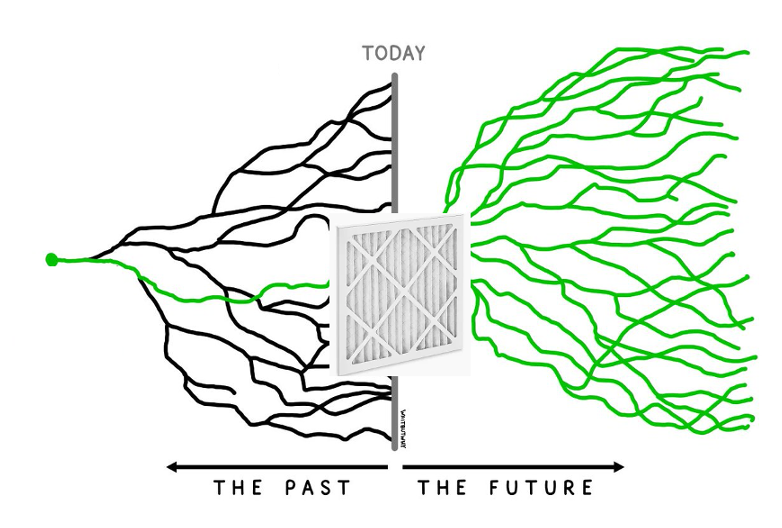
Technological waves tend to follow a recognizable pattern. In the early stages, capabilities are concentrated. A small number of organizations with access to talent, capital, and infrastructure drive progress. This is the filtration phase, where the underlying technology is refined and its potential becomes clearer.
Over time, these capabilities mature and begin to diffuse. Infrastructure becomes more accessible. Tools become easier to use. Knowledge spreads more broadly. This marks the transition into the dispersion phase. We are now entering that phase with AI.
Capabilities that were once limited to frontier labs are now available to founders, operators, and builders globally. Intelligence is increasingly commoditized, which narrows the speed to development and iteration. The constraint is shifting from access to the most powerful AI models and tools to the ability to apply AI effectively internally.
This is not only technological, but economical and structural.
The dispersion of AI is enabling the emergence of capital-efficient, nimble firms composed of humans and AI teams. These firms scale not through headcount, but through systems. They operate with smaller teams (with an increasing ratio of agents to humans), move faster, and adapt more fluidly to changing conditions. We are already seeing early signals of this shift. In our own work, workflows that previously required days of research and coordination can now be executed in minutes through coordinated AI systems. Market mapping, investment diligence, and portfolio support are now orchestrated systems, with the role of a Decasonic human team member increasingly shifting to an orchestrator of those systems.
This will transform the future of work, the structure of companies, and how startups are built.
AI Teammates: From Tools to Augmentation
For decades, software functioned as a tool. It required direct input, executed predefined commands, and remained reactive. Human operators were responsible for initiating and managing each step of the process. That model is changing.
AI systems are now capable of orchestrating software, through reasoning, providing output, and iterating towards outcome-oriented outputs. Instead of executing instructions, they pro-actively interpret intent. Instead of supporting work, they increasingly participate in it and provide the foundation of work, anchored by existing firm-wide workflows. For firms looking to effectively leverage AI, this represents a shift from viewing AI in the lens of automation to augmentation.
Automation replaces tasks. Augmentation expands human capability. It increases the number of decisions that can be made, the range of opportunities that can be explored, and the speed at which work can be executed. Automation improves efficiency. Augmentation impacts performance.
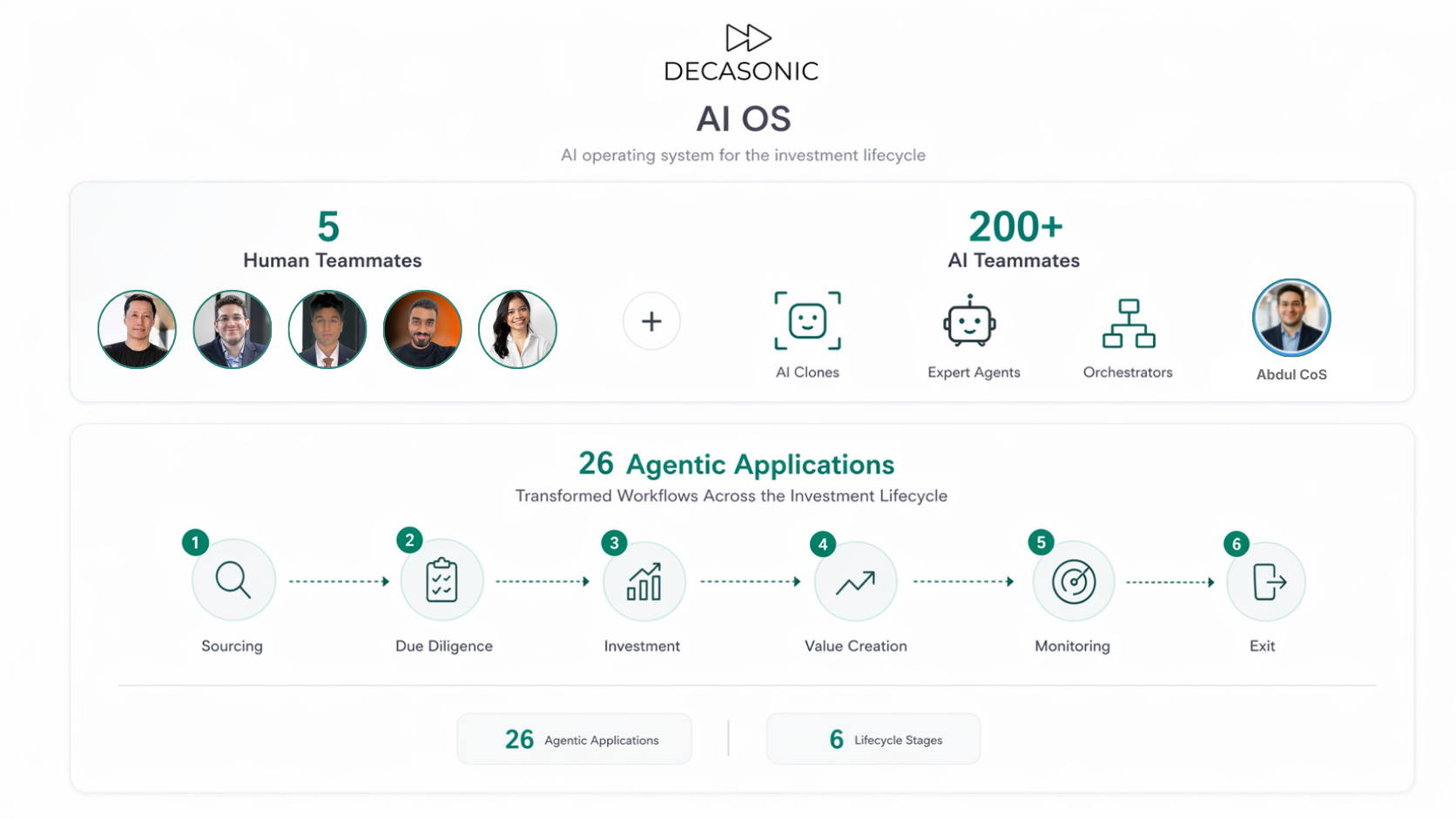
This shift becomes tangible when implemented at scale. At Decasonic, we operate with five human teammates working alongside more than 220+ AI teammates - including AI clones, expert agents, orchestrators, and chief-of-staff agents. Across the investment lifecycle, we have transformed twenty-six workflows into agentic applications spanning six stages. These systems are integrated through an AI Operating System that connects more than fifteen internal systems into a unified orchestration interface for intelligence. Through the AI Engines Portal, we extend these capabilities to portfolio companies, orchestrating more than one hundred agents across multiple organizations.
The shift introduced by the effective integration of AI systems results in the defining question being how effectively a firm collaborates with AI teammates.
The Modern Firm: From Partnerships to Systems
If AI teammates exist, the structure of the firm must evolve.
Traditional organizations are built around people. Talent, time, and attention act as limiting factors. Scaling typically requires adding headcount, and institutional knowledge often remains fragmented.
The modern firm is increasingly becoming a system.
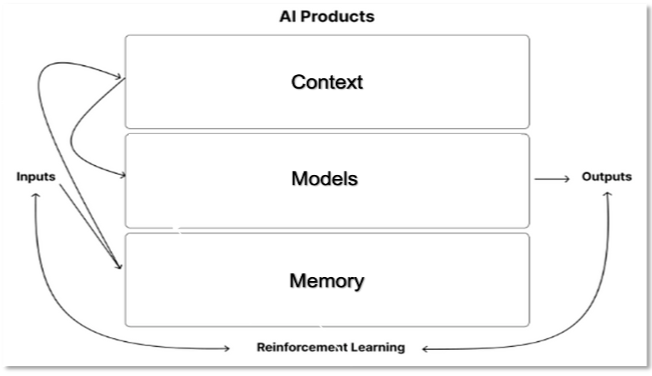
At Decasonic, we have taken a product-first approach to venture capital. Rather than simply investing in AI, we build AI systems ourselves, operating at the frontier of what is possible. Our firm has been transformed into an operating system that integrates context, models, and memory through continuous feedback loops. This system is designed to learn, adapt, and improve over time.
In this model, workflows are orchestrated by a team of humans and AI. Decisions are informed by continuously updated context. Knowledge compounds organization-wide vs being siloed to individuals. Output scales without proportional increases in headcount. Advantage comes not from individual effort alone, but from systems design.
This transformation is also reshaping how startups are built. Founders can now design companies that are natively integrated with AI from the outset. AI teammates can support research, product development, customer engagement, and operations. Early-stage teams can remain small while achieving meaningful output. Capital can be deployed more efficiently, and iteration cycles are significantly compressed.
The result is a new generation of startups that are leaner, faster, and increasingly more adaptive.
Our Journey: From Using AI to Building AI Systems
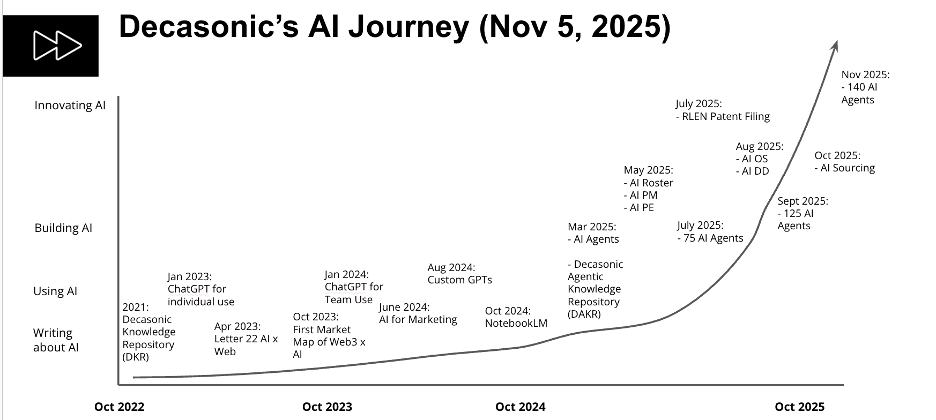
This transformation did not happen overnight. Our journey reflects a broader progression that many organizations will follow.
We began by writing about AI and experimenting with early tools. Initially it was individual-based AI experimentation and development. Over time, we moved to using AI across individual workflows, with a focus on enabling human-AI collaboration across the entirety of Decasonic’s functions. This evolved into building custom systems and agentic applications. Today, we operate as an AI-native firm, with coordinated systems of intelligence across our workflows.
We believe what appears novel today will become standard. What appears complex will become infrastructure, primarily accelerated by the rapid commoditization of intelligence.
Investment Alpha and Enhancement Capital
This system-driven approach is central to how we generate value.
Our AI Operating System enhances sourcing precision, deepens diligence, and accelerates decision-making. It allows us to identify patterns across markets and act with greater speed and conviction. This is how we generate investment alpha in an AI-native context.
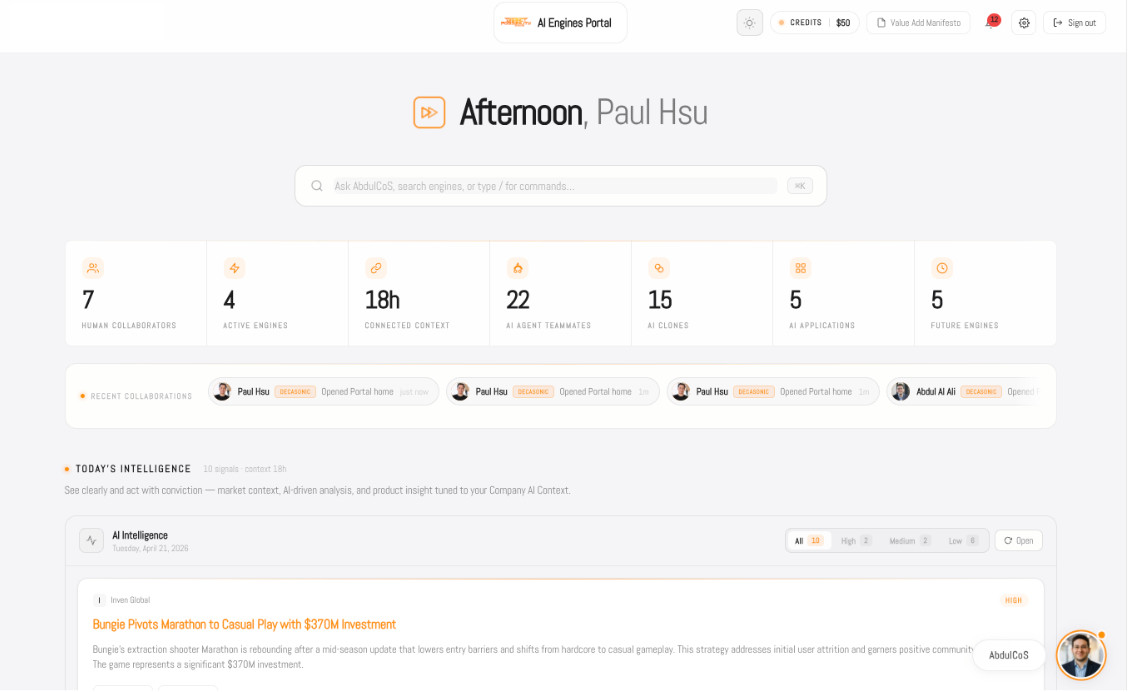
At the same time, through our AI Engines Portal, we extend these capabilities to the companies we back. This is what we refer to as enhancement capital. It is not simply capital allocation. It is system deployment, workflow acceleration, and intelligence amplification. We help founders build and operate as AI-native companies from the outset.
Why Builders Win: From Learning to Building
These changes at the level of work and firms have direct implications for individuals.
The source of advantage is shifting away from knowledge accumulation and toward execution capability. Knowledge is becoming abundant. Execution remains scarce. This creates a widening gap between those who understand AI conceptually and those who build with it in practice.
Builders win because they learn faster. Each time something is built, it generates feedback. That feedback refines intuition. Intuition improves decision-making. Over time, this creates a compounding advantage.
Builders also operate closer to the frontier. There is a meaningful difference between reading about AI systems and designing workflows that incorporate them. Practical experience reveals constraints and opportunities that are not visible from a distance.
Over time, this develops judgment, or taste, which becomes increasingly valuable.
Finally, builders capture asymmetric upside. With AI teammates, a single individual or a small team can achieve levels of output that previously required significantly more resources. Well-designed systems can scale globally with minimal incremental cost.
This is why build to learn is not just a philosophy. It is a strategy.
Conclusion: Building in the Dispersion Era
We remain early in this transition. The filtration phase has produced powerful capabilities. The dispersion phase is now unlocking who can use them.
This is the phase where new firms are formed, new leaders emerge, and new categories are created. We are beginning to see what is possible through AI Operating Systems, AI Engines Portals, and coordinated agent workflows. These are early signals of how intelligence will be structured, scaled, and applied.
For founders, this means building AI-native companies. For LPs, it means evaluating system-driven firms. For individuals, it means adopting a builder mindset.
The principle is straightforward. Build to learn. Learn to build.
The next decade will not be defined by those who best understand AI in theory. It will be defined by those who integrate it into how they work, how they build firms, and how they create value.
In that environment, builders will have a decisive advantage.
The content of this material is strictly for informational and educational purposes only. It is not intended to constitute investment advice, nor should it be considered a recommendation or a solicitation to buy, sell, or hold any asset. Decasonic does not endorse investments in any specific tokens, and nothing in these blog posts should be construed as legal, tax, or financial advice. Please consult with a qualified professional advisor before making any financial decisions. Decasonic provides no warranties, whether expressed or implied, on the content provided in these blog posts, including its accuracy, completeness, or correctness. The opinions expressed here are those of the authors and do not necessarily reflect the views of Decasonic. Please note that Decasonic may hold a position in some of the tokens mentioned, including Virtuals. Decasonic is not liable for any errors or omissions in the content of this material or for any actions taken based on the information provided herein.