
Crypto enables the AI economy to scale
Introduction
The pace of AI innovation continues to accelerate, and the deployment that follows it is accelerating just as fast. AI agents are moving into production at scale, and Physical AI is entering its early innovation phase. Each new capability unlocks new use-cases, and each use-case pulls forward the capital required to serve it. That demand drives the projected ~$750B in hyperscaler capital expenditure expected by year-end 2026, a figure already overshadowed by the ~$1.1T expected in 2027.
A defining moment for capital markets was the IPO of SpaceX, a market-formation event that delivered a ~$75B raise at a ~$1.77T valuation. SpaceX aims to meet the rising need for AI deployment through Orbital Data Centers, providing cheaper, always-on inference that accelerates both software AI and Physical AI. The quarter also brought the consequential IPO filings of the two most valuable privately held companies, OpenAI and Anthropic. Their continued need for capital follows directly from the demand for AI deployment and the data-center buildout required to power customer and client workloads.
Ownership of Expertise
As deployment accelerated, companies experimented with how they used AI. This produced the rise of "Tokenmaxxing," initially and widely viewed as a means of survival in the age of barriers to market entry decreasing due to AI. Companies soon recognized both the mounting expense of the approach and the deeper cost, the erosion of their edge in owning the means of production for their own AI systems. Expertise is a core part of that means of production: the workflows, knowledge, edge, alpha, and domain expertise a company accumulates across its operating history. Deploying that expertise effectively, and ensuring it stays truly yours, is a durable accelerant of what becomes possible with AI. The stakes are amplified by the continued upstream and downstream movement of frontier model labs, including Anthropic's retention of prompts and its entrance into knowledge work.
The next two themes are the rising need for user-owned and user-aligned AI. Deploying AI with an emphasis on expertise lets companies and individuals own their alpha and retain it. This matters in an environment defined by two shifts. First, the value of expertise is compounding, as companies like Mercor and Handshake cross $2B in gross revenue and $1.1B in revenue respectively by providing expert data for training and evaluation. Second, access to frontier intelligence faces a growing crackdown. Owning your inputs preserves a competitive edge regardless of staggered model releases from OpenAI and Anthropic. That ownership, combined with open-source models that keep closing the gap on cost and performance, is what enables competitiveness to persist.
Delivering Outcomes
Value will continue to accrue to the ownership of inputs. Owning those inputs, and orchestrating them with edge, is the competitive advantage that becomes the pathway to delivering outcomes.
At Decasonic, we are a team of investor-operators actively investing in AI, Web3, and the intersection of the two. We believe Web3 enables the AI economy to scale, giving agents and machines the ability to deliver outcomes at scale as AI agents accelerate into deployment and machines enter their early innovation phase. Web3 further enables economic coordination through user-aligned AI, enabling competitiveness of input providers to deliver outcomes. Value, in our view, accrues to the products (Interfaces and Applications) that own the user relationship and deliver the best outcomes at scale.
We believe this accelerates the early innings of AI moving from generating outputs to delivering outcomes. Crypto is fundamental to this shift. In that shift, crypto enables the AI economy to scale, allowing AI agents and machines to become economic actors in their own right, coordinating transactions, verifying outcomes, and delivering value. This piece is dedicated to exploring where our focus sits as an investor-operator venture fund for Q3 of this year, and it is an open letter to the founders and partners who want to be part of our journey.
Key Perspectives
The themes driving our beliefs are primarily due to two forces. The first is that intelligence keeps commoditizing, so value moves to whoever owns the user relationship and delivers the best outcome. The second is that crypto is becoming the capital-formation and coordination layer for AI: it funds the buildout, it coordinates the inputs that produce a good output, it enables software AI and Physical AI deployment to become economic actors, and it lets the output stay user-owned.
We believe that is how the AI economy scales, and increasingly how it stays user-aligned. That view leads us to six sector priorities for Q3 2026, emphasized through a vertical and horizontal perspective across: AI Interfaces and Agents; Physical AI; AI Applications and Services; AI Networks, Platforms, and Marketplaces; AI x Fintech; and Consumer AI.
Defining the Sectors
- AI Interfaces and Agents: The horizontal control surface through which humans and agents express intent and have it executed, coordinating and orchestrating services, agents, memory, and context across multi-modal environments: chat, voice, generative UI, browsers, and wearables.
- Physical AI: Embodied intelligence in machines that observe, think, and act in the physical world, the expansion of AI from software into hardware. Form factors include humanoid robots, autonomous vehicles, drones, industrial robots and arms, and wearable interfaces.
- AI Applications and Services: Domain-focused vertical products and services that deliver high-intent, outcome-driven results for an end customer, human or agent, the get-the-job-done layer the interface is pointed at and distinct from consumer experience.
- AI Networks, Platforms, and Marketplaces: The supply layer where AI's inputs and capabilities, models, compute, and data, are produced, priced, discovered, and distributed.
- AI x Fintech: The financial and settlement layer of the AI economy: the products, rails, and markets where AI agents, machines, and humans coordinate capital and settle value.
- Consumer AI: AI experiences across everyday productivity, entertainment, and social, where engagement is the product.
We map our six key active sectors of interest in a horizontal and vertical approach below. We further provide themes we are actively tracking within the identified sectors of interest.
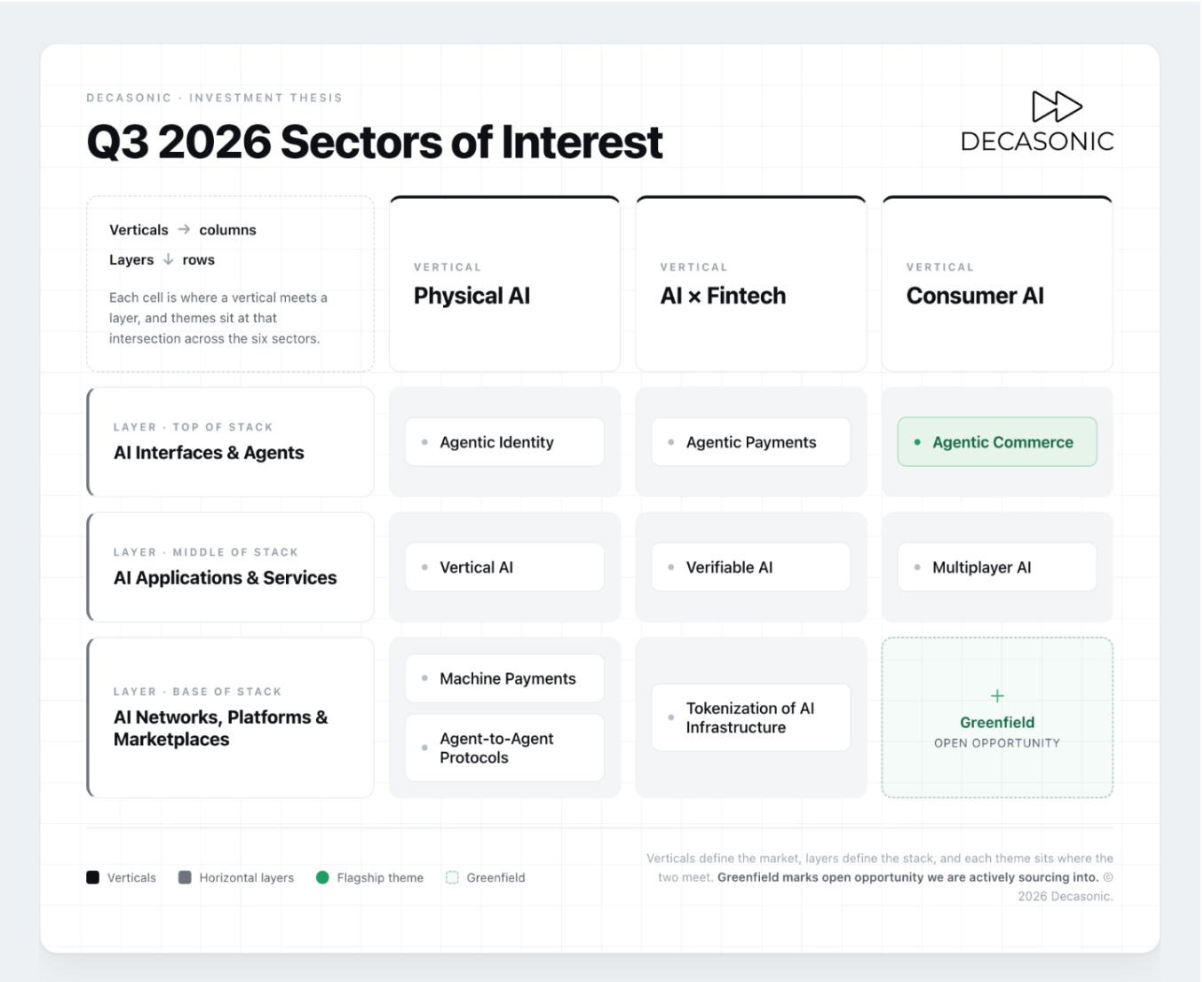
AI Interfaces and Agents
We increasingly see AI Interfaces and Agents as the primary value-capture and orchestration layer for AI. The interface is collapsing into a single conversational surface from which a user invokes any service or agent.
An AI output is only as good as the inputs assembled to produce it, and those inputs, the models, memory, context, tools, and data, are increasingly composable and increasingly bought from many suppliers and providers, traditional companies or other agents. We believe crypto provides the coordination layer that delivers outcomes from those inputs: verifiable routing, neutral settlement, and portable reputation that let an interface pull the best input from any supplier and pay for it, so the output is the best available.
What Q2 2026 clarified is that the agents themselves are beginning to commoditize under the interface, with the harness emerging to subsume much of the orchestration. OpenAI is increasingly racing towards providing a unified interface that combines its traditional conversation interface, Codex, image generation, and third-party partner applications into a single-interface. Perplexity Computer provides an autonomous digital worker interface that orchestrates more than 19 AI models to complete multi-step workflows, including the orchestration of compute resources. Orthogonal, a Decasonic portfolio company, delivers skills and APIs to AI agents at scale by moving intent through a single coordinating interface. Orchestration itself is increasingly being delivered by AI Interfaces to users, and this is the major shift we continue to observe.
AI is shifting from outputs to outcomes, and we believe that shift could create a new version of the AI-services economy, one where an interface is responsible for delivering a complete outcome end to end rather than a single response. When the interface owns the outcome, it owns the relationship, the memory, and the routing that produced it. Where we think value accrues here is in products that own the relationship, the memory, the permissions, the context, and the routing.
The deeper alignment forming this year is about ownership, of a user's or a company's data, judgment, and expertise, and of the outputs and inputs that compound with use. The idea that you should own your data and what your models produce from it has moved from the crypto fringe toward the center of enterprise software.
Crypto makes the interface-user alignment verifiable, user-owned, and enforced through on-chain routing and reputation.
The ownership primitives are already forming: ERC-8004 put agent identity and reputation registries on-chain with tens of thousands of registrations in their first month (with ~313,768+ registered AI agents), and user-signed agentic wallets from Coinbase, MetaMask, and Trust Wallet let agents act within revocable, on-chain guardrails that allow for the continued accelerated deployment of human-owned agents.
Physical AI
Physical AI moved further from research narratives toward deployment in Q2 2026. Humanoid production timelines became concrete, with Tesla targeting first Optimus output this summer, Figure running a pilot with BMW, and the deployment of Venture Capital dollars in Physical AI continuing to accelerate.
Where we think value accrues here is in the systems that coordinate machines, data, energy, human resources, and capital across manufacturer boundaries, and in the horizontal real-world data supply that deployment depends on and cannot scale without.
Web3 is the coordination layer that lets Physical AI scale its deployment. It works today as resource coordination, connecting the humans, data, and machines a deployment needs. It extends to machine identity, giving each robot or device a verifiable way to be discovered and trusted. Its endpoint is machine-to-machine payments, where machines pay each other for work as the machine economy scales. PrismaX, a Decasonic portfolio company, is that resource-coordination layer in practice: a decentralized teleoperation network connecting human operators to the companies deploying Physical AI, and supplying the real-world operation data that is the binding constraint on scaling it.
AI Applications and Services
AI Applications and Services is often where domain expertise is manifested through. Applications are a product that a human (enterprise or individuals) hires to deliver an outcome often expressed in a workflow, and where the moat is vertical depth. Services are what an agent hires to do the work, from data and search to tools, evals, and compute. Q2 2026 raised the stakes on both. Four frontier releases in five weeks lifted the quality floor again, so raw capability stopped being the moat and depth, retention, and delivered outcomes became the differentiators. In parallel agents became a second class of customer, accelerated by Web3 enabling agents to become economic actors, making the services that feed them the fastest-accelerating picks-and-shovels layer in AI.
The moat that survives the cycle of model releases is domain-expertise and ownership of expertise. This is often referred to as the proprietary data loop, which aims to accelerate the deployment of AI applications across domain-specific use-cases. A product that owns a workflow, repeats it measurably, and compounds data a generalist model cannot reproduce holds an edge against a frontier model that competes on raw benchmarks. The same loop pays twice. It powers the human-facing application, and it becomes a machine-callable service other agents buy from that same proprietary source.
Web3 matters here when ownership, provenance, creator economics, or user-aligned value capture strengthen the moat: portable memory and credentials that follow the customer, provenance on data and outputs, and metered access an agent can trust. Web3 fundamentally enables the ownership, retention, and value-capture from the core inputs that provide defensibility to AI Applications and Services.
AI Networks, Platforms, and Marketplaces
AI Networks, Platforms, and Marketplaces are increasingly about coordination. AI systems need inputs. These inputs include: inference (providing compute), models, data, tools, and skills, and value is climbing from raw compute toward the platforms and control planes that build, serve, govern, and distribute them. Crypto provides the neutral coordination layer for Networks, Platforms, and Marketplaces to compound in adoption; coordinating the inputs required to deliver outcomes.
AI x Fintech
AI x Fintech is the financial system of the AI economy, the rails and markets through which agents and AI companies raise capital, hold and move money, price risk, and settle value. As intelligence commoditizes and software stops being the bottleneck, capital and settlement become the constraint, and the financial layer becomes where value is won.
Agentic payments, enabling agents to pay for services, continued to gain adoption, accelerated by Machine Payments Protocol and x402. We think value migrates one layer in, from the commoditizing payment rail to the control, credit, and settlement planes beneath it. Cards will move most agent-to-merchant payment, so the durable position is the settlement plane, where agents pay each other and machines settle conditionally at machine speed, with programmable and revocable control a card network cannot match.
Capital formation is the fastest-accelerating part of the sector, and we believe crypto is becoming the capital-formation layer for AI. The logic is structural: AI companies stay private longer and raise larger, capital rather than code is the constraint, and the issuance and settlement of that capital is moving on-chain. Three flows are forming. Demand for AI exposure is being met on-chain through pre-IPO offerings and tokenized equities, giving anyone exposure to names like OpenAI and Anthropic before they list, regardless of public-market access. The buildout itself is being financed on-chain, with projects like USD.AI channeling credit into the GPU and data-center capex that AI deployment requires. And the set of who can raise is widening: token rails let solopreneurs bootstrap a company with aligned stakeholders, and payment capacity lets AI agents participate in capital formation directly, earning, paying for services, and hiring other agents.
Web3 matters here because it is the settlement and capital-formation substrate an economy of agents and AI companies actually needs. That economy raises, pays, and settles at machine speed and stays private far longer than the public markets were built to reach.
Consumer AI
Consumer AI is the user economy, where the product that owns the relationship owns the value. The next wave competes on three things: attention, lasting relationships, and personalization. Capability is not the differentiator on the consumer surface, since the same models are available to everyone. The differentiator is the context a product accumulates about a user and the relationship it builds from it.
Giant, a Decasonic portfolio company, builds personalized experiences for children, turning each child into the star of their own story through content generated around them. It is the personalization thesis in its most defensible form: the more a child creates, the more the product knows, and the harder it is to leave.
The theme we watch most closely is the shift from single-player to multiplayer AI. Single-player experiences are already here, like Poke, which lets a user text an AI agent on iMessage. Multiplayer puts the AI inside shared spaces, a social group or a workspace where a user tags Claude into a shared thread, Claude Tag. Multiplayer changes the economics. It raises usage because the AI is present wherever people already gather, it deepens personalization because the AI learns from the group and not just the individual, and it compounds retention because leaving means leaving the people, not only the product. Retention feeds richer context, richer context sharpens personalization, and the social graph becomes a moat a competitor cannot copy.
Value accrues to products that own attention, emotional context, creator relationships, and memory, and most durably to the multiplayer experiences where the social graph built allows the moat to compound.
Web3 matters where it changes who owns that context. The context, memory, and attention a user creates are often held and owned by a platform. Crypto turns them into user-owned, portable assets that follow the person across products, and it lets the inputs and outputs of a consumer experience be attested and verified, so a user can trust what an AI remembers, represents, and acts on. The relationship stays owned by the user and aligned to the user.
Building and Investing in the future
Our underwriting remains grounded in Product Market Fit, Narrative, and Execution, combined with a product-depth and network-effects lens. We are thesis-driven early-stage Web3 x AI investors, and we move with speed and high-conviction execution. We are also an AI-native team that has built AI agents and applications ourselves, which gives us an investor-operator lens and a goal of enhancement capital, activating strategic value when it matters most to a founder.
Our internal builds for Q3 2026 are centered on Predictive Workflows: systems that leverage our own internal domain-expertise to evaluate signals and execute internal workflows, so the reasoning that surfaces a good decision also runs the work behind it. We believe the same pattern that makes agents valuable for our founders makes them valuable inside our own firm. This is what allowed us to scale to ~333 AI agents built, augmenting our 3-human investment team.
A call to builders
We are actively looking to invest in founders building the frontier across the six sectors we defined. If you are actively seeking a value-add, investor-operator partner; reach out to us at Decasonic.
The content of this material is strictly for informational and educational purposes only. It is not intended to constitute investment advice, nor should it be considered a recommendation or a solicitation to buy, sell, or hold any asset. Decasonic does not endorse investments in any specific tokens, and nothing in these blog posts should be construed as legal, tax, or financial advice. Please consult with a qualified professional advisor before making any financial decisions. Decasonic provides no warranties, whether expressed or implied, on the content provided in these blog posts, including its accuracy, completeness, or correctness. The opinions expressed here are those of the authors and do not necessarily reflect the views of Decasonic. Please note that Decasonic may hold a position in some of the tokens mentioned, including Virtuals. Decasonic is not liable for any errors or omissions in the content of this material or for any actions taken based on the information provided herein.