
Innovation at University Communities
- Decasonic

- Aug 7
- 8 min read
Why talent, research, capital, and commercialization are converging in Chicago
-- Paul Hsu, CEO and Founder, and Ayanna Tan, Growth Marketing Manager, Decasonic
Innovation talent is everywhere. Given the partnerships of private capital, private industry and universities and other public institutions, top innovations can thrive. Some of the most important technology companies of the next decade may begin in places that investors still overlook.
Universities are no longer simply institutions that educate talent and publish research. Increasingly, they are becoming innovation engines: places where technical breakthroughs are translated into companies, students gain real-world operating experience, and founders gain access to the infrastructure, customers, and capital required to build durable businesses.
That shift is especially visible across Chicago and the broader Midwest.
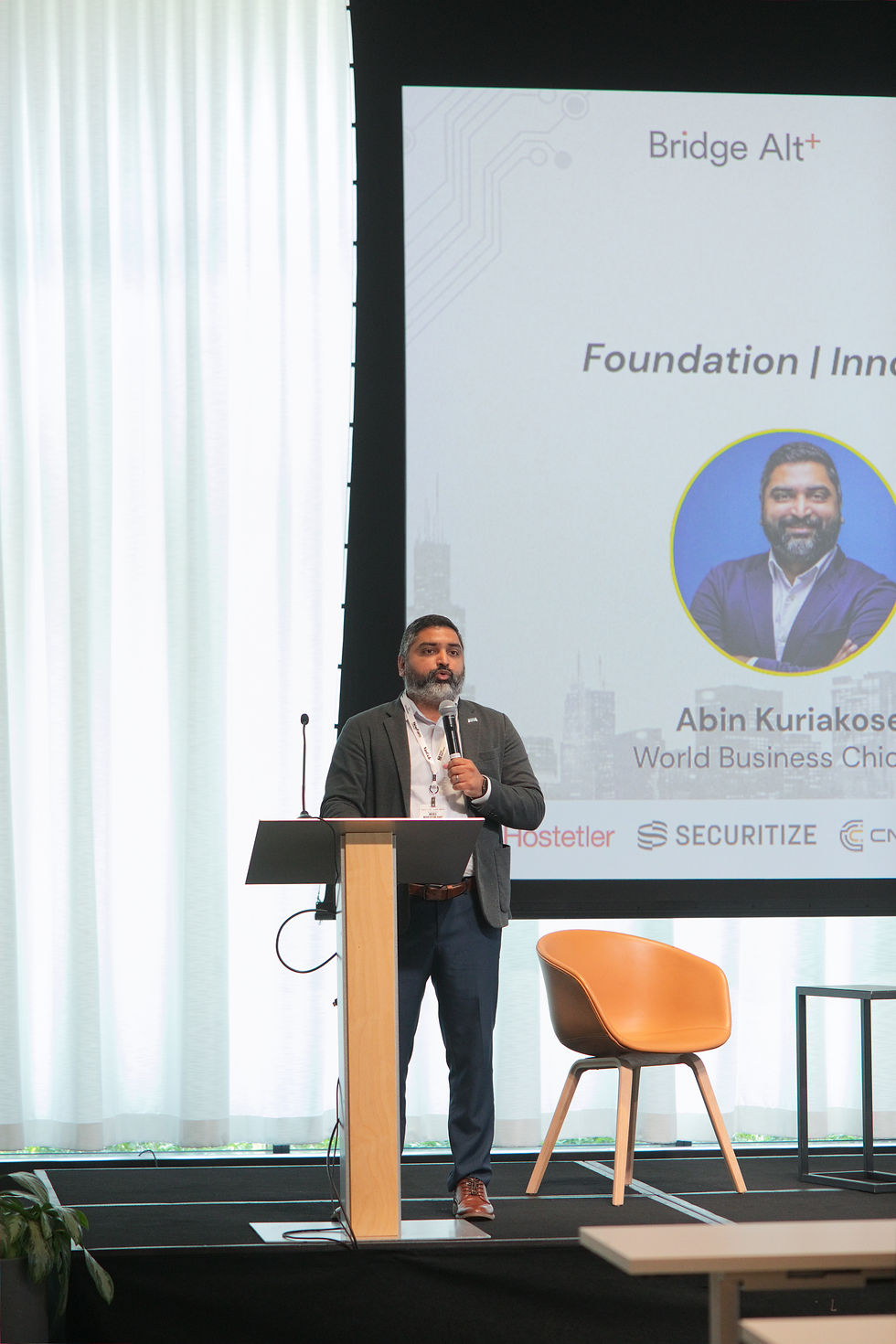
During our Web3 Investor Day, we were honored to host an energizing conversation with Abin Kuriakose from World Business Chicago, Samir Mayekar from the University of Chicago, and Erik Brown from Northwestern University. Their discussion explored how the region’s universities are becoming more active participants in innovation and company formation. The conversation reinforced a broader point we have seen across emerging technology markets: breakthrough research matters, but adoption depends on the system surrounding it.

Talent must connect with industry, especially the bleeding edge of frontier research. Research must connect with productization, commercialization and sustainable business models. Founders must connect with innovation capital, especially investors with a long term outlook. Increasingly ,we are seeing universities can increasingly serve as the bridge between each of these layers.
The Midwest’s first advantage is talent
The Midwest’s most durable advantage begins with its talent base.
Chicago alone produces more than 150,000 college graduates each year, while the broader Midwest trains a significant share of the country’s engineers, scientists, and AI builders. The region combines major research universities with a deep concentration of technical, financial, healthcare, industrial, and operating expertise.
That talent matters because emerging technology companies require more than software engineers. They need researchers, domain experts, operators, investors, product leaders, and customers who understand the industries being transformed.
They need the liberal arts to align technology for mainstream adoption.
Chicago’s economy, with its diversity across industries and backgrounds, provides that range. No single sector represents more than 15% of the city’s economy, giving founders access to potential customers across financial services, healthcare, logistics, manufacturing, professional services, and other major industries. The region also has one of the world’s highest concentrations of Fortune 500 headquarters.
This creates an advantage that becomes more important as AI moves from experimentation to enterprise adoption.
Many AI companies can build quickly in concentrated startup ecosystems. The harder challenge is finding real customers, integrating into complex organizations, and solving problems that matter at scale. Chicago and the broader Midwest offer access to the institutions where that mainstream adoption can occur, across mainstream industries, mainstream customers and mainstream families. It's where manufacturing brings goods and services to America’s industry. It’s where families raise their kids with technology in school and at home.
The next phase of AI will not be driven only by companies selling to other technology companies. It will be shaped by companies capable of serving the industrial and enterprise economy.
Research becomes valuable when it becomes usable
Universities have long produced important technical and scientific breakthroughs. What is changing is the degree to which they are building systems to commercialize those breakthroughs for the mainstream adoption of such technoloiges.
The University of Chicago’s Polsky Center for Entrepreneurship and Innovation now helps create approximately 50 companies each year across the university and medical enterprise. Those businesses span deep technology, healthcare, science, and other research-intensive sectors. In the prior 12 months, companies connected to the center had raised or exited approximately $2 billion.
This reflects a more active model for university innovation.
The university is not simply waiting for research to become a business. It is providing incubation space, laboratory infrastructure, commercialization support, and connections to customers and investors. That infrastructure is especially important for deep technology companies, which often require specialized facilities and longer development cycles than traditional software startups.
The opportunity is particularly significant in Chicago’s growing quantum and microelectronics ecosystem.
A multibillion-dollar quantum and microelectronics park is under construction on Chicago’s South Side, while Hyde Park Labs has become a hub for science and deep-technology commercialization. The facility already houses multiple quantum computers and a growing group of startups working across advanced technologies.
This is how an innovation ecosystem begins to develop real gravity.
The presence of research alone is not enough. A durable ecosystem requires labs, founders, technical talent, capital, customers, and companies choosing to establish operations in the region. Chicago is increasingly assembling those pieces around quantum, advanced manufacturing, life sciences, and other areas of deep technology.
Deep tech may extend the durability of the the current AI cycle
The market is currently concentrated around AI, and that attention is understandable.
Deep technology follows a different adoption trajectory. These companies tend to be grounded in physical systems, scientific breakthroughs, manufacturing capabilities, or proprietary infrastructure. They are often harder to build, but they can also be harder to replicate.
Quantum computing, microelectronics, advanced materials, energy systems, and biotechnology require significant technical depth. They cannot be recreated simply by adding a new interface to an existing model. In fact, they are augmented and accelerated in their innovation trajectory with AI.
That makes universities especially important.
They provide access to the research, facilities, faculty, and technical talent needed to support businesses that may take years to mature. They also provide continuity across market cycles. Venture attention may move quickly from one category to another, but research institutions continue developing technologies whose commercial impact may unfold over much longer periods.
We believe this is one reason the Midwest’s university ecosystem deserves more attention.
The region is not only producing software talent. It is building in categories where scientific expertise, physical infrastructure, and industrial relationships create meaningful barriers to entry.
Adoption begins when students work on real problems

University innovation becomes more valuable when it extends beyond the classroom.
Northwestern has developed programs that place students directly inside private equity firms, venture capital firms, portfolio companies, startups, and larger enterprises.
Through initiatives such as its private equity lab, venture capital lab, and AI lab, students work on active business problems rather than hypothetical assignments.
The AI lab is particularly instructive.
Teams combine technical and non-technical students and deploy them for 10-week projects with investment firms, startups, and established companies. These students are not simply studying AI. They are applying it to actual use cases with measurable business implications.
That distinction matters. Education creates awareness. Applied experience creates adoption.
When students help a private equity firm improve a workflow, analyze a portfolio, or design an agentic system, the university becomes an implementation partner. Students gain practical experience, while companies gain access to technical capabilities and new approaches they may not yet have developed internally.
The same model can strengthen the broader technology ecosystem. Students build domain expertise, firms gain exposure to emerging tools, and universities become more connected to the needs of the market.
This creates a reinforcing loop between education and industry.
Universities train talent. Companies provide real-world problems. Students develop practical expertise. Some eventually become founders, operators, or investors who remain connected to the ecosystem.
Capital remains a structural constraint
The Midwest has strong talent and research, but access to early capital remains uneven.
According to the panel discussion, the average founder in Middle America can take approximately 18 months longer to raise an initial $500,000 than a comparable founder in a major coastal technology hub. In a market where technology evolves rapidly, that delay can materially weaken a company’s competitive position.
This is not necessarily a reflection of founder quality. It is often a distribution problem.
Many investors understand that strong engineering and scientific talent exists across the Midwest. They also recognize the region’s industrial base and operating discipline.
However, investors may still be less likely to travel consistently to discover companies outside their established networks.
The University of Chicago and several partner institutions are addressing that gap directly.
A new office in San Francisco gives Midwestern founders a base while they raise capital. It brings companies closer to one of the world’s densest concentrations of venture firms without requiring founders to relocate permanently. It’s called the Third Coast Foundry and Decasonic is proud to partner with the university on this effort.
The more important innovation is collaboration.
Eight major Midwestern universities, including the University of Chicago, Northwestern, the University of Illinois Urbana-Champaign, Purdue, Washington University in St. Louis, the University of Wisconsin–Madison, Carnegie Mellon, and Ohio State, have come together to present a larger and more coordinated pipeline of founders.
Collectively, these institutions conduct approximately $10 billion in research annually and educate roughly 350,000 students. That scale changes the conversation with investors. Instead of asking venture firms to travel for one company or one institution, the universities can present a concentrated portfolio of talent, research, and startup formation.
At a recent demo day, this collective effort attracted investors representing approximately $200 billion in assets under management.
This is an important systems-level lesson.
Individual universities may compete for students, faculty, and recognition. However, they can create more economic value when they collaborate around commercialization and access to capital.
The Midwest becomes more competitive when it presents itself as a connected innovation region rather than a series of isolated campuses.
University ecosystems need investors inside them
Mature technology ecosystems tend to have strong movement between academia, industry, and capital.
Researchers become founders. Operators return as mentors. Investors engage with students and faculty before companies formally enter the market. Alumni provide introductions, expertise, and early support.
That integration remains less developed in many Midwestern university ecosystems, but the opportunity is clear.
University founders often begin with technical depth that is difficult to reproduce. They may be working on important problems before the broader market recognizes their commercial potential. Investors willing to build relationships inside these ecosystems can develop an advantage in understanding the technology, the team, and the opportunity earlier than the rest of the market.
The panel’s call to action was direct: spend time on campus, meet the founders, and bring a checkbook.
The strongest ecosystems connect talent, infrastructure, customers, and capital
University communities can become powerful adoption engines, but only when they connect the full system.
Research without commercialization can remain trapped inside the institution. Talent without practical experience may leave the region. Founders without capital can lose critical time. Technology without customers may never move beyond experimentation.
The strongest university ecosystems connect each of these elements.
They develop technical talent and place it inside real-world environments. They give researchers access to commercialization resources. They provide founders with laboratories, mentors, customers, and capital. They create opportunities for investors and operators to engage before companies become widely visible.
Chicago is increasingly building this kind of ecosystem.
Its universities produce talent. Its research institutions create technical breakthroughs.
Its corporate base provides customers. Its emerging deep-tech infrastructure supports company formation. Its public, academic, and private-sector leaders are beginning to coordinate more deliberately.
The opportunity now is to increase the density of those connections.
The content of these blog posts is strictly for informational and educational purposes and is not intended as investment advice, or as a recommendation or solicitation to buy or sell any asset. Nothing herein should be considered legal or tax advice. You should consult your own professional advisor before making any financial decision. Decasonic makes no warranties regarding the accuracy, completeness, or reliability of the content in these blog posts. The opinions expressed are those of the authors and do not necessarily reflect the views of Decasonic. Decasonic disclaims liability for any errors or omissions in these blog posts and for any actions taken based on the information provided.
Comments