

in this piece
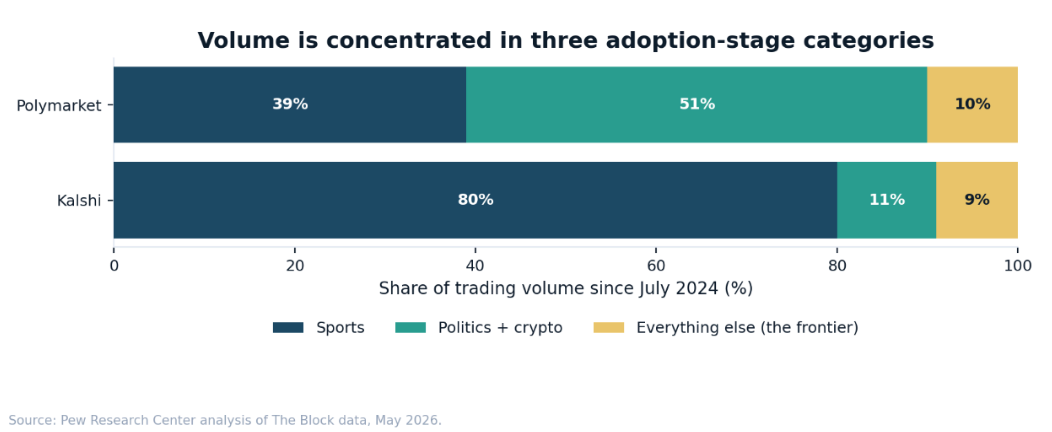
all perspectivesPrediction markets cleared a record $54.1 billion in notional volume in July 2026, and daily volume peaked at $4.8 billion during the World Cup. The category grew while the rest of crypto contracted. But almost none of that growth came from the parts we find interesting. Sports, politics, and crypto price contracts account for roughly 90% of all volume since July 2024, and those three categories are past frontier adoption.
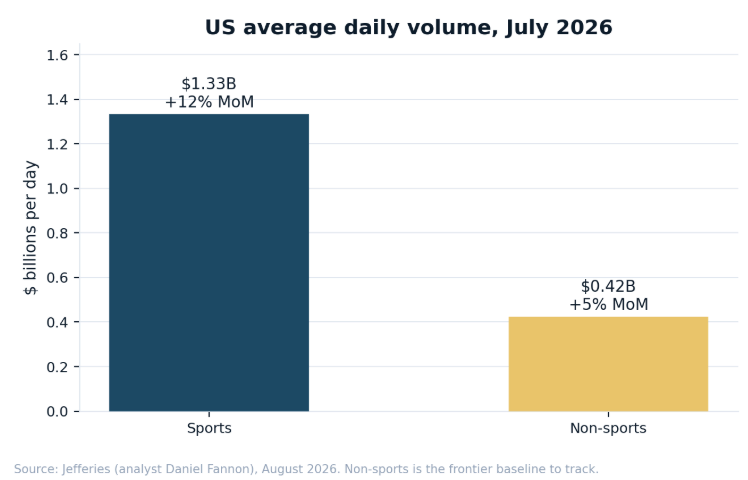
The stage that matters for us sits inside a much smaller number. Jefferies puts US average daily volume at $1.91 billion in July, with sports at $1.33 billion and non-sports at $424 million, which still grew 5% month over month through a World Cup. Every category in this post lives inside that $424 million a day, which is what frontier adoption looks like: small share, working products, paying customers.
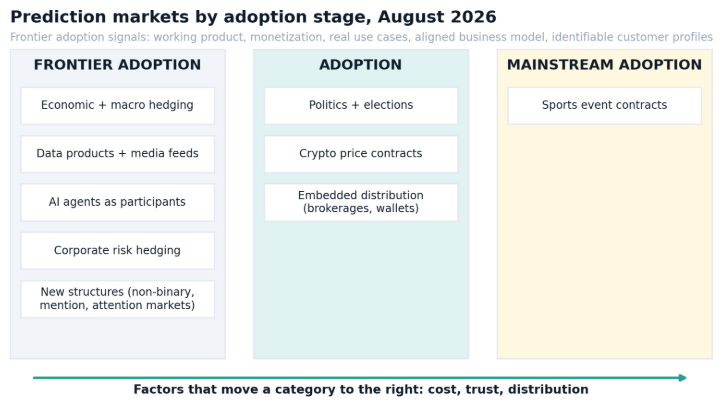
We laid out the stages in an earlier post on what frontier technologies need to reach mainstream adoption. Frontier adoption is where bleeding-edge users prove out a working product, real monetization, real use cases, an aligned business model, and identifiable customer profiles. Frontier products start expensive and get cheaper as volume grows. Cost, trust, and distribution then carry a category into adoption and eventually mainstream adoption, which is exactly the sequence that moved sports and politics: a court ruling, a Robinhood partnership that put contracts in front of 27 million funded accounts, then a CFTC chairman who withdrew the agency's proposed restrictions. Each step lowered a cost, added trust, or opened a channel.
The question worth asking now is which categories are at the frontier, showing the same signals at small scale.
Distribution is already doing that work at the far end. Event contracts became Robinhood's fastest-growing line, generating $156 million in Q2 revenue and passing both crypto and equities, while the company actively lowers the spread it collects on less popular markets. Falling take rates against compounding volume is the cost factor behaving exactly as the framework predicts, and it is why we expect the venues that win to be the ones supplying liquidity, clearing, and data underneath everyone else's front end.
Economic and macro hedging
The strongest trust signal comes from the Federal Reserve itself. A 2026 Fed staff working paper found Kalshi's market-implied forecasts for headline CPI are a statistically significant improvement over the Bloomberg consensus, and that it provides real-time distributional forecasts for indicators like GDP and unemployment where options-implied data has never existed. Professional forecaster surveys update monthly; event contracts reprice in the hours around each release.
The customer profile is identifiable and starting to pay. A Coalition Greenwich survey of 53 US market structure specialists in January found 60% see prediction markets as a new data source, 43% as alternative data for hedging, and 36% expect entirely new hedging applications. Roughly 40% of Kalshi's volume already comes from institutions, and quant desks trade dislocations against Fed funds futures. Opinion, which we backed, built its exchange specifically around this use case, and its framing is the clearest statement of the problem we have seen: a trader who expects a rate cut buys Bitcoin or another volatile proxy and takes on every unrelated risk attached to it, when what they want is exposure to the rate decision itself. Its average institutional trade size reached roughly $2,500 in 2026, well above retail-weighted averages at peer venues.
On our prediction markets panel at Web3 Investor Day, the same argument arrived from a very different starting point. Two properties do the work. Granularity: rather than going long Disney, you can go long park attendance or concessions, isolating the exposure you have a view on. And realized rather than implied settlement: anyone who has traded earnings knows the experience of being right on the number and losing anyway because guidance moved the stock, where an event contract settles to what happened.
That decomposition implies a second step, and it is the least developed frontier area on this list. If risk breaks into components, those components can be reassembled into products. On our panel they were described a themed wrapper built from FDA approvals, federal research funding, and pharmaceutical outcomes, giving an investor exposure to progress on a disease rather than to any one company. Nothing at that level of packaging exists yet, but the inputs do, and structured products built from event contracts would give this category its first institutional distribution channel.
Scientific outcomes are the natural starting point for that packaging. Trial readouts, regulatory decisions, and grant awards resolve against public records on known dates, which removes the ambiguity that breaks most long-tail contracts. The customers are identifiable too: funders sizing a portfolio, suppliers planning against an approval, researchers hedging a program that lives or dies on one readout. What is missing is liquidity, since a market on a single phase III result has no natural counterparty until someone is willing to quote it, which is the constraint the next section is about.
Monetization is expanding into price contracts and margin products. Kalshi's crypto price contracts hit a record $218 million in single-day volume on July 15, roughly 44x their January level, Nasdaq and Cboe have filed to list similar contracts on equity indices, and Kalshi launched a margined perpetual futures business for institutions. The use case is reaching the real economy too: CNBC recently profiled a California goat herding company hedging wage risk, and analysts point to multinationals offsetting tariff exposure. The eventual shape of this category is parametric protection for businesses too small for traditional derivatives desks, alongside internal decision markets where firms price their own launch dates and forecasts against their employees' private information.
Open interest tells the honest version. Combined open interest peaked near $2 billion in early July and fell to roughly $1.2 billion after the World Cup. Hedging demand shows up as committed capital that persists between event peaks, and that persistence, starting with the midterms, is the signal we track here.
Data products and media distribution
Market prices are becoming a product separate from trading. Polymarket data now distributes across major consumer platforms, and media channels routinely report Kalshi odds ahead of CPI releases alongside the Dow Jones economist consensus. Average Brier scores near 0.09 mean forecast quality has held up while volume scaled 10x. That gives the category a second customer profile: newsrooms, research desks, and risk teams that consume the data without placing a trade. Kalshi's midterm election hub draws heavy traffic, but only about a quarter of its viewers trade those contracts.
Three quarters want the information alone. That ratio is the clearest evidence we have seen that the data is a product in its own right, and it describes a conversion funnel as some share of those viewers come to trust the signal enough to trade it. Most current deals still look like distribution agreements rather than licensing revenue. When licensing becomes a reported revenue line, this category has moved into adoption.
AI agents as market participants
AI agents are the most active frontier category by on-chain evidence, and where web3 and AI converge most directly. Analysis of Polymarket's public leaderboard found 14 of the 20 most profitable wallets are bots, agents represent over 30% of wallet activity, and more than 37% of agents show positive profit and loss against 7% to 13% of human traders. Olas launched Polystrat, a consumer autonomous trading agent, in February; users set strategies in natural language and it executed more than 4,200 trades in its first month. Bloomberg's April wallet study adds the nuance: humans pick the correct side more often than bots but enter later at worse prices and get picked off as quotes update. Execution, not judgment, is where agents currently win.
Agents are also consumers of the data. Bridgewater's AIA Forecaster reaches a 0.10 Brier score with agentic search against 0.36 without it, and academic benchmarks now use prediction markets as ground truth for evaluating AI forecasting. Polymarket ships an open-source agent framework and has partnered with Kaito AI on attention markets, an asset class agents price better than humans. Meta has reportedly directed an internal team to build a prediction market app using Llama to generate and resolve markets across its 3.56 billion daily users.
The less visible shift is agents moving into the infrastructure. Opinion AI, the agentic oracle underneath Opinion, handles market creation and resolution: a user writes a prompt, the system converts it into a contract with settlement terms, expiry, and reference sources, and refuses to publish markets that cannot resolve objectively. Resolution runs as an optimistic proposal reviewed by a jury of models including Claude, ChatGPT, and Grok, with human reviewers verifying and Chainlink supplying data for macro and price markets. The refusal is the important part. Disputed resolutions have been a recurring failure across venues, and the practitioner view on our panel was that a contract needs both a credible settlement source and rules concrete enough to cover edge cases. Even a presidential election contract has to specify which event resolves it: the call on the night, the certification, or the swearing-in. Market creation has been a binding constraint on long-tail coverage precisely because that language has to be written unambiguously. If agents can write and resolve markets reliably, listing cost falls toward zero.
AI in pricing and market making
The category that gets least attention, and that we think matters most, is AI moving from trading against the book to making the book. Every market a venue lists carries an ongoing cost, since someone has to quote both sides continuously, hold inventory, and absorb the risk of being picked off. Those economics, more than user demand, set the edge of what is worth listing. Analysis of spreads against volume in January found the same pattern in prediction markets and crypto order books alike: below a certain volume threshold, spreads widen until the market stops working as a price signal. Most bots cover only the top hundred markets, and anything under roughly $500,000 in volume draws little algorithmic attention.
This is why the long tail stays thin. It is not that nobody wants a market on a specific regulatory decision or a mid-size company's quarterly outcome, it is that no maker can justify quoting it. a16z's 2026 outlook bets that AI agents will supply the attention and liquidity for long-tail markets, and as intelligence gets cheaper, more markets become viable, until the constraint is no longer who will quote a market but which questions are worth asking.
Automating this is harder than it sounds, because event contracts are structurally different from stocks. A share trades again tomorrow. An event contract snaps to $1 or $0 at settlement, so a maker cannot hold inventory through a bad patch and wait for mean reversion, and news can move a price from 50 cents to 10 cents in seconds. Capital is locked until resolution, which is why some venues pay roughly 3.25% annualized on eligible long-dated positions. Paradigm's pm-AMM takes the automated route, concentrating capital where trading actually happens instead of across price ranges that never trade.
The evidence on agents filling the role is promising and unsettled. An April study simulating 3,000 markets calibrated to Polymarket parameters found agent makers winning 68% to 70% of the time, with mean profit varying 3.4x purely on calibration quality. The same paper carries a warning: on resolved Polymarket questions, five frontier language models showed true estimation error an order of magnitude larger than their apparent agreement with market prices. An agent can look calibrated because it anchored on the market while being badly wrong, the failure mode that kills a maker in a thin book. Venues are designing for machine liquidity anyway. Opinion charges makers nothing and routes half of every taker fee to the liquidity provider on that trade, and its Metapool pools depth across related markets so that a hundred thin macro markets can behave more like one deep book.
The stakes run through every other category here. Corporate hedging needs markets specific enough to match one firm's exposure, which is by definition long-tail. Data products need coverage broad enough to license. Agent trading needs a counterparty at three in the morning on an obscure question. All three are gated by the same constraint, and sustained agent-quoted depth in sub-$500,000 markets, holding up without incentive subsidies, is one of the more important signals in the category.
Crypto-native venues and new market structures
The regulated US exchanges are winning the categories that already work. The crypto-native venues are where new structures get invented and where the composability agents need actually exists, which is why the frontier designs cluster there even though the volume does not.
Opinion is the venue we know best, having invested in the company. It runs a central limit order book rather than an AMM, giving professional makers a familiar venue and finer-grained probability pricing. Makers pay nothing; takers pay a dynamic fee that peaks near 50% probability and falls toward zero as an outcome settles. Underneath sits a stack aimed at being infrastructure rather than a destination: Opinion AI as the agentic oracle, Metapool as the cross-market liquidity layer, and Opinion Protocol as a token standard meant to make prediction assets interoperable across venues and usable as DeFi collateral. It reached third by open interest within a month of launching, though a meaningful share of early volume came through points and rewards, so retention after incentives is the real test.
That collateral point is a frontier area in its own right, and the numbers behind it are striking. Prediction market positions currently show close to zero collateral utilization, against 40% to 80% for ordinary crypto tokens, which leaves billions in capital locked until resolution doing nothing else. Kalshi tokenized its positions on Solana in December 2025, putting a regulated exchange's contracts where smart contracts can reach them for the first time. The plumbing to actually lend against them is still missing, since binary positions need liquidation mechanics and valuation models that single-asset lending protocols never had to solve. Whoever builds it turns idle collateral into working capital, and it addresses the same locked-capital problem that makes market making expensive.
Venue design is moving the same direction. Drift BET wires prediction markets into existing perpetuals and lending engines on Solana, letting traders post margin in roughly 30 assets and keep earning lending yield on collateral while an event position is open. The general form of all of this is markets as components rather than destinations, where prices get read, reacted to, and reused by other systems instead of only displayed on a site. A lending protocol reading a settlement probability, an insurance contract triggering off one, a treasury rebalancing against one: none of that requires the user to visit an exchange.
Governance is the earliest live test of that idea. Decision markets let a DAO price the expected outcome of a proposal before the vote rather than argue about it afterward, turning governance into a forecast rather than a poll. The mechanism has been theorized for two decades and the on-chain implementations are still small, which is precisely what a frontier category looks like: the product works, the customers are identifiable, and the volume is negligible.
The rest of the long tail shows how crypto rails let these markets take shapes a regulated exchange cannot. Limitless owns short-duration trading on Base with over $500 million in volume, Predict.fun connects yield-bearing collateral with Binance's reach, and Myriad embeds markets inside articles, apps, and wallets, a model closer to a media primitive than an exchange.
Contract structures are moving fast on the regulated side too. Horizons have compressed to five-minute markets, Kalshi's World Cup combo markets reached $22.4 billion before the final, and mention markets on words said in speeches and earnings calls are live and under CFTC review. Regulation is moving with the products. The CFTC's June proposed rule is permissive in aggregate and places economic indicators entirely outside the restricted categories, Gibraltar became the first jurisdiction with a dedicated framework in July, and more than 20 exchanges are currently seeking CFTC approval, with several already granted.
The unresolved question is state preemption, and our panel was blunt about how messy it is. Roughly 18 state actions are pending across state and federal courts. The Third Circuit has held that federal law preempts state gambling statutes; state courts have gone the other way. In one episode a district court ordered Kalshi to liquidate in-state positions and the CFTC countermanded it to preserve settled trades. The panel expected this to end at the Supreme Court on whether exclusive CFTC jurisdiction means what it says, unless Congress resolves it first. Futures exchanges faced the same fight a century ago, when states tried to shut them down as immoral gambling on farmers, and the Commodity Exchange Act settled it with the preemption language now being litigated.
A second question matters more for the frontier categories than for sports: which contracts are commodities and which are securities. Corporate KPI contracts look to many practitioners like securities belonging on securities exchanges under SEC oversight, and at least one traditional exchange is listing binaries and KPI contracts that way rather than under CFTC rules. Since corporate performance contracts are among the most investable frontier categories here, how the regulators divide that ground determines who can list them and how fast.
What we are watching
Every category above shows the frontier adoption signals already: working products, real monetization, identifiable customers, at costs falling as volume grows. Cost, trust, and distribution decide which ones reach adoption. For hedging, the test is open interest that persists between event peaks, starting with the midterms, and whether anyone packages contracts into a product an allocator can buy. For data products, it is licensing showing up as a reported revenue line. For agents, it is whether agent-supplied liquidity holds spreads together in small markets once incentive programs stop paying for it. For crypto-native venues it is retention after incentives end, and whether prediction positions start getting used as collateral instead of sitting idle. For embedded distribution, it is take rates continuing to fall while volume compounds.
The non-sports daily volume line, $424 million and growing through a sports-dominated month, is the number that summarizes the frontier. We expect those categories to be the fastest-growing part of the market over the next year, and they are where we are spending our diligence time.
The content of this material is strictly for informational and educational purposes only. It is not intended to constitute investment advice, nor should it be considered a recommendation or a solicitation to buy, sell, or hold any asset. Decasonic does not endorse investments in any specific tokens, and nothing in these blog posts should be construed as legal, tax, or financial advice. Please consult with a qualified professional advisor before making any financial decisions. Decasonic provides no warranties, whether expressed or implied, on the content provided in these blog posts, including its accuracy, completeness, or correctness. The opinions expressed here are those of the authors and do not necessarily reflect the views of Decasonic. Please note that Decasonic may hold a position in some of the tokens mentioned, including Virtuals. Decasonic is not liable for any errors or omissions in the content of this material or for any actions taken based on the information provided herein.