

in this piece
all perspectivesDecasonic is an AI-native venture firm focused on the Web3 x AI intersection. We co-build with our founders to be the best advisors we can be, and to deliver value-add beyond capital. Building internally is how we sharpen that lens.
Every Friday, we run AI Ship Day (ASD), our internal cadence for shipping and reviewing the AI applications we build for the firm. Across the last several ASDs, a clear pattern has surfaced. Software is no longer scarce. Good software is no longer scarce either.
What separates good software from impactful software is the coordination workflow loop between the humans and AI. ASD is how we hold that loop together.
ASD also forces a focus on multiplayer AI. The applications we build are designed for the team, not for individuals. That collaborative posture creates network effects in how AI gets used and deployed inside the firm, and it forces every function to think together about how AI can maximize the impact of our collaboration. It also compresses the feedback loop. Going from a product description or outline to a working prototype within days is what lets us validate quickly that what we are shipping actually resonates with the team.
Below are recap takeaways from April’s AI Ship Days. These takeaways are synthesized from our learnings shared on LinkedIn: ASD 4/24/26, ASD 4/17/26, ASD 4/10/26, ASD 4/3/26
1. AI-Native Means Building Our Own Tools (Own your Workflows)
Decasonic deploys AI in the form of an internal operating system. There are two surfaces. One is internal to the firm, where every teammate composes and runs agentic workflows. The second is the AI Engines Portal, our AI OS for portfolio companies. Both are end-to-end workflows across sets of AI agents composed in the form of AI applications, surfaced through one interface.
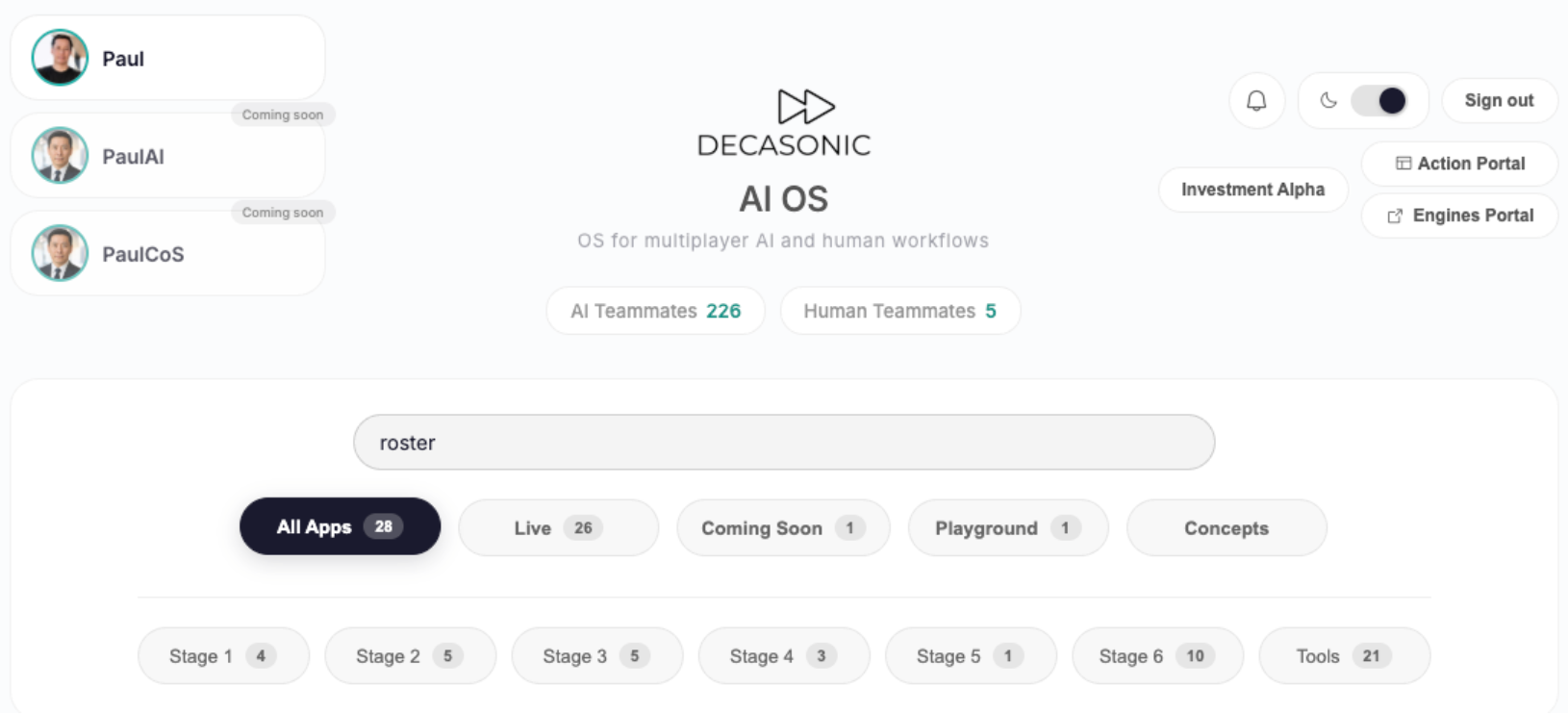
The point of building internally is not novelty, it is core to refining an investor’s perspective. An AI-native firm cannot credibly advise founders building AI without building AI itself.
The harder question is what to build. There is a near-infinite set of software a firm could ship internally, and most of it is noise. The discipline that keeps the stack focused is a single criterion: does this AI application, including ones that extend beyond a workflow, contribute to investment alpha? If yes, we agree as a team to build, ship, and iterate. If no, it does not earn a place in the stack. Investment alpha is the boundary that turns ASD from a build-everything cadence into a build-the-right-thing cadence.
2. Stop Automating the Past. Redesign the Workflow.
We started building AI internally by mapping it onto existing workflows the team already ran. Meeting humans where they already work in the workspace lowers the barrier to entry for AI adoption, and that was a powerful first step in how we built AI inside Decasonic.
What changes over time is that you earn the chance to build an AI-native firm from the ground up. That means redesigning workflows as a company from first principles, not just layering AI onto the shape of the workflows that existed before.
Paul Hsu, CEO and GP of Decasonic, framed it as: stop automating the past, redesign workflows from first principles.
When you ship AI for an existing workflow, you compress your imagination to the boundaries of that workflow. The leap happens when you ask, given the capabilities now available, what would this firm be doing if we built it from scratch today. Humans drive insight, judgment, and non-consensus conviction. AI drives synthesis, speed, and scalable execution. The implication is that AI agents are treated as first-class users of the workflow, with their own needs around context surfacing, decision criteria, and feedback loops.
The teams that get this right do not ship a faster version of the old prototype. They ship a different prototype, one that did not exist when humans owned the entire workflow.
3. Human Design Thinking + Systems Thinking + AI Critical Thinking
A recurring ASD distilled the AI-native operating posture into three lenses applied together.
Human Design Thinking is where creativity and imagination live. The investor framing the question, the founder lens being applied, the non-obvious comparable. AI does not generate that on its own.
AI Critical Thinking is where structured evaluation lives. The model surfaces decision criteria, explains scoring rationale, and pressure-tests ideas with scenarios a human alone would not generate quickly enough.
Systems Thinking is what glues the two together. It is the discipline of embedding AI across every workflow that matters, not bolting it onto one task. It is also what makes the multiplayer posture work. The systems lens is what turns an AI tool into an AI operating posture, and that posture is what compounds across the firm.
4. Bring Your Own Expertise
A core ASD principle is BYOE: Bring Your Own Expertise. Better AI outputs do not come from better one-shot prompts. They come from the deliberate alignment of human domain depth and AI leverage.
The expertise that upgrades our internal AI is not technical infrastructure expertise. It is the product-first perspective Decasonic brings across functions. The marketing team, the operations team, the data team, and the investor team each bring a distinct lens to ASD. Each one of us provides feedback on AI applications from the angle of how the output serves our function, not from the angle of how the underlying infrastructure was built.
BYOE also extends into RLEN, our patent-pending Reinforcement Learning Expert Network. RLEN is a social network of AI and humans, composed of human clones configured with the personas of domain experts the firm draws on. The principle scales there: bring your own expertise, and pair it with the expertise of clones who are domain experts in their own right.
This points towards something most AI-tooling discourse skips. The model itself is the commodity layer. The expertise layered around the model, both human and clone, is the actual differentiator. Domain depth multiplied by AI leverage is what makes an internal tool defensible against the next frontier model release.
5. Speed in Shipping Is the Real Moat
A non-obvious takeaway from ASD is that shipping speed matters even for a venture firm that does not sell software.
We do not ship products to customers. We ship internal applications to ourselves. The speed at which we can build, test, and iterate is the speed at which we stay current with frontier models, new orchestration patterns, and the workflows our founders are actually shipping. A firm that lags six months on internal AI tooling cannot credibly hold a peer conversation with a founder shipping at frontier pace.
Speed in shipping, combined with weekly accountability through ASD, is how a builder team stays at the edge of the AI x Web3 stack. The firm that ships internally on Friday is the firm that can advise the founder building the actual product on Monday.
6. A Tight End-to-End Loop Drives Impactful Software
The through-line across every ASD is the loop. We define what investment alpha looks like. We build the tool against that standard. We use the tool inside real investment workflows. We assess the output every Friday in front of the team. We iterate. The loop is short, the cadence is fixed, and the accountability is public.
There is a difference between good software, bad software, and impactful software. Good software works. Bad software does not. Impactful software changes how the team operates. The only reliable mechanism we have found to drive towards impactful software is in the form of a build-use-assess loop tight enough that drift gets caught the same week it appears.
The Friday cadence is the forcing function. It is how we hold accountability, stay current with the relative tools, models, and information available from an AI and LLM perspective, and ensure the internal stack compounds rather than fragments over time.
Conclusion
ASD is a practice any AI-native organization can adopt. For us, it installs internal discipline, leverages our product-first perspective to build AI as a collaborator to the entire company rather than to single individuals, and pushes us towards the frontier of what is possible in AI. We co-build and co-invest alongside founders building at the intersection of AI and Web3. If you are building, reach out to Decasonic.
The content of this material is strictly for informational and educational purposes only. It is not intended to constitute investment advice, nor should it be considered a recommendation or a solicitation to buy, sell, or hold any asset. Decasonic does not endorse investments in any specific tokens, and nothing in these blog posts should be construed as legal, tax, or financial advice. Please consult with a qualified professional advisor before making any financial decisions. Decasonic provides no warranties, whether expressed or implied, on the content provided in these blog posts, including its accuracy, completeness, or correctness. The opinions expressed here are those of the authors and do not necessarily reflect the views of Decasonic. Please note that Decasonic may hold a position in some of the tokens mentioned, including Virtuals. Decasonic is not liable for any errors or omissions in the content of this material or for any actions taken based on the information provided herein.