
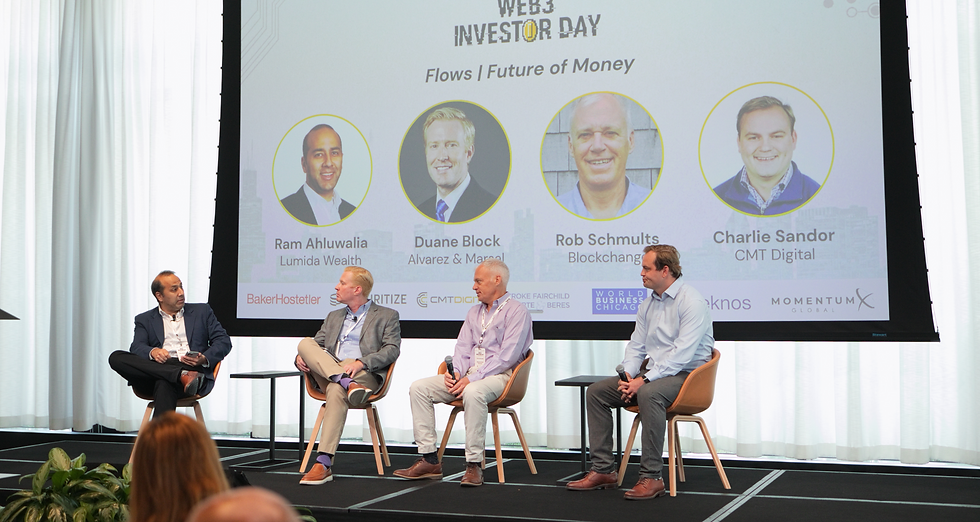
Future of Money
Ram Ahluwalia | Lumida Wealth
Duane Block | Alvarez & Marsal
Rob Schmults | Blockchange
Charlie Sandor | CMT Digital

Session Video


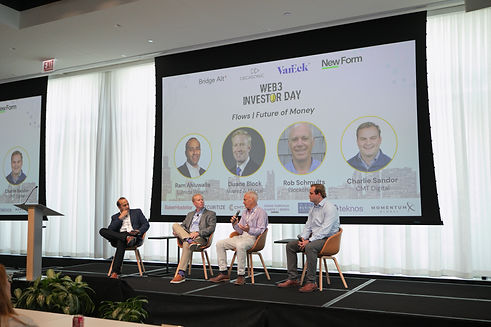
The Future of Money panel examined how stablecoins and blockchain infrastructure are reshaping payments, banking, and financial services. Duane emphasized the opportunity for infrastructure providers that make stablecoin rails seamless and invisible, Rob focused on how blockchain can remove inefficient intermediaries, and Charlie highlighted emerging enterprise payment models where stablecoins improve cross-border settlement, reduce costs, and create new opportunities for banks, fintechs, and merchants.
Core Themes or Shifts
Infrastructure is emerging as a key beneficiary, particularly providers of on- and off-ramps, custody, and integrations that embed stablecoins into existing systems. Intermediaries that rely on inefficiency or toll-taking are more exposed as blockchain moves “under the hood,” while correspondent banking and enterprise payments are already seeing pressure from faster, lower-cost stablecoin settlement. Consumer adoption may take longer, especially in markets where credit-card rewards, access to credit, and strong payment-network effects remain deeply entrenched.
Key Strategic Insights
The strongest near-term opportunity appears to be in B2B rather than consumer payments, where large transaction volumes can make even small efficiency gains economically meaningful. Stablecoins are increasingly positioned as invisible settlement infrastructure rather than a product consumers must consciously adopt, with the greatest value emerging from lower cross-border costs, faster settlement, improved interoperability, and more efficient treasury management. At the same time, meaningful adoption will depend on breaking existing network effects, improving regulatory clarity, and building sufficient utility for businesses to change established financial workflows.
Implications for Builders or Investors
For builders and investors, the opportunity is concentrated in the infrastructure that makes blockchain rails invisible to end users while delivering tangible economic value. Areas of interest include enterprise payments, cross-border settlement, stablecoin middleware, banking infrastructure, interoperability, and agentic payments, where AI systems may increasingly use programmable money for machine-to-machine transactions. The panel characterized the market as still early, with most investable opportunities currently in private markets and significant upside likely to come from use cases that are not yet fully predictable.


Speakers
Ram Ahluwalia
CEO & Founder
Lumida Wealth
Duane Block
Managing Director
Alvarez & Marsal
Rob Schmults
General Partner
Blockchange Ventures
Charlie Sandor
Investor
CMT Digital