
in this piece
all perspectivesFor the first time at meaningful scale, consumers have access to intelligence that can actively represent their interests across an increasingly complex retail landscape.
Some key questions confront brands and stores competing for Black Friday 2026, or Agentic Black Friday:
- What happens when every consumer has a personal shopping agent with the analytical capabilities of an expert buyer, the market intelligence of a professional researcher and the contextual understanding of a trusted personal assistant?
- What happens when millions of these agents simultaneously evaluate Black Friday promotions, compare products and optimize purchasing decisions?
- How will retailers compete when purchasing intelligence becomes abundant?
Black Friday offers a window into the next structural transformation of commerce as AI-powered shopping begins to reshape consumer behavior. Throughout the history of retail, innovations have expanded what consumers can access, how they discover products and how they make purchasing decisions. Agentic AI introduces the possibility of expanding consumer agency itself.
Let’s take a step back and consider the broader arc of commerce innovations to today’s Agentic Commerce.
The Evolution of Commerce: From Department Stores to Personal AI
The history of modern commerce is a history of expanding consumer possibilities. Each generation of retail innovation has introduced new shopping experiences, reduced existing constraints and created new opportunities for businesses. Understanding these transitions provides a framework for imagining the future of agentic commerce.
The department store: Shopping as an experience

In the late nineteenth and early twentieth centuries, Marshall Field's in Chicago and Macy's in New York helped transform shopping into a cultural and social experience. Department stores brought an extraordinary assortment of merchandise under one roof, combining product discovery with attentive customer service, architectural grandeur and entertainment. Shopping became an activity that people could aspire to and enjoy.
During the holidays, decorated windows, elaborate displays and family traditions elevated these retailers into destinations. Marshall Field's and Macy's understood that commerce could appeal to people's imagination as much as their practical requirements. The department store effectively expanded the emotional dimensions of consumption.

The Sears catalog: Shopping without geographic boundaries
Another Chicago based company, Sears, extended this innovation. The Sears catalog introduced another structural transformation by bringing an expansive assortment of products directly into American households. Consumers living far from major cities could discover and order clothing, tools, furniture and even prefabricated houses. Access to commerce became progressively less dependent on proximity to a physical store.

The catalog also became an instrument of imagination, particularly during the holiday season. Families could explore products together, children could create wish lists and consumers could envision possibilities beyond what their local merchants offered. The Sears Wish Book helped make product discovery part of the holiday experience.
Amazon and e-commerce: Shopping without physical constraints
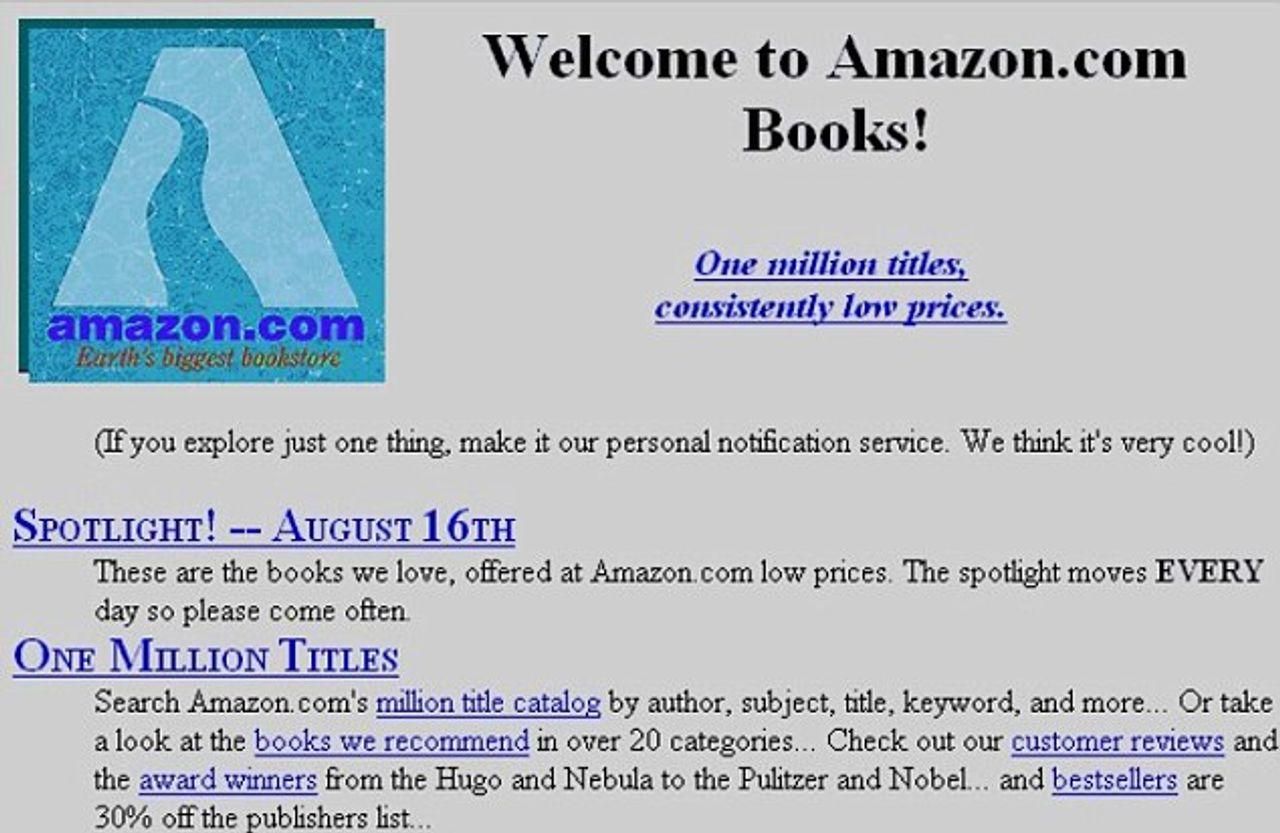
When Amazon launched its online bookstore in 1995, it offered access to more than one million book titles, an assortment that would have been impractical for a traditional bookstore. The internet dramatically expanded product selection while introducing search, digital reviews, price transparency and increasingly convenient fulfillment. Amazon subsequently demonstrated how these capabilities could extend across virtually every retail category.
E-commerce transformed shopping from a geographically constrained activity into an always-available service. Search engines and digital marketplaces became central distribution channels, while logistics and customer convenience emerged as major competitive advantages. The ability to discover almost anything introduced a new challenge, however: the cognitive burden of evaluating almost everything.
Read Amazon's original 1995 announcement.
Mobile and social commerce: Shopping at the point of inspiration
The emergence of Chicago-based Groupon in 2008 and LivingSocial popularized an entirely new dimension of digital commerce: collective purchasing power and social discovery. By aggregating consumer demand, these platforms unlocked attractive deals while introducing people to local restaurants, experiences, services and businesses they might otherwise never have discovered. Groupon's rapid expansion to 33.7 million active customers across 47 countries by the end of 2011 demonstrated the scale of this emerging consumer behavior.
Smartphones subsequently brought commerce into the everyday moments of consumers' lives. Instagram, Pinterest, YouTube and TikTok expanded product discovery through communities, creators, entertainment and social recommendations. Shopping became increasingly integrated with how people spent their time, pursued their interests and connected with others.


Agentic commerce could reinvent the original promise of Groupon and LivingSocial through personalized intelligence and coordinated demand. Imagine thousands of personal AI agents independently identifying similar purchasing intentions, aggregating demand and negotiating preferential pricing directly with merchants. Collective purchasing power could evolve from merchant-initiated promotions into consumer-initiated markets, creating new economic opportunities for consumers and businesses alike.
Personal AI: Shopping at the point of intent
Personal AI introduces a new consumer interface organized around individual context and intent. Instead of navigating multiple retailers, search engines and social platforms, consumers can increasingly express their desired outcomes to an agent. The agent can then research, compare, personalize and potentially execute purchasing decisions across these environments.
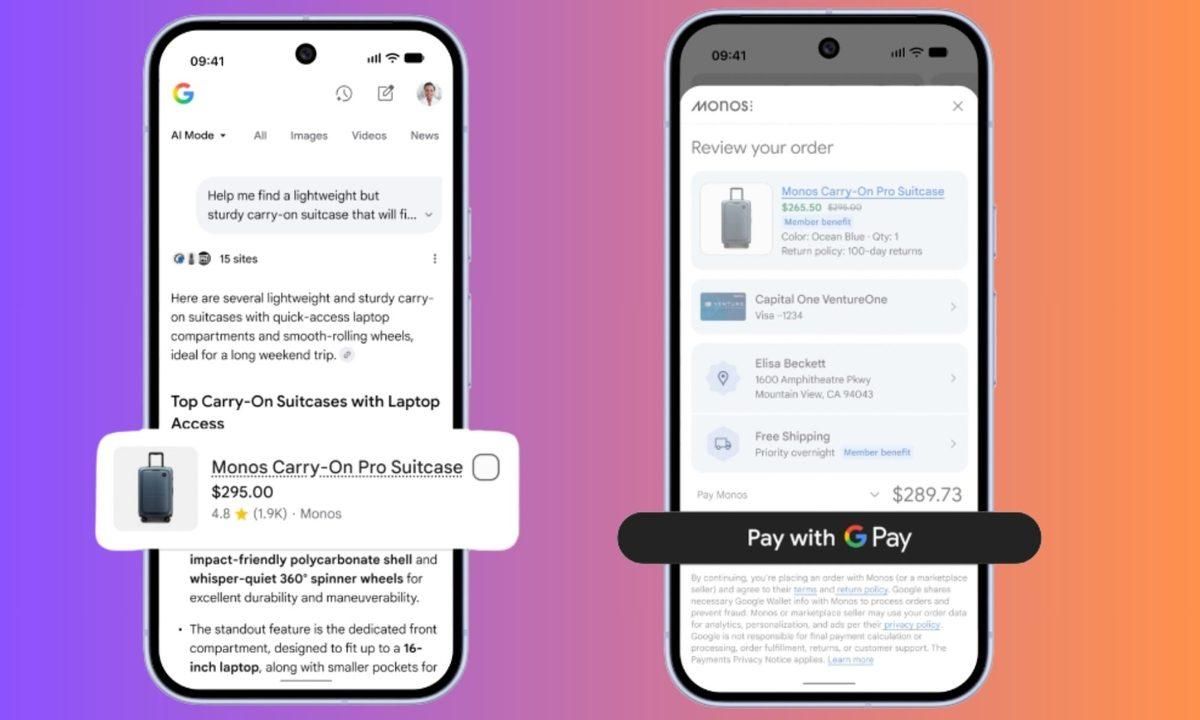
Personal AI shoppers combine attributes from previous generations of commerce: the service of a department store associate, the discovery of a Sears catalog, the selection of Amazon and the personalization of mobile social commerce. It adds a capability that previous generations could not provide at comparable scale: continuously evolving intelligence aligned with an individual consumer's interests. The next frontier of commerce becomes the relationship between the consumer and their personal AI.

Black Friday continues to grow in economic significance even as the underlying shopping experience evolves. Adobe reported that American consumers spent $11.8 billion online on Black Friday 2025, an increase of 9.1% from the previous year. Total US online spending during the 2025 holiday season reached $257.8 billion.
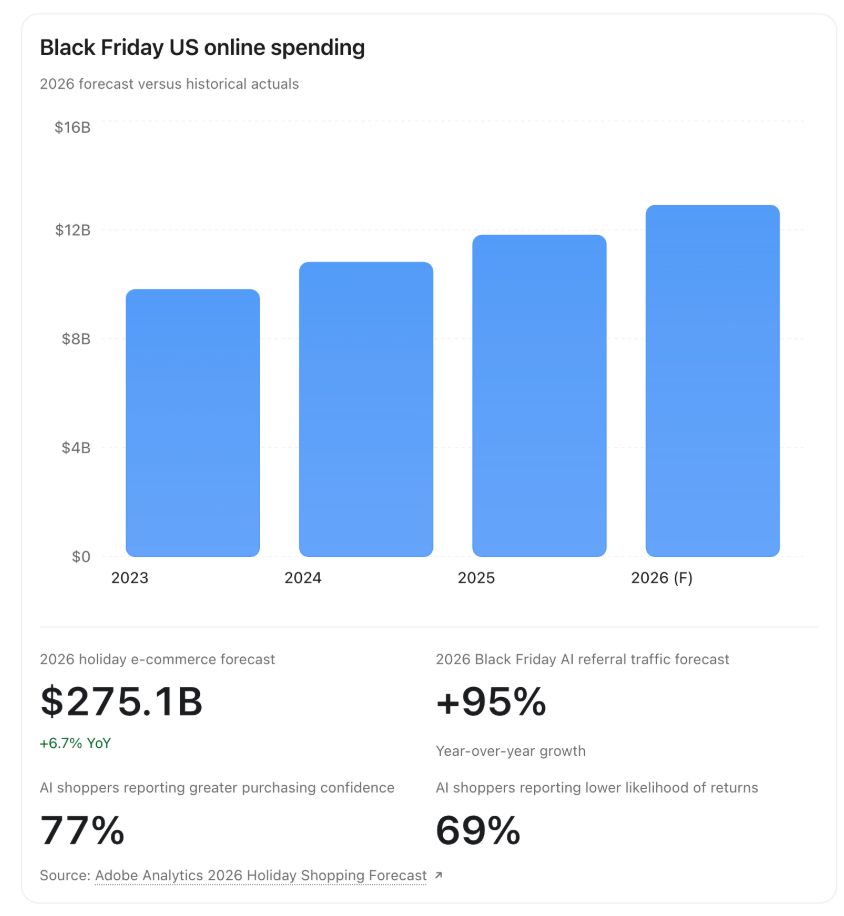
For 2026, Adobe's holiday shopping forecast projects $12.9 billion in Black Friday online spending, $15.1 billion on Cyber Monday and $275.1 billion across the holiday season. Adobe also anticipates that traffic from AI-powered tools to retail websites will increase 95% year over year on Black Friday. These projections suggest that artificial intelligence is becoming a more consequential interface for discovering and evaluating products.
Consumer behavior provides another important signal. Among surveyed consumers who had used AI for online shopping, Adobe found that 77% reported greater purchasing confidence and 69% said they were less likely to return an item. While these are self-reported outcomes, they point toward an opportunity for AI to improve the quality of purchasing decisions rather than solely increase transaction volumes.
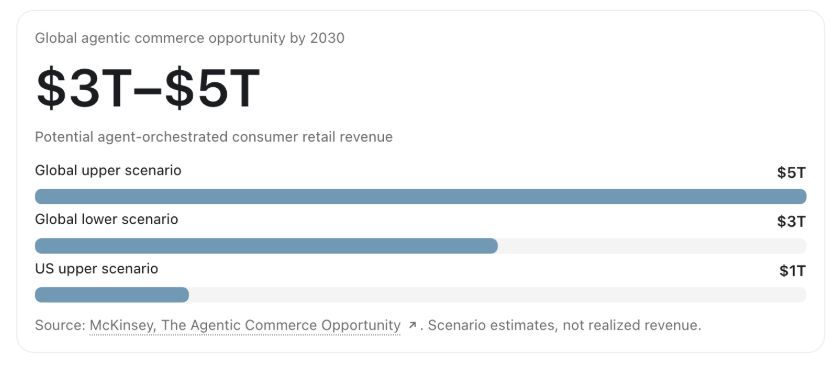
The longer-term economic opportunity for AI e-commerce could be substantial. McKinsey estimates that agentic commerce could orchestrate $3 trillion to $5 trillion in global consumer retail revenue by 2030, including up to $1 trillion in the United States. The significance of that projection extends beyond transaction volumes to the potential redistribution of economic value among consumers, retailers, brands and technology platforms.
Commerce for Needs and Commerce for Wants
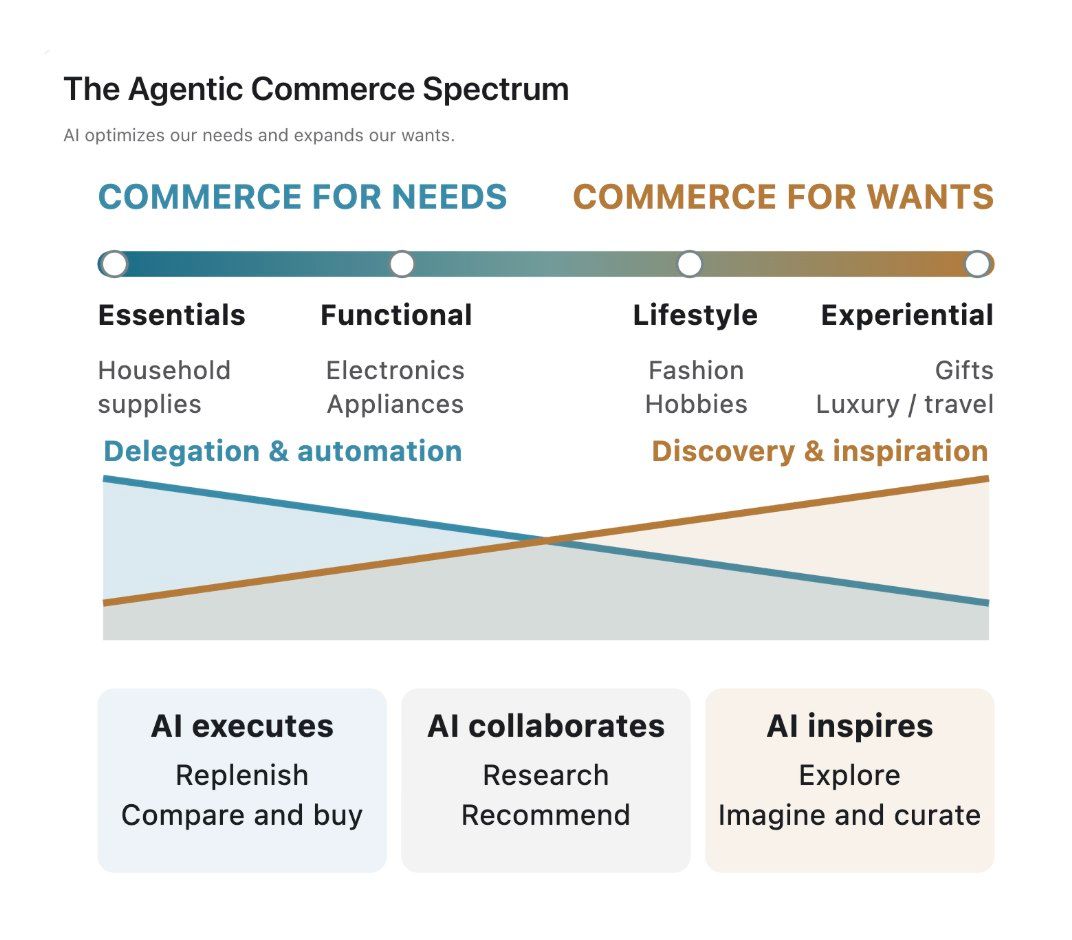
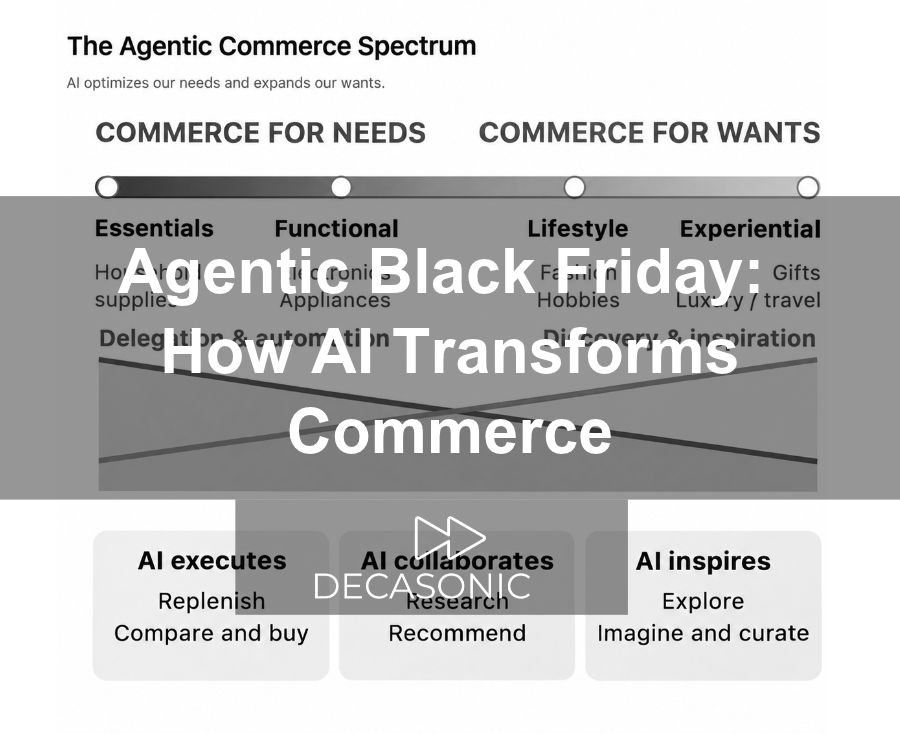
One of the most important distinctions in understanding the future of agentic commerce is the difference between shopping as a functional activity and shopping as an experiential activity. Consumers purchase products to fulfill needs, satisfy wants and express their aspirations. These motivations exist along a spectrum, and AI will create different forms of value across that spectrum.
Commerce for needs: Optimize the outcome
Household essentials, routine replenishment, commodity products and replacement purchases typically involve relatively well-defined requirements. Consumers often know what they need and would benefit from spending less time researching, comparing and ordering these products. Agentic commerce is particularly well suited to making these transactions more efficient.
Imagine a household agent monitoring the family budget, anticipating replenishment requirements and identifying Black Friday opportunities to purchase a year's supply of selected essentials at attractive prices. The agent could evaluate historical prices, alternative brands, bulk discounts and delivery costs. With appropriate permissions, it could execute purchases within predefined limits.
For these categories, the best shopping experience may be the one that requires the least shopping. Consumers can reclaim their time while making more informed decisions about household expenditures. Retailers can potentially benefit from more predictable demand, lower customer acquisition costs and fewer mismatched purchases.
Commerce for wants: Expand the experience
Consumers also shop for enjoyment, self-expression, exploration, social connection and inspiration. Discovering a new fashion brand, imagining a family vacation, exploring a new hobby or selecting a meaningful gift involves emotional and experiential dimensions that cannot be reduced to price optimization. In these categories, the discovery process itself creates value.
AI can dramatically expand this experience through personalized recommendations, generative interfaces, virtual try-ons and creative exploration. A personal shopping agent might introduce a consumer to emerging designers, niche products or experiences that would otherwise remain undiscovered. It can make the universe of relevant possibilities larger while helping the consumer navigate it.
The opportunity is to preserve and enhance the enjoyable elements of shopping while removing unnecessary friction. Consumers should retain control over the moments where discovery, judgment and personal expression matter most. AI becomes an augmentation of human imagination.
The needs-to-wants spectrum
Most purchases occupy positions somewhere between these two extremes. A winter coat may fulfill a practical need while also expressing personal style, and a laptop may serve professional requirements while reflecting aspirations about design and performance. The degree of AI autonomy should therefore reflect the consumer's motivation, preferences and the consequences of the decision.
The future of agentic commerce will involve dynamic collaboration between people and their agents. Consumers will delegate some decisions, collaborate on others and retain complete control over purchases where the experience is integral to the outcome. The differentiated AI shopping products will recognize when to optimize, when to inspire and when to give people space to explore.
Three Emerging Black Friday Shopping Experiences
Mass comparison shopping: Intelligence becomes purchasing power
Black Friday is an unusually complex environment for purchasing decisions. Thousands of retailers simultaneously introduce promotions, product bundles, limited-time discounts, loyalty incentives and inventory constraints. The resulting information asymmetry often makes it difficult for consumers to determine whether an advertised deal represents genuine economic value.
AI shopping agents can evaluate far more alternatives than a consumer could reasonably research independently. They can analyze historical pricing, comparable products, shipping costs, warranties, merchant reputations, expected durability and return policies. The relevant metric becomes the total value of the purchase rather than the advertised percentage discount.
Google's Universal Cart, launched in the United States in October 2026, illustrates an early step toward this future by consolidating products across merchants and monitoring promotions. Its earlier AI holiday shopping capabilities introduced conversational comparison, local inventory research and permission-based agentic checkout. These experiences are beginning to connect product discovery with purchasing execution.
The ability to evaluate Black Friday AI deals across merchants could help consumers distinguish genuine savings from promotional incentives.
In the future, personal agents could continuously monitor markets on behalf of consumers rather than restricting their search to the hours of Black Friday. They could identify when a product is likely to reach a desired price, evaluate whether waiting is worthwhile and recommend alternative products when inventory changes. Black Friday could evolve from an event that rewards consumers with the most time and patience into one that rewards consumers with the best purchasing intelligence.
Agentic loyalty: From merchant rewards to consumer outcomes
Traditional retail loyalty programs have been designed largely to encourage repeat purchasing within a particular merchant's ecosystem. Consumers accumulate points, receive targeted promotions and gain access to exclusive benefits, often across dozens of disconnected programs. Understanding the relative economic value of these incentives introduces another layer of complexity into purchasing decisions.
Personal commerce agents could aggregate these relationships and evaluate them holistically. They could consider available rewards, credit card benefits, membership discounts, shipping privileges and expiring credits when recommending where to purchase a product. A retailer offering the lowest advertised price might ultimately lose a transaction to another merchant providing greater total value.
This raises a deeper question about the future of loyalty. Will consumers remain primarily loyal to individual retailers, or will they become loyal to the personal agents that consistently deliver the best outcomes across retailers? The agent itself could become the most valuable consumer relationship in commerce.
For brands and retailers, this creates an opportunity to build loyalty around verifiable product quality, service reliability and differentiated experiences. Businesses may also develop direct relationships with consumer-authorized agents, creating new forms of personalized offers and negotiated benefits. Loyalty could become more reciprocal, with businesses earning repeat purchases through demonstrated value.
Personalized wish lists: Rediscovering the joy of gift-giving
The holiday wish list has evolved from handwritten notes and printed catalogs to digital registries and shared shopping lists. Personal AI can introduce a new dimension by helping people discover gifts based on their understanding of loved ones. AI gift recommendations could combine contextual intelligence, creativity and personalized discovery.
Imagine creating an AI-assisted wish list for your family that reflects each person's interests, hobbies, aspirations and previous gifts. A parent could explore educational toys aligned with a child's curiosity, experiences that the family could enjoy together or products that encourage a developing creative skill. The agent could then compare Black Friday opportunities within a predetermined budget.
Multiplayer AI could extend this experience to groups of friends and families. With consent and appropriate privacy protections, personal agents could coordinate wish lists, prevent duplicate purchases and surface shared experiences that people might enjoy together. They could help consumers discover thoughtful gifts beyond the products that dominate conventional retail advertising.
The most interesting opportunity here is deeply human. By reducing time spent on transactional research, AI can create more space for the consideration and imagination that make gift-giving meaningful. The objective is to make the experience more personal, expressive and connected.
From Search Engine Optimization to Generative Engine Optimization
The rise of AI shopping agents will transform how brands and merchants approach digital distribution. Search engine optimization (SEO) helped businesses compete for visibility in search results, while social commerce introduced new opportunities through creator-led discovery. Generative engine optimization (GEO) introduces a new challenge: earning inclusion in AI-generated recommendations.
In agentic commerce, accurate and accessible product information becomes a strategic asset. AI agents need reliable information about specifications, inventory, pricing, shipping, customer reviews, merchant reputation and returns. Brands with differentiated products and high-quality structured data may gain distribution advantages across AI shopping platforms.
Google's September 2026 agentic commerce updates illustrate this transition through new tools for merchants to monitor AI-driven discovery and strengthen product feeds. As agentic distribution expands, businesses will increasingly evaluate how often their products appear in AI recommendations. They will also need to determine whether that visibility translates into profitable transactions and enduring customer relationships.
For emerging brands, this could create attractive new distribution opportunities. A small merchant with an exceptional product, credible reviews and competitive fulfillment could become discoverable to consumers beyond its existing advertising reach. The risk is that new AI intermediaries could reproduce existing platform concentration through sponsored recommendations, exclusive integrations and preferential placement.
Five Questions for the Future of Commerce
If comparison shopping becomes nearly perfect, what happens to pricing power?
Amazon expanded price transparency, but personal shopping agents could make comparisons more comprehensive, continuous and contextual. Commoditized products may increasingly compete on measurable value, while differentiated brands could retain pricing power through emotional connection, quality and experiences that are more difficult to replicate. Retailers may have to reassess which advantages depend on information asymmetry and which deliver genuine consumer value.
Who owns the customer relationship when the agent owns the interface?
Historically, retailers have invested heavily in acquiring customers and building repeat purchasing relationships. If personal AI agents increasingly mediate discovery and purchasing, a portion of this strategic value could migrate toward the companies operating those interfaces. The emerging competition for consumer trust, contextual memory and permission to transact may prove more consequential than the competition for website traffic.
Could agentic commerce make Black Friday less important?
Retailers have traditionally concentrated promotions around predictable periods of consumer demand. Personal agents that monitor pricing throughout the year could weaken the artificial urgency associated with these events and enable purchasing whenever attractive opportunities emerge. Black Friday could retain its cultural significance while losing some of its economic importance as continuous intelligent purchasing becomes mainstream.
Will AI increase consumption or improve consumption?
Agentic commerce could encourage additional purchases by reducing friction and uncovering previously undiscovered products. Equally, consumer-aligned agents could help households avoid unnecessary purchases, reduce returns, manage budgets and prioritize durability. The answer will depend substantially on whether agents are rewarded for maximizing spending or improving consumer outcomes.
Can the long tail of commerce become economically viable?
Personal AI could connect highly specific consumer preferences with specialized products from independent brands, artisans and smaller merchants. By reducing the cost of discovery and helping consumers evaluate unfamiliar sellers, agents could expand markets for differentiated products that previously struggled to acquire customers. Commerce could become simultaneously more efficient for standardized needs and more diverse for individualized wants.
What Will Define the Winners in Agentic Commerce?
As a product-first technology investor, I am particularly interested in the emergence of new consumer behaviors that become durable over time. The history of commerce suggests that category leadership emerges when new technologies deliver differentiated experiences compelling enough to change people's everyday habits. Agentic commerce will be no exception.
The strongest companies will demonstrate measurable improvements in consumer outcomes, including time saved, money saved, purchasing confidence, repeat engagement and product satisfaction. Businesses serving recurring needs will need to establish reliable execution and attractive unit economics, while businesses focused on wants will need to create experiences worth returning to. Both categories will depend on earning consumer trust and aligning incentives.
Infrastructure will also matter as AI shopping agents gain transactional capabilities. Interoperable payment systems, secure identity, verified product information and consumer-controlled permissions will help make delegated commerce more reliable. Emerging programmable financial infrastructure, including selected Web3 technologies, could complement these developments where it improves transaction efficiency or interoperability.
I expect the most transformative commerce products to combine personal intelligence, contextual memory, differentiated interfaces and continuous learning from purchasing outcomes. They will understand the difference between optimizing a household replenishment order and helping someone discover a meaningful holiday gift. Their competitive advantage will emerge from how well they serve the consumer across these different experiences.
Expanding the Possibilities of Commerce
Marshall Field's expanded the experience of shopping, the Sears catalog expanded its geographic reach and Amazon expanded its assortment. Groupon introduced shopping at the point of inspiration, connecting consumers with products throughout their everyday lives. Personal AI expands the intelligence available to consumers at the point of intent.
The next generation of commerce has the potential to make purchasing more efficient, discovery more imaginative and economic participation more inclusive. Consumers could gain greater control over their spending, independent merchants could reach new audiences and families could enjoy more personalized shopping experiences. These possibilities become particularly compelling when AI is designed to augment human agency.
This Black Friday, the opportunity extends beyond finding better deals. It is an opportunity to imagine how commerce evolves when every person has access to intelligence that can understand their needs, expand their imagination and act in their interests. The next great shopping experience may be as personal as the individual experiencing it.
The content of this material is strictly for informational and educational purposes only. It is not intended to constitute investment advice, nor should it be considered a recommendation or a solicitation to buy, sell, or hold any asset. Decasonic does not endorse investments in any specific tokens, and nothing in these blog posts should be construed as legal, tax, or financial advice. Please consult with a qualified professional advisor before making any financial decisions. Decasonic provides no warranties, whether expressed or implied, on the content provided in these blog posts, including its accuracy, completeness, or correctness. The opinions expressed here are those of the authors and do not necessarily reflect the views of Decasonic. Please note that Decasonic may hold a position in some of the tokens mentioned, including Virtuals. Decasonic is not liable for any errors or omissions in the content of this material or for any actions taken based on the information provided herein.
Frequently Asked Questions
What is agentic commerce?
Agentic commerce is the use of AI agents to research, compare, recommend and execute purchasing decisions on behalf of consumers or businesses. These agents can incorporate personal preferences, budgets and contextual information into their decisions. More advanced systems can complete transactions within user-authorized parameters.
How is AI changing Black Friday shopping?
AI shopping agents help consumers evaluate products, compare historical prices and identify relevant promotions across multiple retailers. They can also incorporate loyalty rewards, delivery costs and return policies into purchasing recommendations. These capabilities can improve purchasing confidence and reduce the time required to find attractive deals.
What is the difference between commerce for needs and commerce for wants?
Commerce for needs centers on functional requirements, convenience and purchasing efficiency, making it particularly suitable for automation through AI agents. Commerce for wants involves discovery, aspiration, self-expression and emotional experiences. AI creates value in both categories through different combinations of automation, collaboration and inspiration.
How will agentic commerce affect retailers and brands?
Retailers will increasingly compete for visibility within AI-generated product recommendations and agent-mediated purchasing decisions. Accurate structured product data, competitive pricing, fulfillment reliability and verified customer satisfaction will become more important. Differentiated brands may also benefit from AI's ability to connect specialized products with highly specific consumer preferences.