


in this piece
all perspectives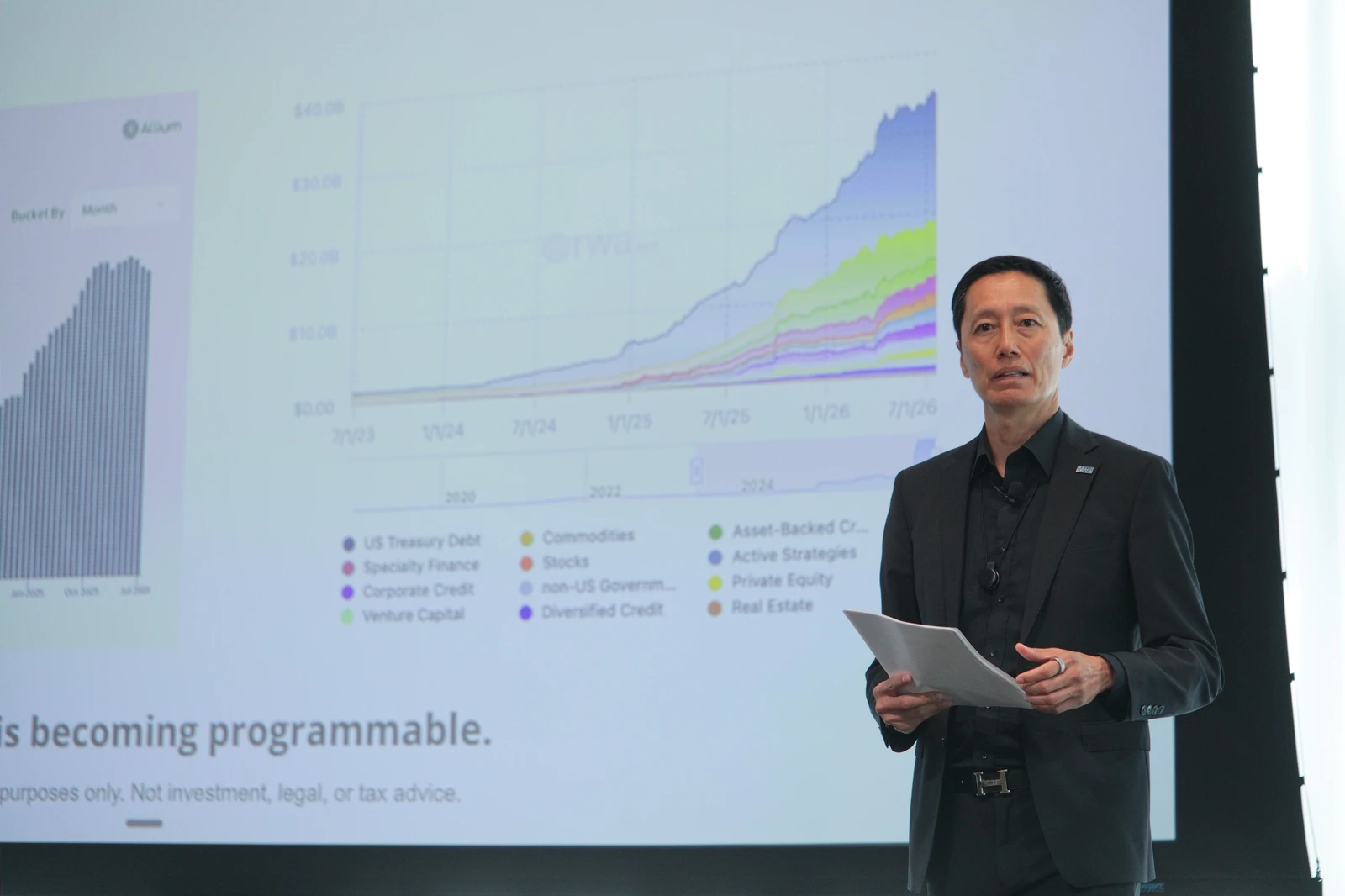
At Decasonic, we believe early-stage investors should do more than observe technology shifts from a distance. We should build with the systems, test the products, understand the workflows, and form our views through direct operating experience.
That is especially true at the intersection of Web3 x AI.
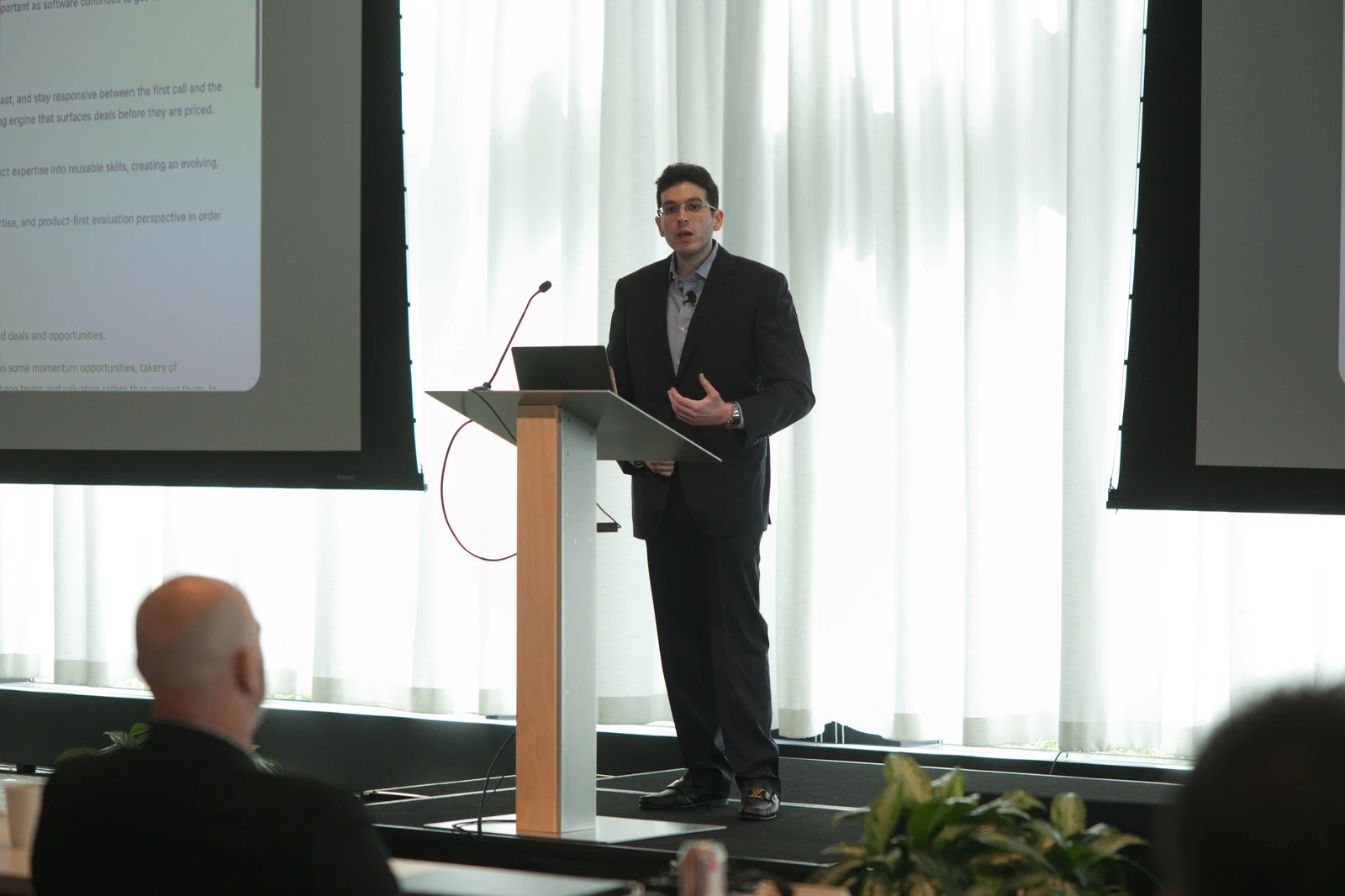
Paul Hsu and Abdul Al Ali recently shared Decasonic’s State of Web3 x AI thesis and demonstrated how we are applying it inside our own AI-native operating system during the 5th Annual Web3 Investor Day. Their central argument was clear: AI is making intelligence abundant, while Web3 is making trust programmable. Together, they are enabling a new class of intelligent economic participants that can act, coordinate, and exchange value.
This convergence is beginning to reshape how firms operate, how markets coordinate, and how value is created across the economy. The opportunity now is to build the infrastructure, applications, and businesses that make this emerging AI economy useful, trusted, and widely adopted.
Two adoption curves are converging
The first curve is AI.
The cost of delivering AI has fallen dramatically, with annual reductions in inference costs ranging from approximately 40x to 900x depending on the model and use case. As with earlier technology cycles, sharp cost declines expand access and accelerate adoption.
That is already visible inside the enterprise. According to the data presented during our Web3 Investor Day session, 88% of leading firms are running at least one AI pilot, while approximately one quarter have moved AI into production.
The implication is straightforward: intelligence is becoming abundant.
Capabilities that were once expensive, scarce, or limited to large technical organizations are becoming accessible to smaller firms, individual operators, and software systems.
As frontier models improve and open-source and open-weight models continue to advance, the base layer of intelligence becomes more widely available.
The second curve is Web3 infrastructure.
Stablecoin supply has grown from almost nothing in 2019 and 2020 to approximately $270 billion. Tokenized assets have expanded into a market exceeding $34 billion. The precise figures will continue to change, but the direction is clear: more value, assets, and financial activity are moving onto programmable rails.
This is why we describe the second shift as trust becoming programmable.
Blockchains, digital assets, identity systems, and on-chain transactions allow rules around ownership, permissions, provenance, and exchange to be embedded directly into software.
When these two curves converge, AI systems move beyond generating information. They begin to act as economic participants.
AI systems are becoming economic actors
We are already seeing early evidence of this transition.
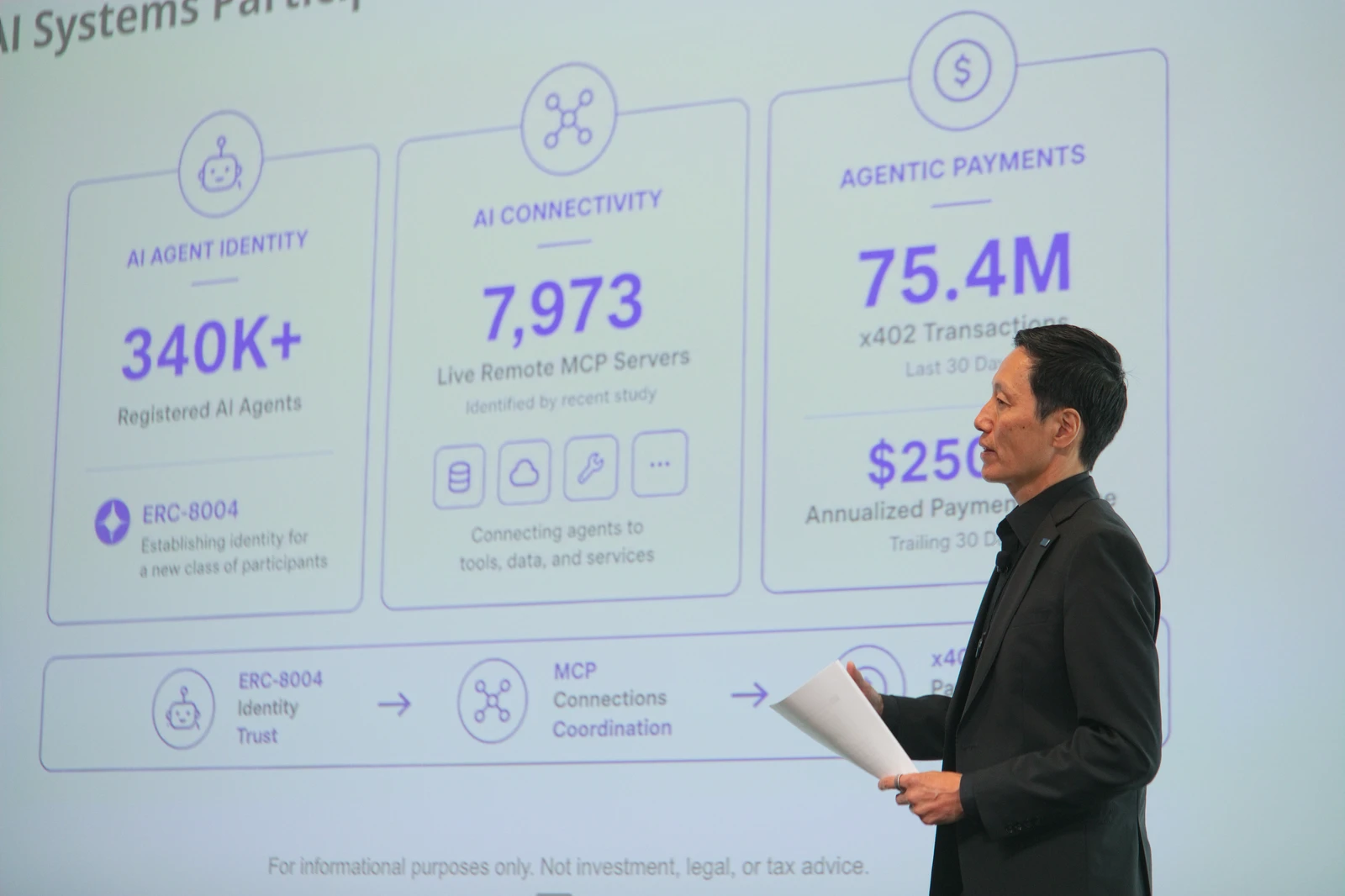
More than 340,000 AI agents have been registered on Ethereum through emerging identity standards. Nearly 8,000 live MCP servers are connecting agents to tools, data, and software services. Agent-to-agent payments have reached tens of millions of transactions, with approximately $250 million in annualized payment volume based on the trailing period discussed in our presentation.
These are still early data points, but they illustrate the systems pattern beginning to form.
Agents need identity so they can be recognized as participants. They need connectivity so they can access tools, services, data, and other agents. They need payment infrastructure so they can compensate those services based on usage.
This is not the first time technology has expanded economic participation.
The Industrial Revolution amplified physical labor. The Internet connected people and accelerated the movement of information. Mobile placed that connectivity in everyone’s pocket. Web3 and AI is another revolution that will bring fresh economic actors into our global economy.
We believe the Web3 x AI cycle will introduce a new class of economic participants: software agents capable of creating, coordinating, and exchanging value.
The market has spent significant time discussing AI automation. Last year, we focused on AI augmentation with our product demos at the 4th Annual Investor Day conference.
This year, our operating experience has increasingly centered on AI economic activity.
That distinction matters.
Automation improves an existing workflow. Augmentation improves human performance. Economic participation creates entirely new forms of economic activity between humans, agents, companies, and machines.
As intelligence becomes abundant, expertise becomes scarce
Our view is that as intelligence becomes abundant, expertise becomes scarce.
That is a contrarian position. Others believe that both intelligence and expertise will become broadly abundant. We have reached a different conclusion because of what we have built inside Decasonic.
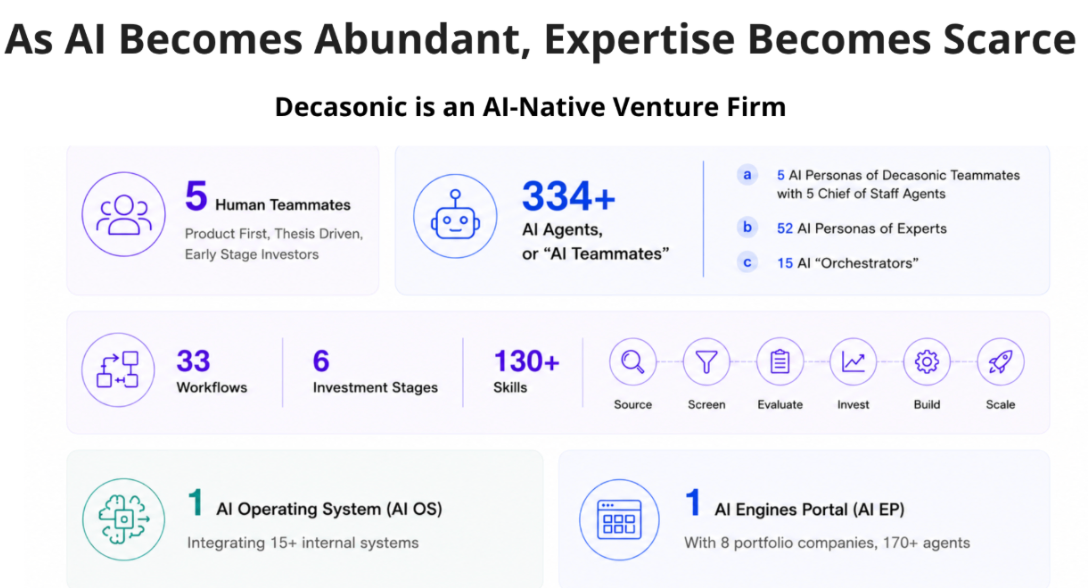
We are an AI-native venture firm. Our human team is supported by more than 330 AI agents and teammates, including orchestrators, chief-of-staff agents, teammate personas, and external synthetic experts. Our AI operating system captures workflows across six stages of investing and more than 130 skills that codify how we source, screen, invest, and support companies.
The important point is not the number of agents.
The number changes constantly as we specialize, retrain, combine, and remove systems based on performance. The more important asset is the expertise those systems can access and the way that expertise is orchestrated.
We distinguish between two forms of expertise.
The first is internal human expertise. This includes our investment frameworks, judgment, processes, pattern recognition, and the lessons we have developed through operating and investing.
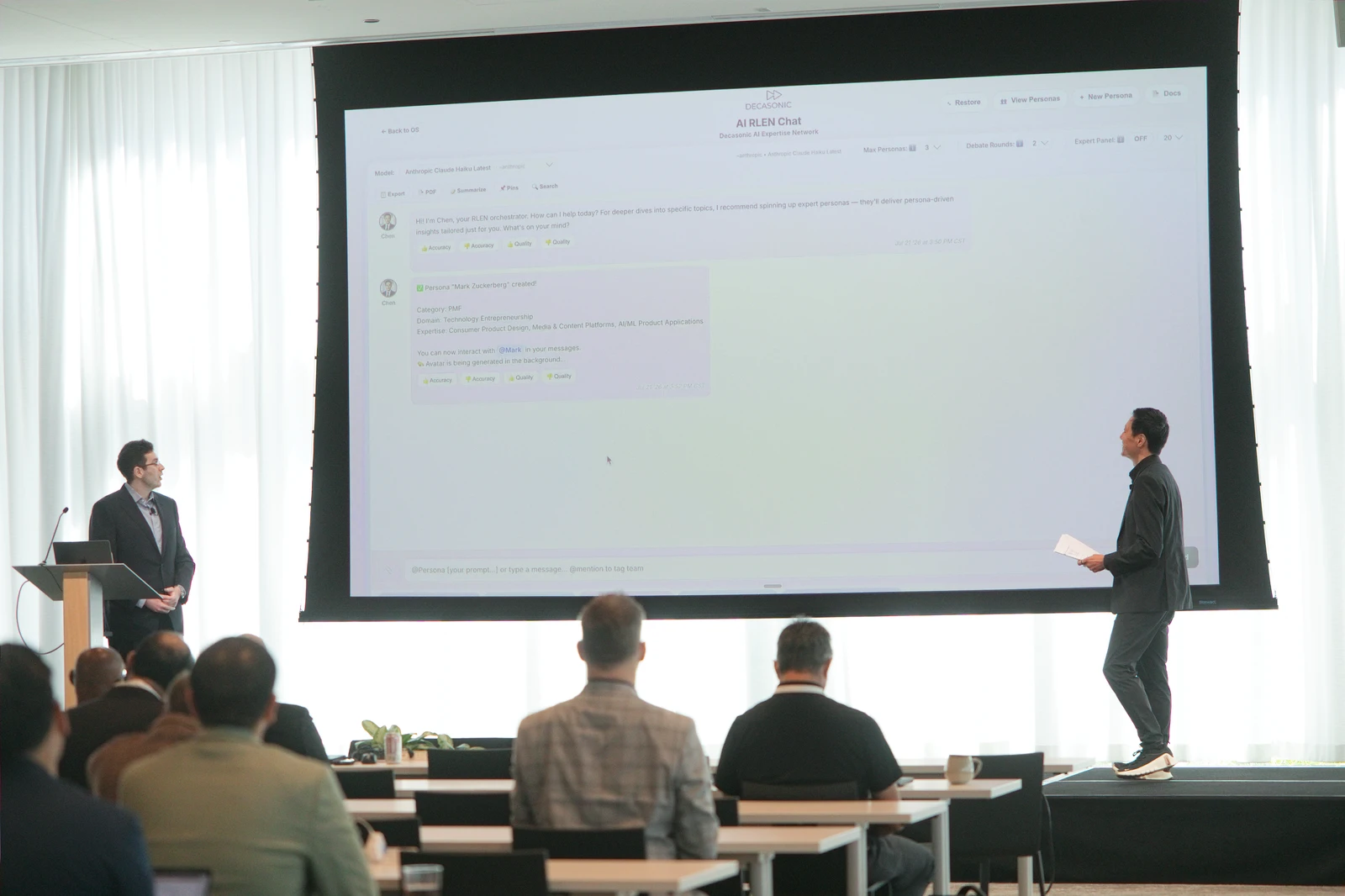
The second is external synthetic expertise. We have built a network of AI personas designed to provide on-demand perspectives from investors, founders, operators, and domain experts. Our reinforcement-learning expertise network allows us to assemble panels, test questions across different perspectives, and synthesize the resulting views.
These systems do not replace human expertise. They help deploy and scale it.
The durable advantage is not simply access to a frontier model. It is the ability to codify, test, update, and orchestrate expertise across the organization.
Expertise can be codified inside a firm
Inside Decasonic, we codify expertise through skills.
These are instruction files that give our AI systems access to the best practices, frameworks, and operating guidance required for specific workflows. Some are created by our team. Some are generated or suggested by AI. Others come from external marketplaces or open-source repositories.
The challenge is that as skills become more abundant, the bottleneck shifts to trust.
A skill may look useful but fail to improve the outcome. It may introduce risk, hallucinate, rely on poor context, or produce work that does not align with the organization’s standards.
This is why we built a testing environment for our agents and skills.
Before a skill enters production, we evaluate its quality, safety, relevance, and effectiveness. We test whether it improves the output for a real use case and whether that improvement moves the system closer to a measurable outcome.
This reflects one of our core operating beliefs: AI systems need feedback, benchmarks, observability, and the ability to improve.
Agents should not remain in the system simply because they were created. They should remain because they are trusted and useful.
Web3 provides three foundational capabilities
As expertise begins to move across people, agents, and firms, Web3 can provide three foundational capabilities: trust, coordination, and ownership.
These are not abstract concepts. They are practical requirements for an economy in which AI systems participate alongside humans and organizations.
Trust enables confident decisions
AI systems can hallucinate. They can receive the wrong memory, the wrong permissions, or the wrong context. Poor inputs produce poor outputs.
Trust requires identity, permissions, provenance, and a clear distinction between facts, opinions, and generated analysis.
This applies at every layer of the AI economy.
A human needs to know whether an agent is authorized to act. An agent needs to know whether a tool is safe to use. A company needs to know whether an external service can be trusted with sensitive information. A marketplace needs to know whether a participant has performed reliably before.
Without trust, there is no meaningful coordination. Without coordination, there is no functioning economy.
The testing systems we have built inside Decasonic are one way we establish trust internally. Web3 can extend similar principles across organizations by making identity, permissions, transactions, and provenance more verifiable.
Coordination creates value together
The second capability is coordination.
Our design principle is that AI and humans should collaborate.
In some workflows, AI may complete 90% of the work while a human contributes the final judgment. In others, the human may do most of the work while AI provides analysis, automation, or decision support.
The ideal balance depends on the workflow.
Inside our AI operating system, humans, agents, skills, enterprise data, workflows, and external services are coordinated through a shared interface. We use MCPs to connect different systems and allow agents to access specialized capabilities.
In the demonstration, we showed how our systems could use Scenario for image and video generation, Orthogonal for skills and API orchestration, and Venice for private AI use cases. These services were not operating independently. They were coordinated with internal files, teammates, knowledge bases, and portfolio-company context to complete multi-step workflows.
This is a practical example of how the AI economy may develop.
Value will not be created by one model or one agent acting alone. It will be created by systems capable of coordinating the right expertise, tools, data, and participants around an intended outcome.
Ownership enables economic participation
The third capability is ownership, and it remains the most frontier part of our thesis.
As expertise becomes portable, important questions emerge.
Who owns a codified skill? Who owns the context that improves an agent? Who owns a prediction, a scenario, or a future world state generated by an AI system? How should that value be attributed when it moves between people, agents, and organizations?
We have been exploring how predictive context and possible future states could be recorded on-chain and used by agents to guide future actions.
This work is still early.
However, we believe the second-order effect of prediction markets and world models may be a new category of ownable intelligence. AI systems will increasingly generate possible scenarios of how the world could look minutes, months, or years from now. Those scenarios may influence decisions, workflows, investments, and economic activity.
If expertise becomes portable, ownership becomes essential.
Web3 can provide infrastructure for assigning rights, establishing provenance, and allowing the creators and contributors of expertise to participate in the value it generates.
AI creates economic actors. Web3 provides the economic infrastructure.
The clearest summary of our thesis is this: AI creates new economic actors. Web3 provides the economic infrastructure.
AI systems are becoming capable of working, coordinating, and transacting. Web3 provides the identity, trust, connectivity, payment, and ownership layers that allow those actors to participate in a broader economy.
When AI meets Web3, expertise becomes portable.
That does not mean every AI application needs a token or that every workflow should be placed on-chain. The relevant question is whether Web3 improves the system’s ability to establish trust, coordinate value, or assign ownership.
The strongest applications will use each technology for the function it performs best.
AI can make expertise more accessible and actionable. Web3 can make that expertise more verifiable, transferable, and ownable.
A moment to build and shape the future
We remain early in the formation of the AI economy.
The identity systems are emerging. The connectivity layer is developing. Agent-to-agent payments are increasing. Enterprises are learning how to codify their expertise. New systems are being built to test, coordinate, and improve AI performance.
The ownership layer is less developed, but it may become one of the most important.
The next generation of Web3 x AI companies will not be defined by combining two popular technology narratives. They will be defined by whether they enable new economic participation.
Can an AI system establish trust? Can it coordinate with people, agents, machines, and firms? Can it exchange value? Can expertise move across systems without losing its provenance or ownership?
These are the questions we are exploring as investors and operators.
Intelligence is becoming abundant.Trust is becoming programmable.Expertise is becoming portable.
It is a remarkable moment to be building and shaping what comes next. We’re excited to co-build what’s to come.
The content of this material is strictly for informational and educational purposes only. It is not intended to constitute investment advice, nor should it be considered a recommendation or a solicitation to buy, sell, or hold any asset. Decasonic does not endorse investments in any specific tokens, and nothing in these blog posts should be construed as legal, tax, or financial advice. Please consult with a qualified professional advisor before making any financial decisions. Decasonic provides no warranties, whether expressed or implied, on the content provided in these blog posts, including its accuracy, completeness, or correctness. The opinions expressed here are those of the authors and do not necessarily reflect the views of Decasonic. Please note that Decasonic may hold a position in some of the tokens mentioned, including Virtuals. Decasonic is not liable for any errors or omissions in the content of this material or for any actions taken based on the information provided herein.