
Unlocking faint Web3 x AI signals for investment alpha -– Eugene Tsai, Venture Data Analyst at Decasonic
Introduction
In the Web3 x AI venture landscape, the most compelling opportunities often emerge before a narrative reaches broad agreement or obvious market attention. The firms that consistently generate outsized outcomes are those that act on subtle, faint indicators in usage, building activity, and community engagement months before the crowd arrives. When deployed with intentional workflows, AI has enabled this capability at scale by integrating on-chain activity, developer ecosystems, community dynamics, and emerging research into predictive intelligence.
The purpose of this blog post is threefold. First, I explain why non-consensus signals define the new alpha frontier. Second, I present a practical three-step framework that shows how to use AI to systematically spot these signals. Finally, I describe how a feedback loop grounded in human-AI alignment strengthens their accuracy and introduces Decasonic’s AI operating system as the signal engine for this workflow, along with the upcoming AI category screener that I am building to connect themes, categories, and assets.
Using the intersection of Web3 x AI as the core context, I outline how investors can turn faint, early patterns into conviction and, ultimately, differentiated investment alpha.
Why Early Non-Consensus Signals Matter for Alpha
Non-consensus signals are measurable outliers from prevailing market assumptions that often precede major value creation in Web3 x AI. Past examples include:
- NVIDIA’s early commitment to CUDA (beta launch February 2007) is a classic non-consensus signal: Jensen Huang repeatedly invested in GPU compute for general purpose and AI workloads long before the market appreciated its importance, ultimately turning a niche technical bet into a core pillar of the modern AI stack.
- DeepSeek’s rise (first model DeepSeek Coder launched November 2023) is accelerating the shift toward open-source AI, with its low-cost, high-performance models catalyzing broader adoption of community-driven LLMs and reinforcing enterprise interest in open-source approaches highlighted in recent a16z work on model choices.
- At the Web3 x AI intersection, the emerging agentic wave is visible first in infrastructure and standards, with proposals like x402 (announced May 2025) and ERC-8004 (proposed Aug 2025) and their early integrations around AI agents signaling a developing on-chain economy well before it becomes a mainstream narrative.
Most observers disregarded these early technical adoption indicators, yet they ultimately generated extraordinary returns for those who recognized their significance before broad awareness formed. In an environment now producing vast amounts of technical and social data each day, AI can reliably surface the next wave of outlier signals through a disciplined and repeatable framework.
How to Use AI to Spot Non-Consensus Signals: A Three-Step Framework
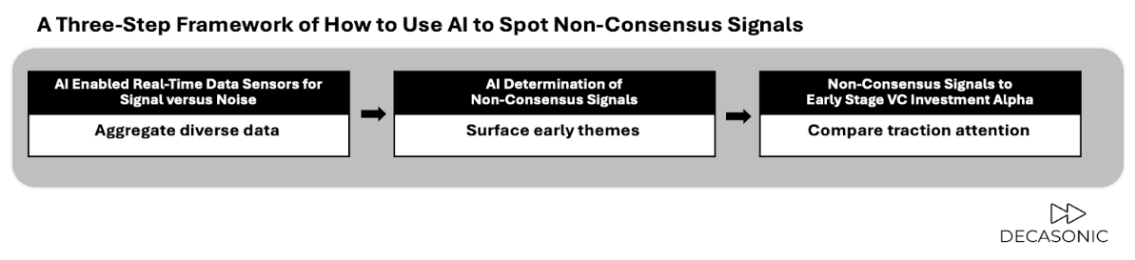
1. AI Enabled Real-Time Data Sensors for Signal versus Noise
AI aggregates diverse, previously disconnected datasets from on-chain activity, open source development, community conversations, and emerging academic work. By integrating these streams into a unified real-time context, AI can reveal early trajectories of signal versus noise long before they become evident to human observers. The core idea is to let models continuously watch the full Web3 x AI surface so they can spot when multiple small signals start to move together, even if no single metric looks dramatic on its own.
For Web3 x AI investors, this can be as simple as setting up a data layer that tracks protocol adoption metrics. For a deeper dive into how to define and interpret those adoption metrics across cycles, see my earlier blog post specifically on Web3 x AI adoption metrics. The point is to quickly see many small movements together in one place, rather than checking each data source in isolation.
2. AI Determination of Non-Consensus Signals
After integration, AI identifies rare anomalies, latent clusters, accelerating semantic trends, and cross-domain relationships by measuring consensus through prediction markets and sentiment analysis. In practice, this means models can detect when usage, development, and conversation around a Web3 x AI theme are quietly moving together, even if that theme is still small, messy, and largely ignored by mainstream narratives.
AI flags steady rises in real usage, developer activity, and on-chain behavior around niche Web3 x AI topics before mainstream notice. The goal is not to predict everything but to consistently surface a small set of early themes that merit deeper review within a human-AI aligned investment process, where investors teach the system which combinations of signals actually matter.
3. Non-Consensus Signals to Early Stage VC Investment Alpha
AI transforms spotted non-consensus signals into early-stage VC investment alpha by quantifying the gap between genuine Web3 x AI traction and market consensus, prioritizing opportunities where building outpaces hype. This step ranks emerging patterns such as protocol adoption surging ahead of price action, funding flows, or social buzz using historical benchmarks to highlight rare mismatches ripe for outsized returns.
In practice, AI scans for Web3 x AI themes showing steady on-chain usage, developer commits, and retention growth decoupled from narrative share, flagging them as high-alpha bets before consensus catches up. Investors then provide feedback loops, teaching the system to refine judgments on signal durability and risk, creating a human-AI engine that consistently converts non-consensus insights into repeatable early VC edges.
While AI can systematically surface faint signals at scale, the strongest conviction insights emerge when these machine generated patterns are interpreted through human expertise, contextual understanding, and strategic judgment.
The Human-AI Alignment Strengthens Signal Accuracy
AI excels at scanning massive and noisy data streams to identify patterns that would be impossible for any individual to detect. Yet these signals become truly investable only when combined with human intuition, context, and domain experience. The most effective early stage investors treat AI as a discovery engine that highlights potential anomalies, while humans determine which represent genuine emerging momentum rather than anomalies or noises.
Each time humans validate, refine, or reject model generated insights, AI learns which features and patterns hold real predictive value. This creates a self reinforcing refinement loop in which AI becomes increasingly precise at surfacing authentic, high value trajectories, and humans become more adept at interpreting early technical and social movements.
Over time, this partnership evolves into a powerful mechanism for converting scattered signals into predictive clarity, significantly increasing both the accuracy and investability of non- consensus insights. As this human-AI alignment compounds, Decasonic’s AI operating system turns it into a signal engine that runs across the entire investment workflow.
Decasonic’s AI Operating System as the Signal Engine
Decasonic’s AI operating system operationalizes the human-AI alignment described above, turning signal discovery into reliable, high-throughput workflows. It runs on principles where agents own defined jobs with input contracts and success metrics, ensuring role clarity and accountability. The Decasonic Agentic Knowledge Repository (DAKR) serves as the structured brain, enabling agents to retrieve, reason over, and cite from memos, market maps, and product docs with full traceability. For a deeper breakdown of this architecture, see our previous blog post on the AI operating system.
Key outcomes show dramatic efficiency gains across investment functions. AI Due Diligence cuts from 6 hours to 20 minutes, AI Sourcing scales to hundreds of leads overnight, AI Product Evaluation uses Reinforcement Learning Expert Network (RLEN) for rapid side-by-side tests, and AI Product Management achieves 60x reduction via AI building AI.
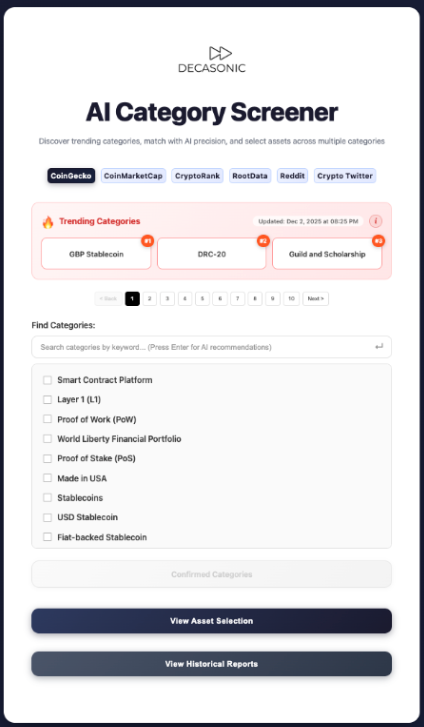
Building on this foundation, the upcoming AI category screener that I am building will match themes to categories with three value propositions:
1. Trending categories surfaces rising themes from top crypto sources
2. Categories matching delivers AI-precision lists of relevant subcategories
3. Asset selection provides multi-category tokens for quick positioning from narrative to assets
Conclusion
As the Web3 x AI ecosystem accelerates, the ability to spot early faint signals before they gain mainstream recognition will increasingly distinguish leading venture firms from the rest of the market. AI now provides investors with a new dimension of visibility, enabling them to sense emerging trajectories across multiple datasets long before they are widely understood. When combined with human intuition and domain awareness, this becomes a dynamic system for transforming early patterns into strategic foresight.
The next generation of category defining opportunities will emerge not from consensus thinking, but from disciplined early signal discovery powered by machine intelligence and human judgment working in tandem. Those who develop this capability today will shape the alpha frontier of tomorrow.
If you are building in this intersection and contributing to the future of Web3 x AI, please reach out to Decasonic as we continue to collaborate with founders driving the next wave of innovation.
The content of this material is strictly for informational and educational purposes only. It is not intended to constitute investment advice, nor should it be considered a recommendation or a solicitation to buy, sell, or hold any asset. Decasonic does not endorse investments in any specific tokens, and nothing in these blog posts should be construed as legal, tax, or financial advice. Please consult with a qualified professional advisor before making any financial decisions. Decasonic provides no warranties, whether expressed or implied, on the content provided in these blog posts, including its accuracy, completeness, or correctness. The opinions expressed here are those of the authors and do not necessarily reflect the views of Decasonic. Please note that Decasonic may hold a position in some of the tokens mentioned, including Virtuals. Decasonic is not liable for any errors or omissions in the content of this material or for any actions taken based on the information provided herein.