

in this piece
all perspectivesIntroduction
Deployment of Physical AI is accelerating. The acceleration is driven by the inflection points observed over the past year, aided by the continued capability expansion of software AI into embodied devices. Signals around these inflection points include: (1) models priced per usage, (2) in-context learning (ICL), enabling devices to learn new tasks with velocity, (3) simulation advancements with higher fidelity in quality, accuracy, and performance, (4) data scaling, where larger and higher-quality datasets translate into higher task performance, (5) business model standardization, and (6) evaluations being rolled out for Physical AI, accelerating AI machines deployment at scale.
As deployment continues to accelerate, the key question becomes where value accrues across the Physical AI stack. The parallels in the value accrual between software AI and Physical AI are increasingly hard to ignore, and we believe software AI offers the clearest set of learnings on where value in Physical AI will accrue.
We envision Physical AI to be specialized and augmentative, with a lens on human-robot collaboration. This includes specialization across models, hardware, and inference. In this environment, we believe value accrues to the applications and interfaces that turn that specialization into high-value deployment at scale.
Intelligence: The Model Layer
The model layer is the intelligence layer of Physical AI, and that intelligence is becoming increasingly abundant. This is primarily driven by (1) the generalization of software LLMs into the control of physical devices, and (2) the growing number of publicly available robot model APIs, alongside model gateways that offer post-training as a service.
The model layer for Physical AI has primarily focused on (1) Robot Foundation Models (RFMs) or (2) the orchestration of multiple RFMs, in the form of VLAs working alongside world action models (WAMs). The key inflection point observed in the model layer is the emergent capability of software LLMs to (1) increasingly control robots, (2) coordinate collaboration across embodiments, and (3) adapt across robots of different shapes and form factors.
GPT-6 Astra was arguably the turning point, ranking first on the RoboDojo simulation benchmark without any robot-specific fine-tuning. This week, Anthropic released Claude Fable 5.2 alongside a ~65% score on the RoboDojo simulation benchmark in its own testing, ahead of most models built specifically to control robots. The direction is increasingly clear: the reasoning capabilities of software LLMs are generalizing to the control of physical devices.
Dream Labs launched what it calls the first publicly available API that takes inputs in the form of (1) a robot's camera feed and (2) plain-English instructions, and turns them into motor commands. Within the same time frame, Physical Intelligence opened the beta of its Pi API, making its models available for both training and inference. Users can upload their own data and launch fine-tuning through the platform, offering a pathway towards specialized, post-trained models. Gemini Robotics ER 2 followed in late October as a public preview, offering a model API that orchestrates tasks across robots of different embodiments, and unlocking multi-robot collaboration. The result is that deployers can increasingly choose between models on a per-task basis.
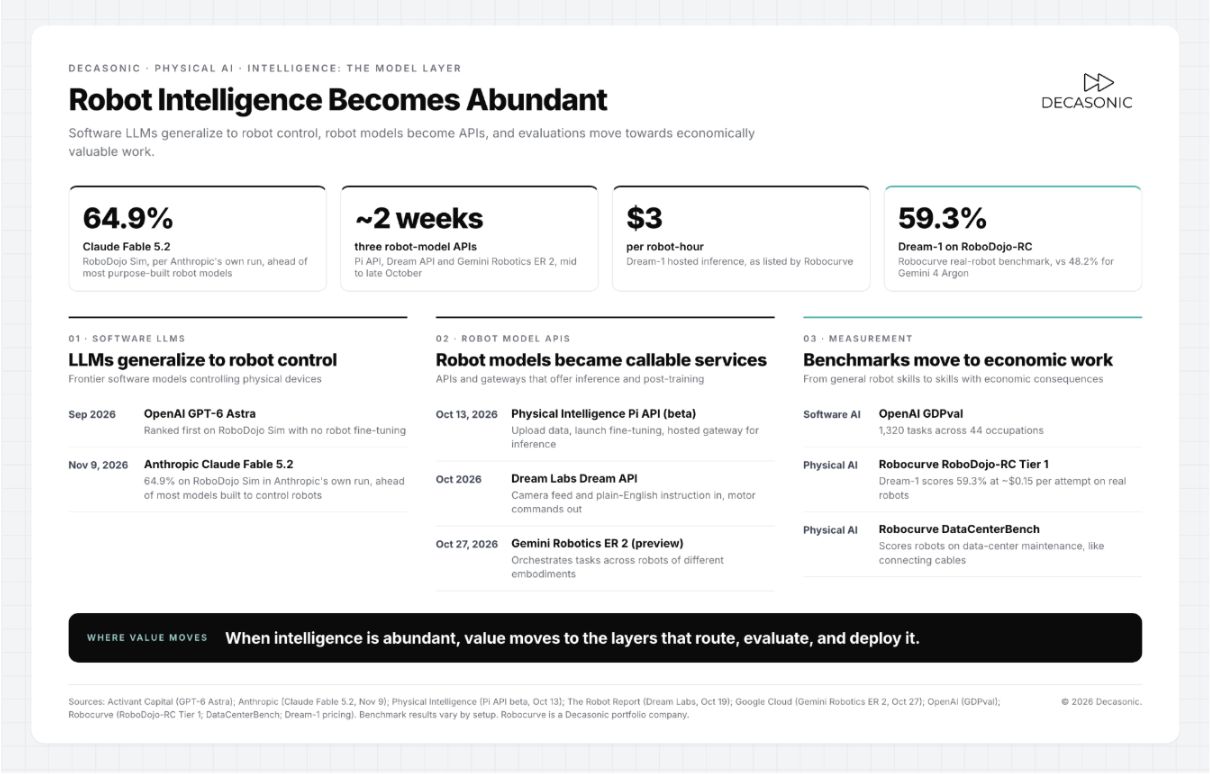
As intelligence becomes abundant, the question shifts to which model performs best for each task, and benchmarks are how that effectiveness is measured. Existing benchmarks for Physical AI remain focused primarily on general robot skills. The parallel we expect is a migration towards skills with economic consequences. Software AI went through the same shift, from general benchmarks to evaluations of economically valuable work, such as OpenAI's GDPval, which covers 1,320 tasks across 44 occupations. In Physical AI, Robocurve, a Decasonic portfolio company, evaluates robots on economically valuable work through benchmarks such as DataCenterBench, which scores robots on data-center maintenance tasks like connecting cables and operating controls. We believe evaluations that measure economically consequential work become the reference point for demonstrating the effectiveness of models, and for the deployment decisions that follow. When intelligence is abundant, value moves to the layers that route, evaluate, and deploy it.
Training: The Environment Layer
Reinforcement learning (RL) took software LLMs from capable to reliable. RL from (1) human feedback taught models to follow instructions, and RL on (2) verifiable rewards produced reasoning models. The impact of RL created a new venture category: RL environments for training language models. In Physical AI, RL primarily plays a role through simulation environments, with the purpose of closing the sim-to-real gap and accelerating the deployment of devices.
We expect RL environments to expand into Physical AI and follow the same trajectory. Robotics companies today either (1) run RL in-house in simulation or (2) use companies that offer environments. Skild is an example of the former, where the team post-trained its S1 model through physical self-play in simulation. Dyna trained its controller’s balance and motion with RL in simulation, where trials are cheap and can run at scale. The latter is what we are observing emerge today, with companies like SE3 Labs, One Robot, and Physicl offering simulation and RL environments-as-a-service.
The specialization of RL in Physical AI is primarily about being specific to (1) an embodiment, (2) a task, or (3) a site. Ultimately, this shows up as benchmark improvements from post-training, in the same way it did for software LLMs. We believe value accrues to the companies offering RL environments that demonstrate measurable benchmark improvements, shortening the path towards deployment at scale.
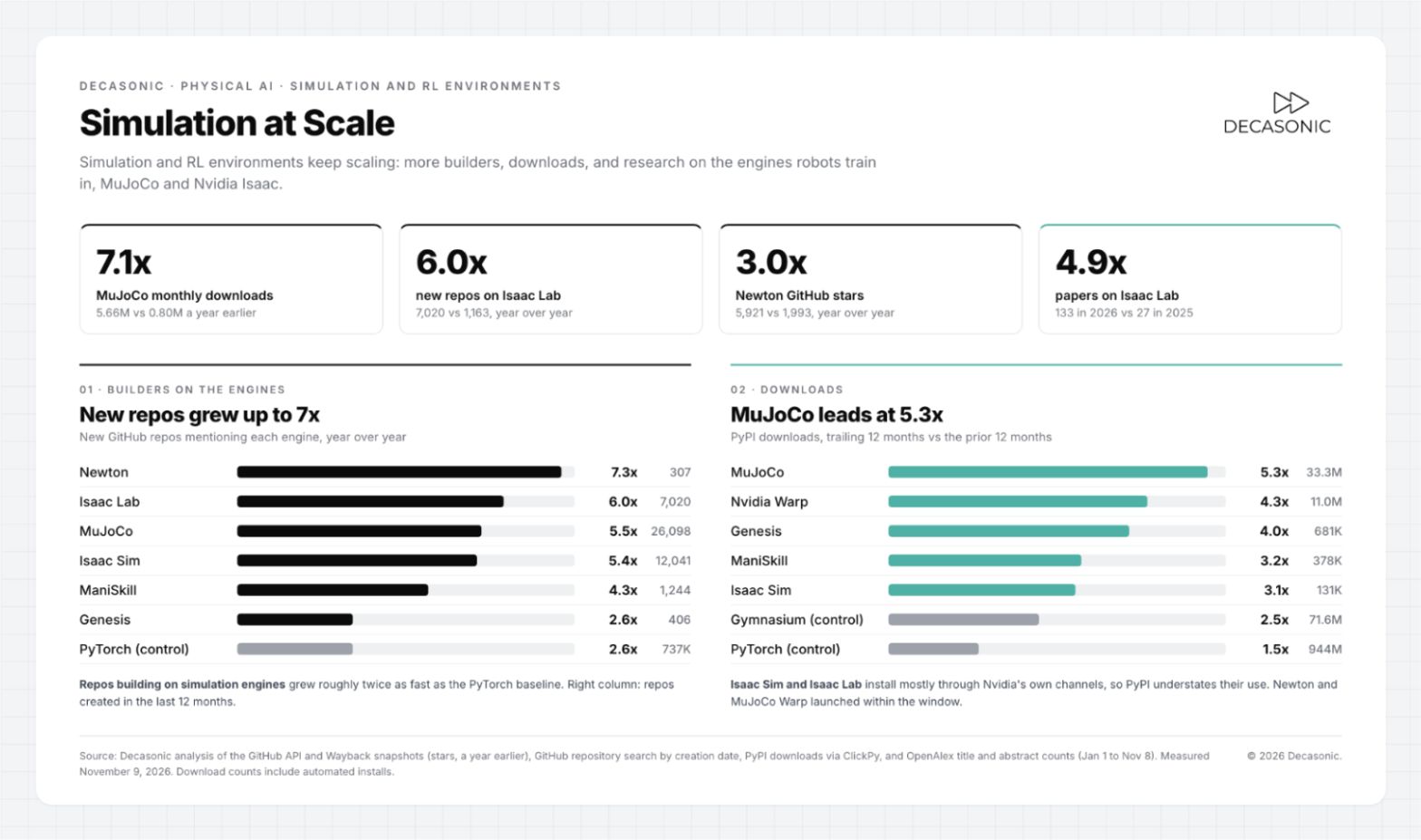
Note: Simulation environment adoption continues to grow. MuJoCo downloads are up ~7.1x YoY. Source: Decasonic
Data: The Quality Layer
In software LLM training, all data was initially valuable, which resulted in models being trained on the internet. That value has since migrated to expertise data, one of the primary reasons behind the significant rise of companies like Mercor and micro1. As we wrote in The State of Physical AI, the same separation is now in its early innings in Physical AI.
Today, Physical AI continues to be constrained by the scale and availability of data. We believe the migration of value has begun, following a similar pattern to software LLMs. This is primarily seen through (1) the falling cost of raw data collection, primarily across egocentric data, (2) the emphasis on benchmarks and annotation for collected data, and the premium that data commands, and (3) the movement of data companies up the stack, towards refinement through evaluations and RL.
This shift marks the beginning of a migration for data collection companies in Physical AI, from scale businesses to refinery businesses. Raw collection is becoming abundant, or replaceable through higher-fidelity simulation environments, and the scarce input for training the next generation of models is data refined from real work conditions. The most valuable data will increasingly be failure data collected at deployment: interventions, edge cases, and recoveries, with recoveries often coming from human-robot collaboration in the form of human interventions. This should feel familiar, as data companies in software AI are already selling trajectory data that captures how agents complete, and fail, multi-step tasks. We expect companies to emerge that sell annotated failure trajectories with demonstrable impact on benchmarks, and those companies will command premium pricing.
The refinery itself takes the form of (1) evaluations, which identify the impact of collected data on model improvements, and (2) RL, which turns failures into measurable improvements. Software AI went through the same shift, as data vendors that began with labeling moved up the stack into evaluations and RL environments, with Mercor acquiring the RL-environment company Deeptune. The same is starting in Physical AI: micro1 already added robotics benchmarks and RL environments, and we expect data companies to increasingly offer RL platforms and simulation environments for both the pre-training and post-training of robot models.
PrismaX, a Decasonic portfolio company, connects human operators to the companies deploying Physical AI and is collecting data at scale today, with an emphasis on higher-quality data. We believe Physical AI data companies will become data refineries, turning real-world and failure data into measurable improvements across the training lifecycle, and that value accrues to the companies that can prove that impact in the form of measurable-benchmark improvements.
Deployment: The Outcome Shift
Business models in Physical AI will increasingly shift towards (1) augmentation and (2) outcomes. This is primarily driven by (1) the move away from selling hardware, towards robots-as-a-service (RaaS) and pricing per task, per order, or per system, and (2) a persistent labor gap, where deployed robots augment existing labor in roles with higher turnover. Software AI has already gone through both shifts.
On the business model front, software AI companies like Sierra, Decagon, and Intercom's Fin AI Agent are increasingly pricing per task or per outcome. The unit customers pay for is moving from access to the software towards the work it completes.
On the labor front, software AI went through a narrative violation. The expectation was that AI would primarily replace labor, especially across knowledge work. Instead, reports in October showed companies rehiring, with 32% of organizations that made AI-related cuts having to rehire staff. Hiring also accelerated in the areas where you would expect AI to reduce demand. The October payrolls point towards a resurgence in professional and business services, which added 70,000 net new jobs in the month, including ~17,000 in management, scientific, and technical consulting. In our view, this acceleration in rehiring is primarily due to AI expanding what a business is capable of implementing. More capabilities result in more outputs, and more outputs result in more work for the people deploying and working alongside AI, in the form of human-AI collaboration.
We believe Physical AI is following, and will continue to follow, a similar trajectory. Robots expand the output a site is capable of delivering, and enable aligned outcomes in the form of human-robot collaboration. On the business model front, value was initially captured through the sale of the robot, and is increasingly shifting towards pricing per outcome. Agility's recent public filings show this transition through a dual business model, with both offerings side by side: Digit purchased outright for ~$200,000, or offered as a service at ~$8,500 per month plus ~$25,000 to deploy each robot.
Shiraz, a Decasonic portfolio company, delivers hardware, model, and on-site deployment as one package for high-mix manufacturing, with robots that learn a new task from a single human demonstration through in-context learning. Shiraz focuses on a RaaS business model, with the promise of increasing the output delivered at each deployment while addressing the core bottleneck across its manufacturing sites: high turnover. We believe value accrues to the companies that augment existing labor by enabling human-robot collaboration, and that price against the outcome delivered.
Use Cases: Lessons from the Digital World
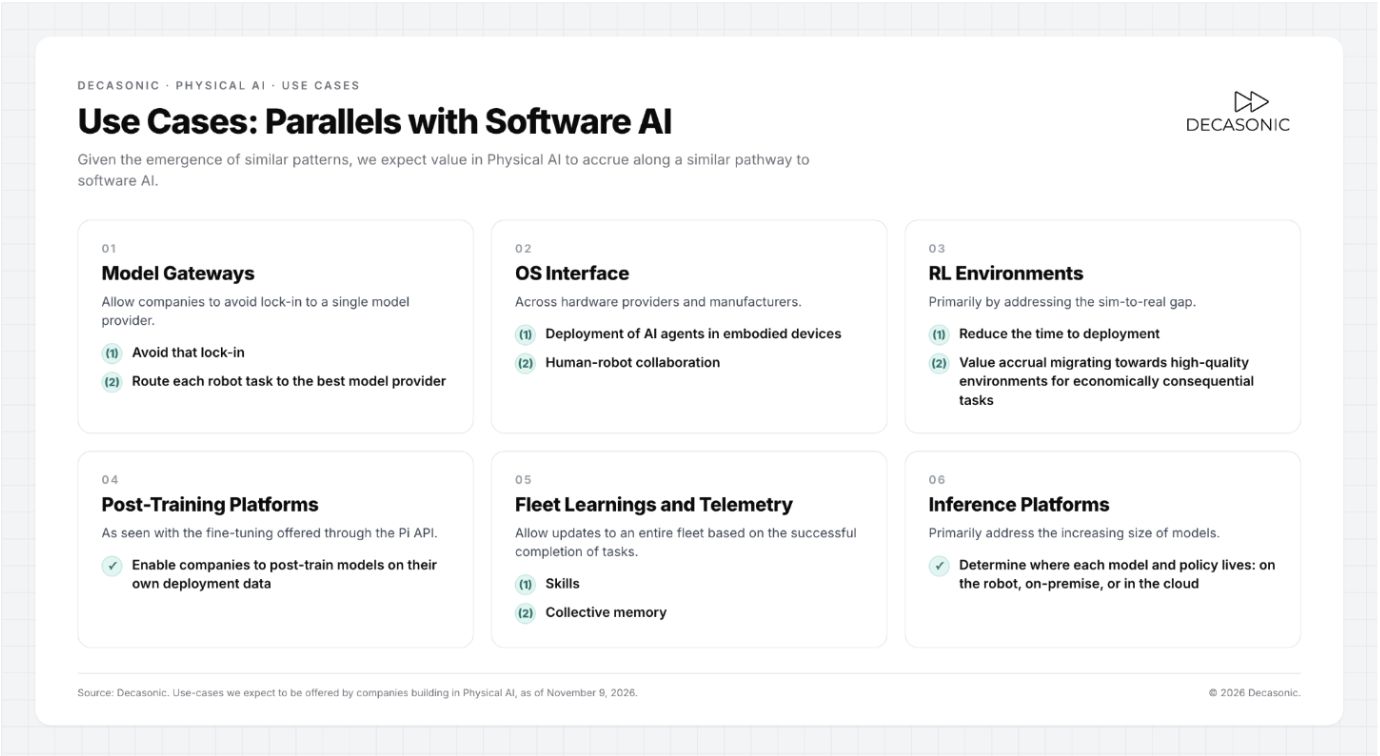
The successful use-cases in software AI will inform where (1) use cases might emerge for physical AI and (2) the trajectory of the value accrual. We expect the following use-cases to be offered by companies building in Physical AI:
- Model Gateways: Allow companies to avoid lock-in to a single model provider. Gateways accrue value through their ability to (1) avoid that lock-in and (2) route each robot task to the best model provider.
- OS Interface: Allows for (1) the deployment of AI agents in embodied devices and (2) human-robot collaboration, across hardware providers and manufacturers.
- The OS layer will further own “observability,” monitoring robots at runtime to ensure policies are deployed with an emphasis on safety and in line with predefined rules.
- RL Environments: Reduce (1) the time to deployment, primarily by addressing the sim-to-real gap, with (2) value accrual migrating towards high-quality environments for economically consequential tasks.
- Post-Training Platforms: Enable companies to post-train models on their own deployment data, as seen with the fine-tuning offered through the Pi API.
- Fleet Learnings and Telemetry: Allow updates to an entire fleet based on the successful completion of tasks, in the form of (1) skills or (2) collective memory.
- Inference Platforms: Primarily address the increasing size of models, and determine where each model and policy lives: on the robot, on-premise, or in the cloud.
Where Value Accrues
We ultimately believe the net beneficiaries of Physical AI deployments will choose the most economical pathway to maximize the value generated, in the form of outcomes per dollar. This results in an environment where specialized models and specialized devices are deployed at scale. Across each layer of the stack, value accrues to the companies that serve deployment, with evaluations, RL environments, and data refineries acting as the interfaces of their layer. Companies that offer applications and interfaces to accelerate specialized deployment will benefit from the same value accrual and migration we are observing in software AI today, and which we expect to continue. Applications can own the deployment outcome, while interfaces can own (1) the optimal outcome per dollar and (2) human-robot collaboration. This is where we believe value in Physical AI accrues.
Conclusion
Physical AI is entering its deployment era, and the deployment stack will continue to specialize. As deployers choose the most economical pathway to the outcomes they define, we believe value accrues to the companies that turn that specialization into physical world deployment at scale, with devices working reliably alongside people: the applications that own the deployment outcome, and the interfaces that own the optimal outcome per dollar and human-robot collaboration.
We are actively investing in and partnering with founders aiming to accelerate the deployment of Physical AI. If you aim to build and push the frontier, reach out to me and Decasonic.
Disclaimer
The content of these blog posts is strictly for informational and educational purposes and is not intended as investment advice, or as a recommendation or solicitation to buy or sell any asset. Nothing herein should be considered legal or tax advice. You should consult your own professional advisor before making any financial decision. Decasonic makes no warranties regarding the accuracy, completeness, or reliability of the content in these blog posts. The opinions expressed are those of the author and do not necessarily reflect the views of Decasonic. Decasonic disclaims liability for any errors or omissions in these blog posts and for any actions taken based on the information provided. Decasonic holds a position in Robocurve, PrismaX, and Shiraz.